
If pests are showing up around your North Texas home, the answer is not automatically to spray inside.
Outdoor pest control is generally best for preventing pests from reaching the house and controlling activity around the exterior. Indoor pest control becomes more important when pests are already established inside, nesting or hiding indoors, or cannot be controlled by exterior prevention alone. Some infestations require both.
For many Dallas-Fort Worth homes, the most effective approach starts with identifying the pest, finding where it is coming from and correcting the conditions allowing it to survive. That follows the basic principles of integrated pest management (IPM): prevention, monitoring, correct identification and targeted control rather than treating every pest problem the same way.
This guide explains the difference between indoor and outdoor pest control, when each approach makes sense and how to determine what your North Texas home actually needs.
Table of Contents
- What Is the Difference Between Indoor and Outdoor Pest Control?
- Is Outdoor Pest Control Usually Enough?
- When Does a Home Need Indoor Pest Control?
- Which Pests Need Indoor vs. Outdoor Treatment?
- Can You Use Indoor and Outdoor Pest Control Together?
- What Does Outdoor Pest Control Include?
- What Does Indoor Pest Control Include?
- Why Pest Identification Matters
- DIY vs. Professional Pest Control
- North Texas Pest-Control Considerations
- How to Reduce the Need for Indoor Treatment
- When to Call a Professional
- Frequently Asked Questions
What Is the Difference Between Indoor and Outdoor Pest Control?
Outdoor pest control focuses on preventing and controlling pests around the exterior of the home. Indoor pest control targets pests that have already entered or established activity inside living spaces, wall voids, kitchens, bathrooms, garages or other interior areas.
The difference is primarily about where the pest problem originates and where treatment is actually necessary.
| Outdoor Pest Control | Indoor Pest Control |
|---|---|
| Focuses on prevention | Focuses on existing interior activity |
| Treats appropriate exterior areas | Targets specific interior locations |
| Addresses exterior entry zones | Addresses indoor harborages/activity |
| May reduce pests before entry | Controls pests already inside |
| Often includes exterior inspection | Requires investigation of indoor activity |
| Can be performed without treating living areas | May require access to affected rooms |
| Useful for recurring seasonal pest pressure | Useful for established indoor infestations |
The two approaches are not competitors.
A good pest-management strategy can use either one—or both—depending on the pest and property.
EPA describes integrated pest management as an approach that combines information about pest biology with prevention and appropriate control methods while seeking to minimize unnecessary risks to people, property and the environment.
That is a better way to think about indoor versus outdoor pest control than simply asking, “Where should we spray?”
Is Outdoor Pest Control Usually Enough?
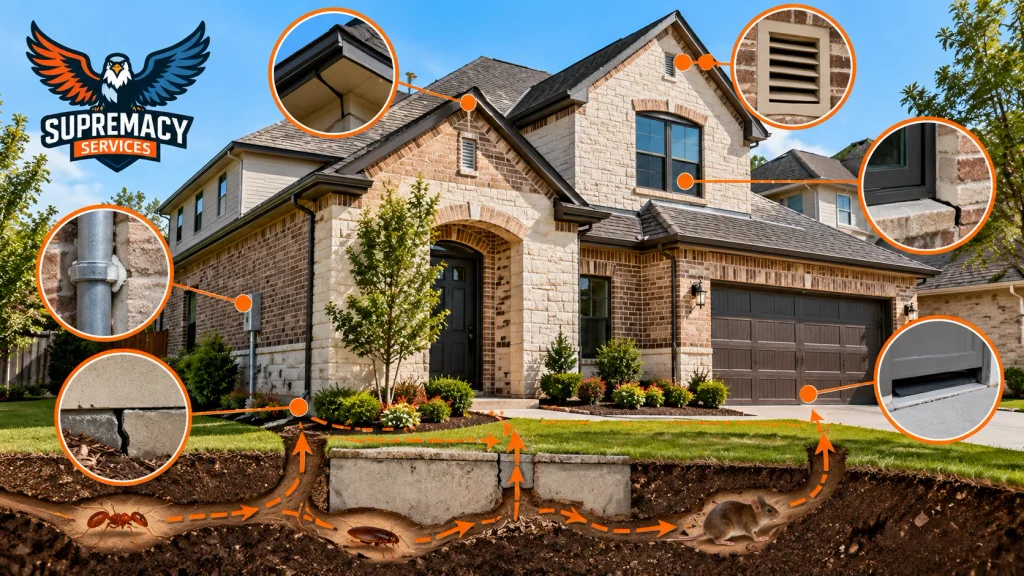
Outdoor pest control can be enough when the primary problem is pests approaching the structure from outside and there is no established infestation indoors.
Ants around a foundation, spiders around exterior lights and other crawling insects approaching doors, windows or utility penetrations are examples where exterior prevention may play an important role.
Supremacy Services’ existing perimeter pest-control program is specifically designed around this approach: treating exterior areas and potential entry zones rather than routinely treating living spaces indoors.
Outdoor-first pest control makes sense when:
- pest activity is primarily outside;
- pests are approaching the structure rather than nesting indoors;
- indoor sightings are rare or isolated;
- the pest can be managed effectively from exterior activity zones;
- entry points can be corrected;
- the goal is ongoing prevention rather than correction of a developed infestation.
Texas A&M’s guidance for household ants illustrates the principle well. Its recommendations include looking for nests around the exterior foundation and sealing cracks around foundations, doors and windows to reduce indoor ant problems.
Seeing pest activity around your foundation, doors or windows? Learn how Supremacy’s perimeter pest control helps create an exterior defense around North Texas homes.
When Does a Home Need Indoor Pest Control?
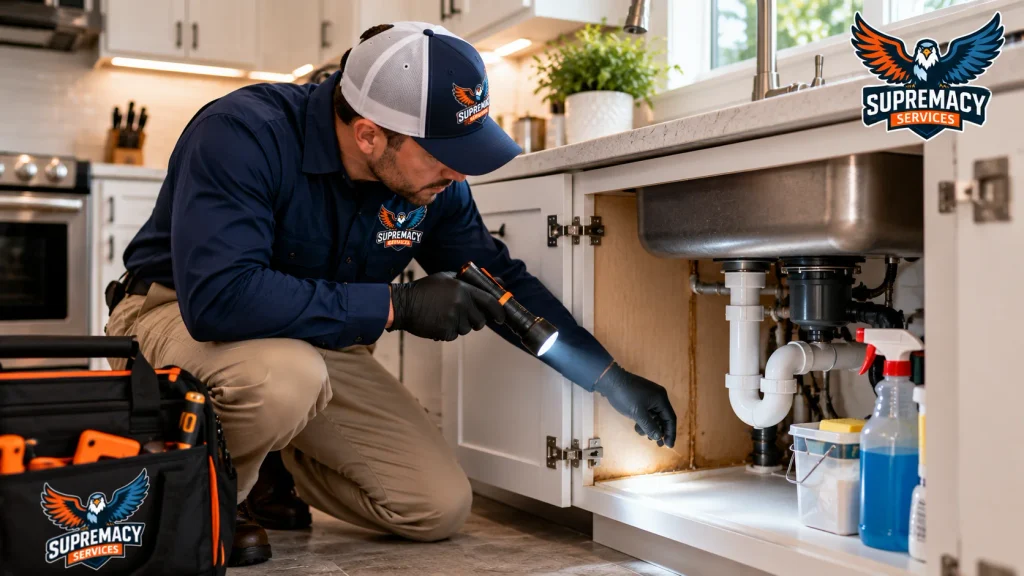
Indoor treatment becomes more appropriate when pests are already established inside the home, when their primary harborage is indoors or when exterior prevention alone cannot reach the source of the infestation.
Seeing one insect indoors does not automatically mean the entire interior needs treatment.
The important questions are:
- What pest is it?
- How many are present?
- Where are they coming from?
- Are they reproducing indoors?
- Where are they hiding?
- Is food, water or shelter supporting them?
- Can the source be addressed without broad indoor pesticide application?
Signs that an interior problem deserves closer investigation
Watch for:
- repeated cockroach sightings in kitchens or bathrooms;
- cockroach droppings or egg cases;
- ants consistently emerging from interior cracks or wall areas;
- pest activity in several rooms;
- rodent droppings or gnaw marks;
- scratching inside walls or ceilings;
- bed bug evidence around sleeping areas;
- recurring insects despite exterior prevention;
- pests concentrated around plumbing or moisture;
- activity inside cabinets, appliances or stored products.
Indoor treatment should still be targeted to the pest and the problem.
EPA recommends addressing pest access to food, water and shelter and sealing potential entry points as part of home pest prevention.
Which Pests Need Indoor vs. Outdoor Treatment?
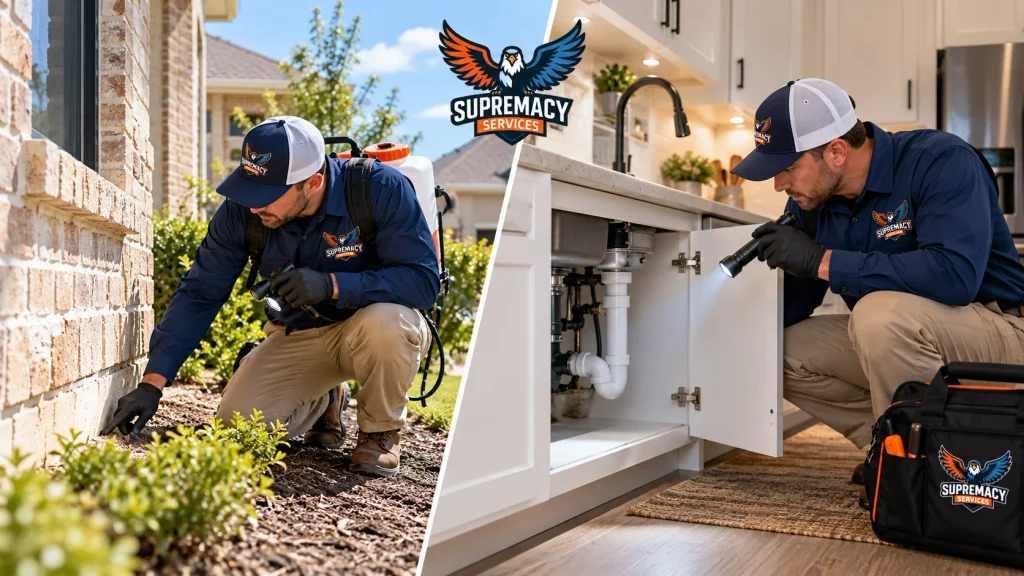
There is no universal answer because pest biology matters.
| Pest | Outdoor approach | Indoor approach | Typical strategy |
|---|---|---|---|
| Ants | Often important | Sometimes needed | Find trails/nests + exclusion + targeted control |
| Cockroaches | Important for some species | Often important for established indoor species | Identification + sanitation + monitoring + targeted treatment |
| Spiders | Often useful | Targeted treatment if activity persists inside | Reduce insects/webs + exterior prevention |
| Scorpions | Exterior prevention/exclusion important | Targeted if found indoors | Reduce entry opportunities and prey |
| Rodents | Exterior exclusion is critical | Trapping/monitoring may be required inside | Control + exclusion |
| Bed bugs | Limited role | Primary treatment area is indoors | Specialized bed bug management |
| Termites | Specialized structural treatment | Depends on system/problem | Dedicated termite inspection/treatment |
| Mosquitoes | Primarily outdoor | Generally not an indoor structural-treatment problem | Habitat reduction + outdoor management |
| Fleas | Yard may contribute | Indoor activity may also require attention | Treat according to source and infestation |
| Wasps/hornets | Usually outdoor nest management | Indoor investigation if entering structure | Locate nest/access route |
The table is intentionally a decision guide rather than a treatment prescription.
Correct pest identification comes first.
For example, cockroach management varies by species and conditions. Texas A&M specifically provides guidance covering cockroach identification, biology and both chemical and nonchemical control methods.
Likewise, termites, bed bugs and rodents should not simply be treated as ordinary crawling-insect problems.
Can You Use Indoor and Outdoor Pest Control Together?
Yes. A combined strategy can be appropriate when an infestation is already active indoors but continued pest pressure or entry routes exist outside.
Imagine ants are repeatedly appearing in a Dallas kitchen.
Treating only the ants visible on the countertop may fail if the colony or entry route remains outside.
Treating only outside may also be insufficient if significant activity is already occurring in inaccessible interior areas.
A better process might involve:
- identifying the ant;
- tracing activity;
- finding likely entry points or nesting areas;
- removing food and moisture sources;
- sealing appropriate openings;
- applying targeted control where needed;
- monitoring whether activity declines.
That is fundamentally different from automatically spraying every baseboard.
The EPA IPM model favors prevention and lower-risk effective controls before escalating treatment where appropriate.
What Does Outdoor Pest Control Include?
The exact service depends on the pest, property and treatment plan, but exterior pest management may involve:
Exterior inspection
A technician can look for:
- pest activity;
- foundation openings;
- door and window gaps;
- utility penetrations;
- vegetation contacting the structure;
- webs or nests;
- moisture conditions;
- potential harborage;
- evidence of rodents or other pests.
Entry-zone treatment
Depending on the product label and pest-management plan, targeted treatment may be appropriate around certain exterior locations where pests travel or attempt to enter.
Web and nest management
Accessible spider webs or pest nests may be addressed when appropriate to the service.
Prevention recommendations
Sometimes the most valuable finding is not where pesticide should be applied.
It is discovering:
- a damaged door sweep;
- an unsealed pipe penetration;
- vegetation contacting the structure;
- a plumbing leak;
- accumulated debris;
- standing water;
- an accessible rodent opening.
EPA recommends reducing pest access to food, water and shelter and physically blocking entryways as part of household pest prevention.
What Does Indoor Pest Control Include?
Indoor pest control should begin with inspection and identification, not indiscriminate application.
Depending on the pest, a professional may investigate:
- kitchens;
- bathrooms;
- laundry areas;
- cabinets;
- plumbing penetrations;
- wall junctions;
- garages;
- attics;
- storage areas;
- appliance areas;
- cracks and crevices;
- other pest-specific harborages.
Treatment can then be matched to the problem.
That might involve monitoring, baiting, trapping, exclusion or appropriately labeled targeted pesticide applications.
EPA notes that pesticide labels specify where a product can be used, which pests it can control, application methods, rates, restrictions and application frequency. Those directions matter for both effectiveness and safe use.
Why Pest Identification Matters
You cannot reliably decide between indoor and outdoor pest control until you know what pest you are dealing with.
A small insect in a kitchen could represent a pest breeding indoors, an outdoor insect that wandered through an open door or something that does not require pesticide treatment at all.
Similarly, “roaches” is not always specific enough to determine the correct strategy.
The same applies to ants.
Texas A&M notes that ant behavior and species identification affect treatment methods and recommends IPM-based solutions.
A useful professional assessment therefore asks:
What is the pest, where is it living, how is it getting there and what conditions are allowing the problem to continue?
Only then should treatment location be decided.
DIY vs. Professional Pest Control
Homeowners can handle many preventive measures themselves. Established, recurring, difficult-to-identify or structurally related infestations are stronger candidates for professional assessment.
DIY prevention homeowners can reasonably perform
- Store food in sealed containers.
- Clean crumbs and spills.
- Keep garbage contained.
- Avoid leaving pet food out overnight.
- Repair plumbing leaks.
- Eliminate unnecessary standing water.
- Reduce clutter.
- Repair screens.
- Maintain door sweeps.
- Seal appropriate cracks and penetrations.
- Trim vegetation away from the structure where practical.
- Inspect boxes before bringing them indoors.
- Correct moisture problems.
These actions closely align with EPA household pest-prevention recommendations.
Be careful with DIY pesticide applications
A product labeled for one location should not simply be assumed appropriate for another.
EPA emphasizes following pesticide labels, including instructions concerning the approved location, target pest, application method, quantity and restrictions.
Using more pesticide than directed does not make a treatment better.
Consider professional help when:
- the pest cannot be identified;
- activity repeatedly returns;
- several rooms are affected;
- cockroaches appear established indoors;
- rodents are entering the structure;
- termites are suspected;
- bed bugs are suspected;
- a nest is inaccessible or presents a safety concern;
- structural exclusion is necessary;
- reasonable prevention and DIY measures have failed.
Texas A&M’s IPM education specifically identifies infestations involving public-health concerns such as rodents and suspected structural termite damage as situations where homeowners should understand when professional assistance is appropriate.
North Texas Pest-Control Considerations
North Texas weather makes it especially useful to think about pest control as a year-round property-management issue rather than simply an indoor spraying schedule.
DFW has substantial seasonal temperature variation. National Weather Service 1991–2020 normals show normal highs around 56.5°F in January and 95.8°F in August, with roughly 37 inches of normal annual precipitation.
Those changing conditions affect moisture, vegetation, outdoor insect activity and when homes provide attractive shelter.
That does not mean every North Texas home needs the same treatment schedule.
Property conditions matter more.
Factors worth evaluating around a DFW home include:
Landscaping
Vegetation touching the building can provide pest pathways or shelter close to the structure.
Irrigation and drainage
Persistent moisture can support pest activity around foundations and landscaping.
Doors and garages
Frequently opened garage doors and worn seals create obvious opportunities for pests to enter.
Utility penetrations
Openings around pipes, wiring and other penetrations can provide access.
Roof and attic openings
These become especially important with rodents and wildlife.
Shared walls
Townhomes, duplexes, apartments and other attached housing can require a broader investigation because pest activity may originate outside the individual living space.
The correct strategy should therefore be based on the pest + property + source of activity, not simply the ZIP code.
Does Outdoor Pest Control Cost Less Than Indoor Pest Control?
There is no reliable universal rule.
Price depends more on the pest, severity, property, treatment method and amount of work required than simply whether treatment occurs indoors or outdoors.
A straightforward preventive exterior service is fundamentally different from correcting an established German cockroach infestation, performing rodent exclusion or treating bed bugs.
Supremacy’s existing North Texas pest-control cost guide similarly identifies pest type, infestation severity, property layout, treatment area, service frequency and exclusion needs as important pricing variables.
Not sure whether the problem starts inside or outside? Request a pest assessment from Supremacy Services so the treatment can be matched to the pest and your property—not a one-size-fits-all spray routine.
How to Reduce the Need for Indoor Treatment
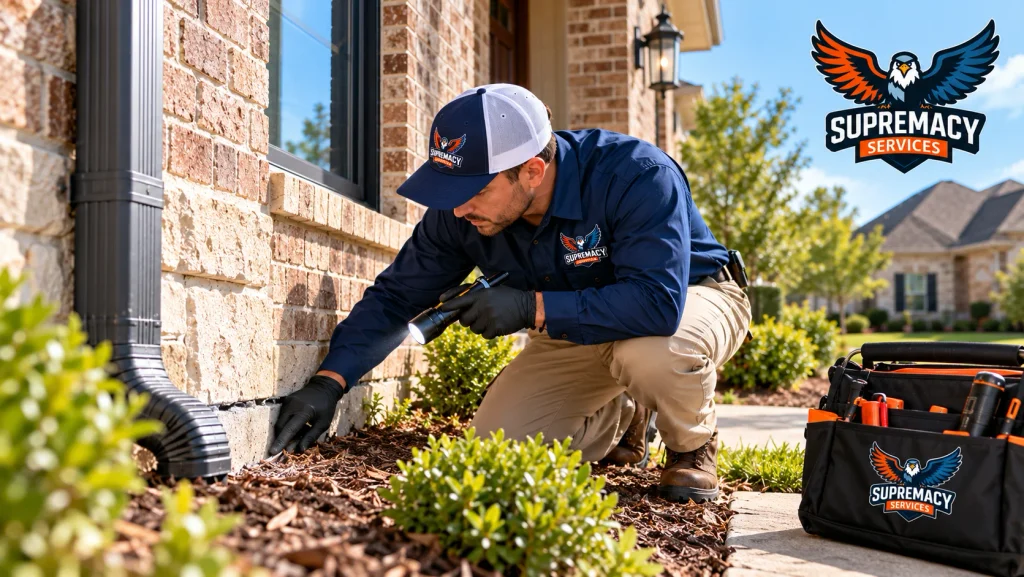
The best indoor pest-control strategy is often preventing pests from becoming established indoors in the first place.
North Texas home pest-prevention checklist
Outside the house
- Inspect doors and weather seals.
- Check screens.
- Look for gaps around utility penetrations.
- Reduce unnecessary debris around the foundation.
- Keep vegetation from contacting the structure where practical.
- Correct standing-water problems.
- Monitor exterior pest activity.
- Inspect garage-door seals.
- Address obvious rodent entry points.
Inside the house
- Store food properly.
- Clean spills and crumbs promptly.
- Keep garbage contained.
- Avoid leaving pet food exposed overnight.
- Fix leaking faucets and pipes.
- Reduce clutter.
- Inspect stored cardboard and packages.
- Monitor kitchens and bathrooms for recurring activity.
EPA’s home pest guidance emphasizes essentially the same principle: make food, water and shelter less available while reducing pest access into the home.
What Should Professional Pest Control Include?
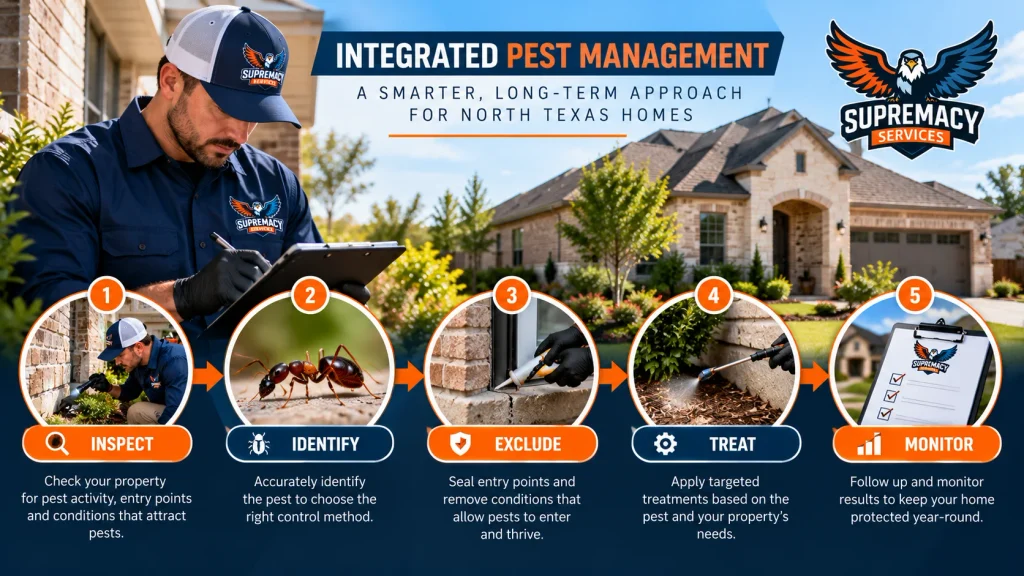
Professional pest management should involve more than showing up and automatically spraying.
Depending on the problem, a useful service may include:
- Inspection — determine where activity is occurring.
- Identification — establish which pest is actually present.
- Source investigation — determine nesting, harborage or entry locations.
- Risk assessment — decide whether treatment is actually necessary.
- Prevention — address food, water, shelter and access where practical.
- Targeted treatment — select controls appropriate for the identified pest.
- Exclusion recommendations — address openings that allow recurring entry.
- Monitoring — determine whether activity is declining.
- Follow-up — adjust the strategy when necessary.
That framework is consistent with integrated pest management rather than relying solely on routine pesticide application.
Texas licensing matters
Structural pest-control services in Texas are regulated by the Texas Department of Agriculture.
TDA states that structural pest control includes controlling pests in and around homes and other structures, and businesses performing structural pest-control services for compensation are subject to licensing requirements.
That is worth checking when hiring a provider.
Indoor vs. Outdoor Pest Control: Quick Decision Guide
| What you’re seeing | Best starting point |
|---|---|
| Bugs mostly around foundation/patio | Exterior inspection/prevention |
| Occasional insects entering at doors | Exterior prevention + entry-point correction |
| Ant trail entering from outside | Find source + exterior/entry management |
| Recurring kitchen cockroaches | Interior investigation + broader source assessment |
| Spider webs around eaves | Exterior management |
| Repeated spiders throughout rooms | Inspect interior + exterior insect pressure |
| Rodent droppings indoors | Interior control + exterior exclusion |
| Bed bug evidence | Specialized indoor assessment |
| Termite evidence | Specialized termite inspection |
| Mosquitoes around backyard | Outdoor habitat/control strategy |
| Pests in several rooms | Professional inspection recommended |
| You cannot identify the pest | Identify before choosing treatment |
Should Pest Control Be Inside or Outside First?
If there is no established indoor infestation, prevention usually begins by understanding exterior pest pressure and blocking entry. If pests are already established indoors, the interior problem should be addressed while also investigating how the pests arrived and whether an exterior source remains.
The objective is not to choose “inside” or “outside” as a permanent rule.
It is to use the least unnecessary intervention that solves the actual pest problem.
For one North Texas home, that may mean exterior prevention.
For another, it may mean targeted indoor cockroach management.
For a third, it may mean trapping rodents inside while sealing entry points outside.
Treatment should follow the evidence.
When to Call a Professional
Consider having the property inspected when:
- pests continue returning after basic prevention;
- activity is spreading;
- you cannot identify the pest;
- cockroaches repeatedly appear indoors;
- rodents are heard or seen inside;
- droppings or gnaw marks appear;
- termite activity is suspected;
- bed bugs may be present;
- ants continually emerge from structural areas;
- several rooms are affected;
- an inaccessible wasp or hornet nest is present;
- DIY treatment repeatedly fails.
A professional should be able to explain what pest was identified, where activity was found, why a particular treatment is being recommended and what homeowners can do to reduce recurrence.
Frequently Asked Questions
Is outdoor pest control better than indoor pest control?
Neither is automatically better. Outdoor pest control is particularly useful for prevention and pests originating outside. Indoor treatment is appropriate when pests are established inside or require targeted interior control.
Do exterminators need to spray inside the house?
Not necessarily. If there is no meaningful indoor infestation, an exterior-focused strategy plus exclusion and prevention may be sufficient. Interior treatment should be based on the pest and evidence of activity.
Can pest control outside stop bugs from coming inside?
Exterior pest management can reduce pest pressure around a structure, especially when combined with sealing entry points, reducing harborage and correcting moisture or sanitation problems. No pest-management method should be presented as making a home permanently pest-proof.
What pests usually require indoor treatment?
Established indoor cockroaches, bed bugs and some ant infestations commonly require indoor investigation or treatment. Rodents inside the structure may require interior trapping or monitoring along with exterior exclusion.
Is perimeter pest control worth it in North Texas?
It can be useful for homes experiencing recurring pest pressure from outdoors because it focuses on preventing pests around exterior entry zones. Whether it is appropriate depends on the pest and property.
Should I have my home sprayed inside every time pest control comes?
Not automatically. Treatment should correspond to identified pest activity and the product label. Routine indoor application without considering whether it is necessary is not the same thing as an IPM-based strategy.
What should I do if I still see pests after exterior treatment?
First determine which pest is appearing, how frequently it is appearing and where. Persistent activity can indicate an indoor harborage, untreated source, structural entry point or a problem requiring a different treatment strategy.
Can I do outdoor pest control myself?
Homeowners can perform important preventive tasks such as sealing gaps, correcting moisture problems, maintaining door sweeps and removing pest harborage. If using pesticides, use only products labeled for the intended pest and application site and follow all label instructions.
Do rodents need indoor or outdoor pest control?
Often both aspects matter. Rodents already inside may need trapping or other control, while exterior openings must be identified and properly excluded to reduce re-entry.
How do I know what kind of pest control my home needs?
Start with pest identification and inspection. Determine what pest is present, where it is living, how it is entering and what is supporting it. Those findings determine whether exterior prevention, interior treatment, exclusion or a combination makes sense.
Choose Pest Control Based on the Problem, Not the Spray Location
Indoor versus outdoor pest control is not really a question of which location is “better.”
It is a question of where the pest is coming from and what will actually stop the problem from continuing.
For North Texas homeowners dealing primarily with outdoor pest pressure, exterior prevention and entry-point management may reduce the need for routine treatment inside living spaces.
When pests are already established indoors, targeted interior control may be necessary—but the exterior source, access points, moisture, sanitation and other contributing conditions should still be investigated.
That combination of identification, prevention and targeted treatment is the foundation of effective integrated pest management.
Seeing ants, cockroaches, spiders or other recurring pests around your Dallas-Fort Worth home? Explore Supremacy Services’ residential pest-control options or request an inspection to determine whether your property needs exterior prevention, targeted indoor treatment or both.

