
For many North Texas homes, quarterly pest-control inspections or service can be a practical starting schedule for general preventive pest management—but there is no universal rule that every home should be treated every three months. Some properties need more frequent monitoring or treatment because of active infestations, recurring cockroaches or ants, heavy exterior pest pressure, moisture problems or other property-specific conditions.
The right answer to how often you should have pest control depends on what pest you are dealing with, whether the problem is active or preventive, the conditions around your property and how well previous control measures are working.
A monthly appointment is not automatically better than a quarterly one. Likewise, one treatment is not necessarily enough simply because the visible pests disappeared.
Good pest management is based on inspection, identification, prevention, monitoring and treatment when appropriate rather than applying pesticides on an arbitrary calendar.
That approach is consistent with the EPA’s principles of integrated pest management (IPM), which emphasize monitoring and identification, prevention, action thresholds and appropriate control measures.
Table of Contents
- How often should pest control be done?
- Monthly vs. quarterly pest control
- When might you need more frequent pest control?
- Does every pest need the same schedule?
- Why pest-control frequency can change during the year
- Do you still need pest control if you don’t see bugs?
- Can you reduce how often professional pest control is needed?
- DIY vs. professional pest control
- What should professional pest control include?
- How much does recurring pest control cost?
- How to choose the right schedule for your North Texas home
- Frequently Asked Questions
How Often Should You Have Pest Control?
For general preventive pest management, many homeowners can begin by discussing quarterly service with a pest professional, but the correct frequency should ultimately be determined by the pest, property conditions and monitoring results—not by a one-size-fits-all schedule.
Think of pest-control frequency as a spectrum:
| Situation | Possible approach | Why |
|---|---|---|
| No active infestation and low pest pressure | Monitoring/prevention or periodic service | Focus is preventing conditions that attract pests |
| Recurring general household pests | Recurring preventive program may be appropriate | Helps address changing exterior activity and recurring entry |
| Persistent ants, roaches or other activity | More frequent initial follow-up may be needed | The source may not be eliminated after one visit |
| Established indoor infestation | Pest-specific treatment schedule | Treatment must address the biology and extent of the infestation |
| Termites, bed bugs or rodents | Specialized program | General quarterly pest service should not substitute for pest-specific control |
| Pest-free home after successful treatment | Continue prevention and monitoring | Frequency may be adjusted based on results |
The key distinction is between routine prevention and correcting an established infestation.
A homeowner who occasionally finds an outdoor cockroach in the garage does not necessarily need the same program as someone finding German cockroaches and nymphs around kitchen appliances.
Likewise, ordinary crawling-insect service should not be used as a substitute for termite treatment, bed-bug control or rodent exclusion.
If ants, cockroaches, spiders or other crawling pests repeatedly move toward your home from outside, see how Supremacy Services’ perimeter pest control addresses foundations, doors, windows and other exterior pressure areas.
Monthly vs. Quarterly Pest Control: Which Is Better?

Neither schedule is automatically better. Quarterly pest control may be appropriate for preventive general-pest management at many properties, while monthly or shorter-interval service can make more sense when pest pressure, monitoring results or an active problem requires closer attention.
Here is the practical difference:
| Factor | Monthly Service | Quarterly Service |
|---|---|---|
| Frequency | About once each month | About once every three months |
| Best considered for | Higher-risk or recurring situations | Routine preventive programs |
| Monitoring opportunities | More frequent | Less frequent |
| Active infestation | May be part of an initial control plan | May be too far apart for some active infestations |
| General prevention | Sometimes more than necessary | Common starting point to discuss |
| Cost structure | More visits per year | Fewer scheduled visits |
| Correct choice determined by | Pest + property + results | Pest + property + results |
The important question is therefore not:
“Is monthly pest control better?”
It is:
“What interval is appropriate for the pest pressure at my property?”
EPA’s integrated pest-management framework supports this results-based approach. IPM involves monitoring and identifying pests, preventing conducive conditions and choosing appropriate controls when monitoring indicates they are necessary.
What about bi-monthly service?
Some pest-management plans operate on intervals between monthly and quarterly service.
Again, the interval itself should not be the main selling point. What matters is whether the program appropriately addresses the pests present, exterior conditions, entry points and activity between visits.
When Might You Need More Frequent Pest Control?
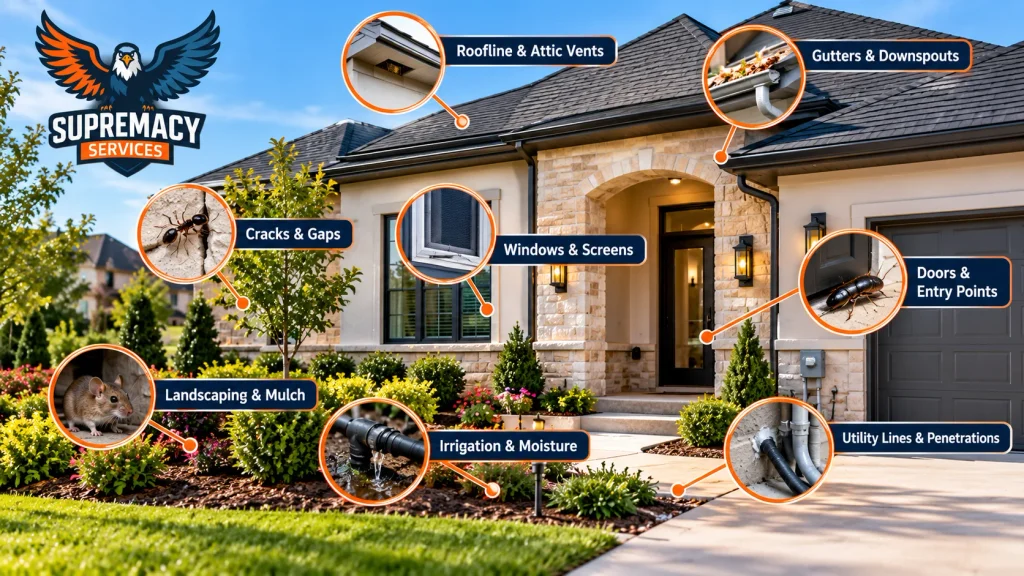
A home may need more frequent pest-control attention when pests continue appearing, an active infestation is being eliminated, conditions around the property favor pests or previous treatment is not adequately controlling the problem.
Watch for these situations.
1. Pests return shortly after treatment
Finding one insect does not automatically mean a treatment failed.
But repeated activity in the same locations deserves investigation.
The technician may need to determine whether:
- the pest was correctly identified;
- an indoor nest or harborage remains;
- exterior populations are continually moving toward the house;
- food or moisture is supporting the population;
- untreated entry points remain;
- neighboring properties are contributing to activity;
- follow-up treatment was part of the original control strategy.
2. You are dealing with an established indoor infestation
Certain pest problems cannot be evaluated using a generic “spray every three months” approach.
German cockroaches, for example, can establish themselves around kitchens, appliances and other protected indoor locations. Supremacy’s cockroach-control page appropriately emphasizes species identification and targeting harborages rather than simply spraying open surfaces.
An established infestation may require closer monitoring and pest-specific follow-up.
3. Your property has persistent moisture
Pests need resources to survive.
EPA recommends addressing food, water and shelter as fundamental components of household pest prevention. Repairing plumbing leaks, removing standing water, properly storing food and reducing shelter can make a property less hospitable to pests.
A home with recurring leaks, irrigation problems or standing water may therefore continue experiencing pest pressure until those conditions are corrected.
4. Landscaping creates extensive pest harborage
Dense vegetation, accumulated leaves, wood piles, clutter and protected areas around the building can provide shelter close to the structure.
That does not mean every landscaped North Texas home needs monthly spraying.
It means the technician should consider the environment around the house, not just the insects visible indoors.
5. Pest activity changes seasonally
Different pests respond differently to temperature, rainfall, moisture, food availability and shelter.
That means your pest-management priorities can change throughout the year.
A fixed calendar may therefore be less useful than a program that combines scheduled prevention with inspection and adjustments when conditions change.
Does Every Pest Need the Same Treatment Schedule?
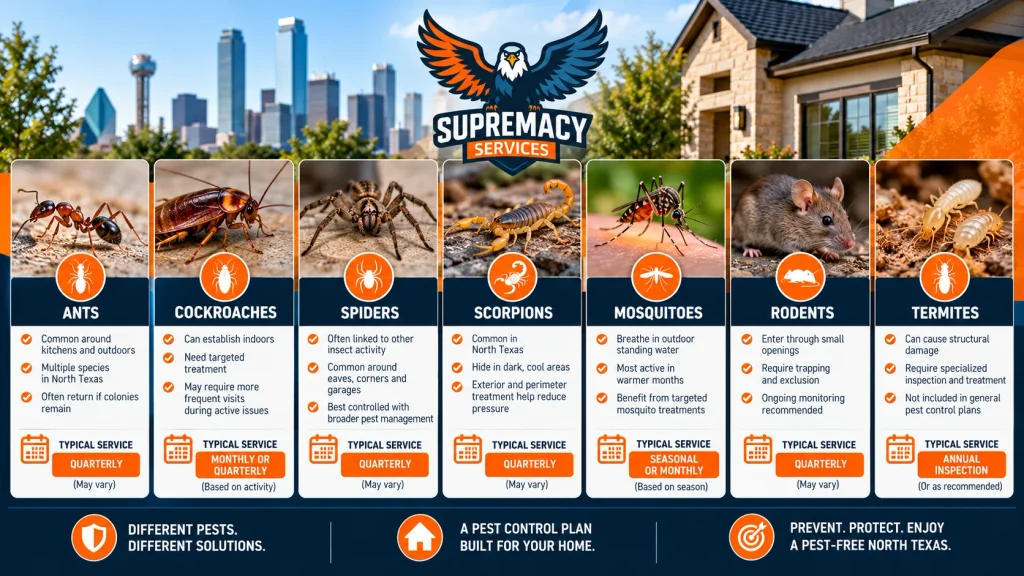
No. Different pests require different monitoring, treatment and follow-up strategies. General household pest control should never be treated as a universal solution for termites, bed bugs, rodents, mosquitoes or every other pest.
Ants
An occasional outdoor ant trail and an established indoor colony are different problems.
Correct identification matters because ant species differ in nesting behavior, food preferences and response to control methods.
If ants continually return after surface spraying, the real issue may be a colony or favorable conditions that have not been addressed.
Cockroaches
Large outdoor cockroaches occasionally entering a garage are not the same as German cockroaches reproducing around a kitchen.
Repeated indoor sightings, nymphs, egg cases or activity around appliances can justify a more intensive inspection and treatment strategy. Supremacy services
Spiders
Spider problems are often connected to the insects they eat.
Supremacy’s current spider-control program therefore looks at webbing, harborages and broader insect activity rather than treating the visible spider as an isolated problem.
Reducing prey can be an important part of reducing recurring spider activity. Supremacy services
Scorpions
Recurring scorpion sightings can be connected to shelter, structural access and the insects scorpions prey upon.
Exterior pest management may therefore form part of a broader scorpion-control strategy rather than simply treating individual scorpions. Supremacy’s dedicated DFW scorpion service follows this property-level approach. Supremacy services
Mosquitoes
Mosquito management is fundamentally different from indoor crawling-pest treatment.
EPA recommends eliminating unnecessary standing water in locations such as gutters, buckets, bird baths, fountains and plant saucers because mosquitoes require water during development.
Rodents
Rats and mice are not simply another quarterly “bug treatment.”
Successful rodent management may require:
- inspection;
- trapping or other appropriate control;
- locating entry points;
- exclusion;
- sanitation improvements;
- monitoring repaired areas.
If the opening that allowed a rodent inside remains accessible, simply removing the current animal may not solve the underlying vulnerability. Supremacy services
Termites
Termite inspection and treatment should remain separate from general household pest-control frequency.
Suspected termites require proper identification and a termite-specific evaluation.
Bed bugs
Bed bugs also require a specialized strategy.
Do not assume routine perimeter pest control or a quarterly general-pest appointment will address a bed-bug infestation.
Why Pest-Control Frequency Can Change During the Year
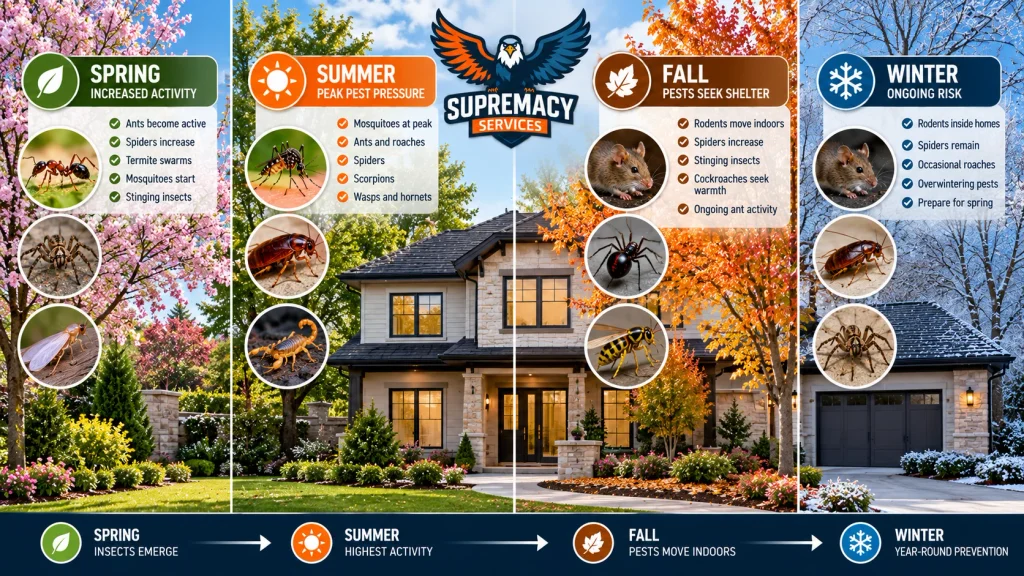
North Texas homeowners can experience different pest pressures at different times of year, so the best pest-management plan may change with the conditions around the property rather than staying identical all year.
Seasonality does not mean pests disappear completely during a particular month.
Instead, different conditions may shift where pests are active and what homeowners notice.
Warmer periods
Warm conditions can coincide with increased outdoor activity from ants, mosquitoes, wasps and numerous other arthropods.
Exterior prevention becomes especially important because many household pest problems begin around the property before pests are noticed indoors.
Hot or dry periods
Changes in moisture availability can alter pest movement.
A pest moving indoors does not necessarily mean the house suddenly became “infested.” It may be entering through structural openings while looking for water, shelter or food.
Cooler periods
As conditions outside change, sheltered structures can become attractive to some pests and rodents.
This makes fall a useful time to inspect:
- door sweeps;
- weather stripping;
- utility penetrations;
- vents;
- garage-door gaps;
- roofline openings;
- damaged screens;
- areas around pipes and cables.
The goal is to prevent entry rather than wait for activity to become established indoors.
Do You Still Need Pest Control If You Don’t See Bugs?
Not seeing pests is a good sign, but it does not automatically tell you whether preventive service should stop. The better decision comes from your home’s history, current risk factors, monitoring results and the type of pests previously present.
Preventive pest management is partly about keeping favorable conditions from developing.
However, this does not mean pesticides should automatically be applied when no problem exists.
EPA’s IPM principles specifically emphasize monitoring, prevention and determining when control is actually necessary.
A pest-management program should therefore ask:
- Have there been recurring problems previously?
- Are pests being detected during inspections?
- Are exterior conditions favorable to pests?
- Have entry points been corrected?
- Are sanitation and moisture issues under control?
- What pests historically affect the property?
- Is the current program producing acceptable results?
That is a much better basis for deciding frequency than “we always spray every month.”
Can You Reduce How Often Professional Pest Control Is Needed?
Good prevention can reduce pest pressure, but it cannot guarantee that a North Texas property will never experience pests.
Homeowners can make a meaningful difference by removing the resources pests use.
North Texas homeowner pest-prevention checklist
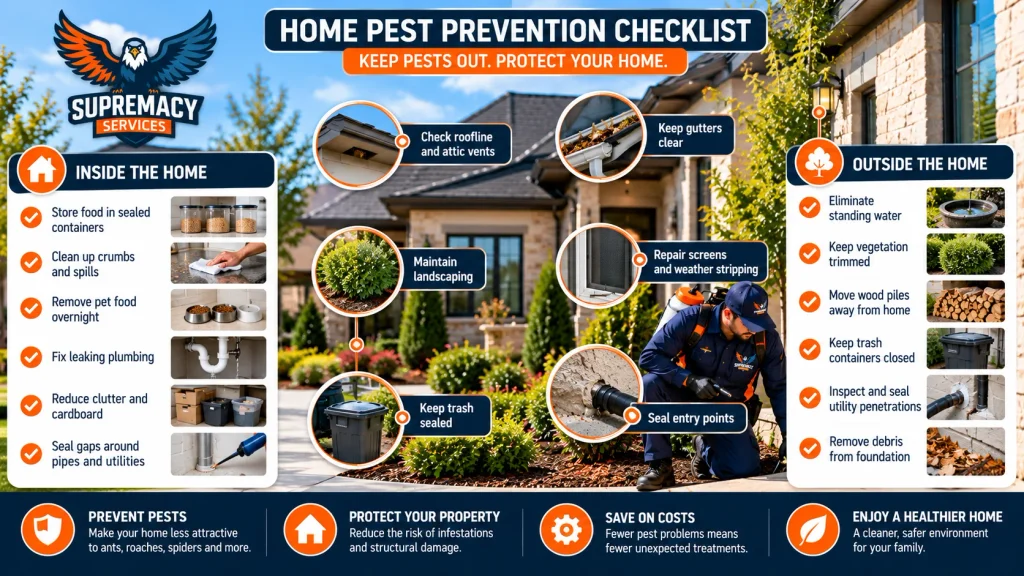
Inside the home
- Store food in closed containers.
- Clean food spills and crumbs.
- Avoid leaving pet food accessible overnight.
- Repair leaking plumbing.
- Reduce cardboard and unnecessary clutter.
- Monitor under sinks and behind appliances.
- Seal appropriate openings around pipes and utilities.
Outside the home
- Eliminate unnecessary standing water.
- Keep gutters functioning properly.
- Check door sweeps and weather stripping.
- Repair damaged screens.
- Reduce debris against the foundation.
- Keep trash containers closed.
- Inspect utility penetrations.
- Address structural openings where appropriate.
- Monitor garages and storage areas.
- Investigate repeated pest activity instead of repeatedly spraying the visible insects.
EPA similarly recommends removing food, water and shelter and sealing potential entryways as fundamental household pest-prevention measures.
DIY vs. Professional Pest Control
DIY prevention is useful for sanitation, moisture management, monitoring and minor pest issues. Professional help becomes more appropriate when the pest cannot be identified, activity repeatedly returns, specialized treatment is required or the infestation is established in inaccessible areas.
| DIY may be reasonable when | Consider professional service when |
|---|---|
| Pest activity is isolated | Activity repeatedly returns |
| You can confidently identify the pest | You cannot identify the pest |
| The source is obvious and correctable | Source or nesting location is unclear |
| Prevention is the main objective | An indoor infestation is established |
| You can safely follow a product label | Treatment requires specialized knowledge |
| No structural pest is suspected | Termites or structural damage are suspected |
| No rodents are established inside | Rodents are entering the building |
| No dangerous nest is present | Wasps or other stinging pests create a hazard |
If you use pesticides yourself, read and follow the product label exactly. EPA warns against using more pesticide than directed or using a product against a pest that is not listed on its label.
Texas licensing matters
Professional structural pest control is regulated in Texas.
The Texas Department of Agriculture’s Structural Pest Control Service licenses and regulates pest-management professionals who apply pesticides in and around structures. Texas also requires businesses providing structural pest control for hire to meet applicable licensing requirements.
Before hiring a provider, homeowners can verify that they are dealing with an appropriately licensed pest-control business.
What Should Professional Pest Control Include?
Professional pest control should be built around the actual pest and property rather than simply spraying visible insects.
Depending on the problem, a professional visit may include:
- Inspection – Determine where activity is occurring.
- Identification – Establish what pest is actually present.
- Conducive-condition assessment – Look for food, moisture, shelter and other factors.
- Entry-point evaluation – Identify likely access routes.
- Treatment selection – Choose controls appropriate for the pest and situation.
- Exterior management – Address pest pressure around relevant parts of the structure when appropriate.
- Prevention recommendations – Explain conditions the homeowner can correct.
- Monitoring – Determine whether the strategy is working.
- Follow-up – Adjust the program when continued activity indicates it is necessary.
This is much closer to integrated pest management than simply applying the same product on the same calendar regardless of what is happening at the property.
If you are seeing recurring ants, roaches, spiders, scorpions or other household pests around your Dallas-Fort Worth property, request a pest-control inspection from Supremacy Services to determine whether your home needs one-time treatment, recurring protection or a pest-specific program.
How Much Does Recurring Pest Control Cost?
Frequency is one factor that affects the overall cost of pest control.
Monthly programs involve more scheduled visits than quarterly programs, while specialized infestations may require entirely different treatment plans.
Rather than duplicating pricing information here, see Supremacy’s Pest Control Cost in North Texas: 2026 Pricing Guide for current third-party Dallas market benchmarks and the factors that can affect a property-specific quote.
The important point when comparing plans is not simply the price per visit.
Ask what is actually included:
- inspection;
- pests covered;
- scheduled treatment;
- interior service when necessary;
- exterior treatment;
- monitoring;
- follow-up;
- callbacks;
- web or nest removal where applicable;
- exclusion work;
- specialized pests that are excluded from the general plan.
A cheap visit that does not address the source of recurring activity may not be the better value.
How to Choose the Right Pest-Control Schedule for Your North Texas Home
Use these five questions.
1. What pest are you actually dealing with?
Identification comes first.
Do not choose a treatment frequency before you know what needs to be controlled.
2. Is the goal prevention or active infestation control?
Preventive service and corrective treatment are not the same thing.
An active infestation may require an initial treatment phase followed by monitoring or additional service.
3. How quickly does activity return?
Keep track of what you see between visits.
Record:
- pest type;
- location;
- approximate number;
- time of day;
- recurring moisture or sanitation problems;
- changes after treatment.
This information can help determine whether the current program is working.
4. What conditions around the home encourage pests?
Inspect the property for:
- water;
- food;
- shelter;
- vegetation;
- clutter;
- structural openings;
- standing water;
- leaking plumbing;
- damaged screens;
- deteriorated weather stripping.
Correcting those conditions can be as important as treatment.
5. Is the existing schedule producing results?
Frequency should be responsive.
If pest pressure remains high, the strategy may need adjustment.
If the home remains well controlled and monitoring shows little activity, ask whether the current interval remains appropriate.
The Bottom Line: How Often Do You Need Pest Control in North Texas?
There is no single pest-control frequency that is correct for every North Texas home.
For general preventive household pest management, quarterly service is a reasonable schedule to discuss with a professional, but monthly or more frequent attention may be appropriate during an active problem or when monitoring shows persistent pest pressure.
Other properties may need less treatment and more emphasis on inspection, exclusion and prevention.
The best schedule is therefore the least intensive program that reliably controls the actual pest problem while addressing the conditions that allow pests to return.
For Dallas-Fort Worth homeowners, the decision should be based on:
- pest species;
- infestation severity;
- previous pest history;
- season and current activity;
- moisture;
- landscaping;
- entry points;
- sanitation;
- effectiveness of previous control;
- whether specialized treatment is required.
Not sure whether your property needs one-time treatment, quarterly prevention or a more intensive pest-management plan?
Contact Supremacy Services for a North Texas pest-control inspection and a treatment plan based on the pests and conditions at your property.
Frequently Asked Questions
Is quarterly pest control enough in North Texas?
Quarterly pest control may be appropriate for general preventive service at many homes, but it is not universally sufficient. Active infestations, recurring activity or pest-specific problems may require different intervals or specialized treatment.
Is monthly pest control necessary?
Not for every home. Monthly service may be appropriate where pest pressure is high, an active infestation requires closer follow-up or the property has conditions that continually support pest activity.
How often should you spray your house for bugs?
There is no universal spraying schedule. Treatment should depend on the pest, product label, property conditions and monitoring results. Pest management should also include prevention rather than relying solely on pesticide application.
Is pest control needed during winter in North Texas?
Pest-management needs can continue when temperatures cool because some pests seek protected environments and rodents can exploit structural openings. Winter priorities may differ from warm-season pest problems.
Should I get pest control even if I don’t see bugs?
Possibly, especially if your home has a history of recurring pest problems. However, preventive pest management should include inspection, monitoring, sanitation and exclusion—not automatic pesticide application simply because a date appears on a calendar.
Why do bugs come back after pest control?
Recurring pests may indicate surviving colonies, exterior pest pressure, moisture, food sources, untreated harborages or entry points. Correct identification and inspection are important before simply increasing treatment frequency.
Can I do pest control myself between professional visits?
Homeowners can reduce pest pressure by sealing appropriate entry points, eliminating standing water, fixing leaks, managing food and garbage and reducing clutter. When using pesticides, always follow the product label exactly.
Are termites included in regular pest control?
Do not assume so. Termites require specific inspection and treatment strategies and should be discussed separately from routine household pest-control service.
How do I know whether I need monthly or quarterly pest control?
Consider the pest involved, whether the problem is active or preventive, how quickly activity returns, property conditions and results between visits. A professional inspection can help determine an appropriate interval.

