
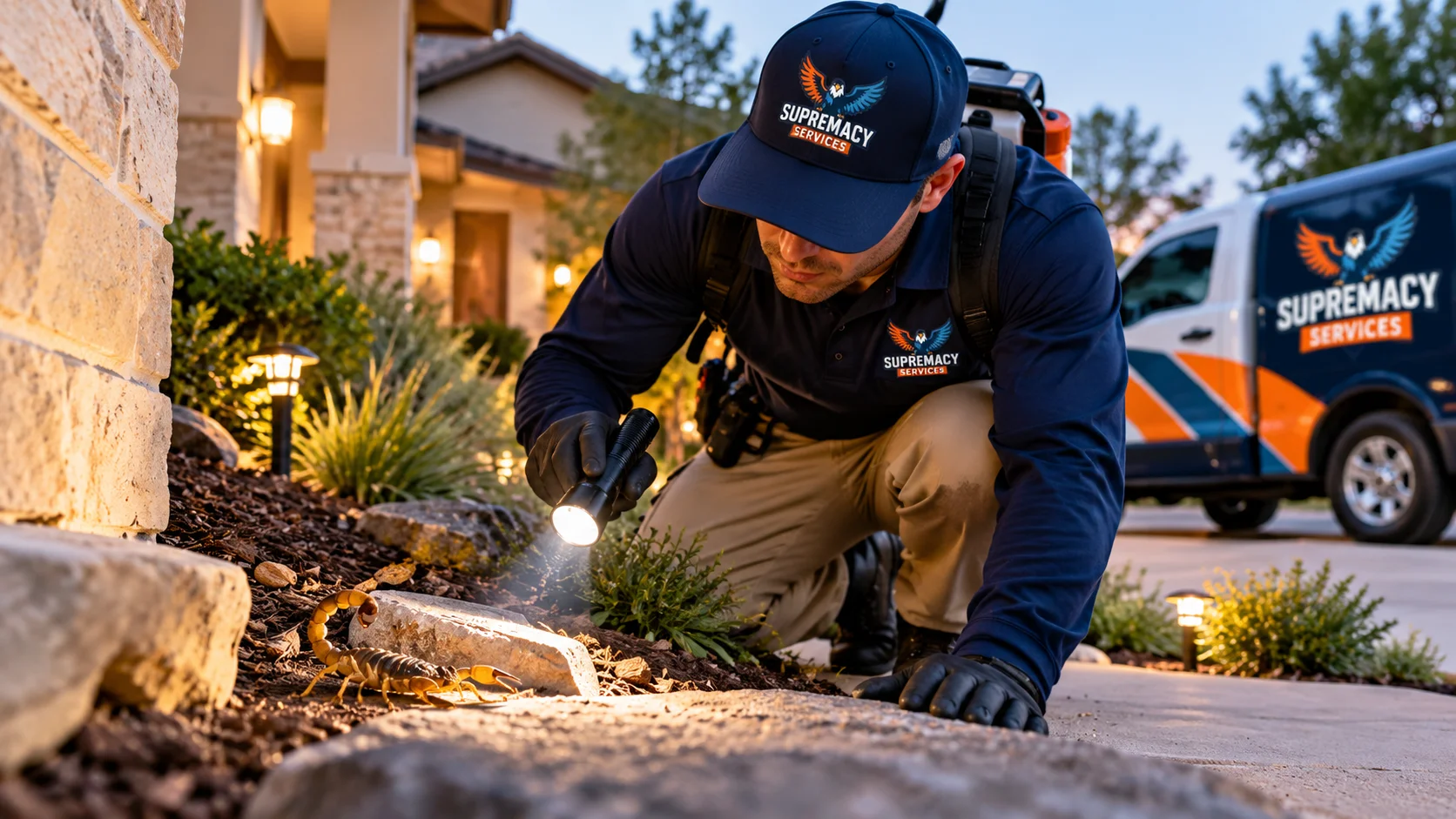
If you are finding scorpions in your North Texas home, professional treatment commonly involves more than spraying the individual scorpions you see. A complete approach may include inspecting the property, treating appropriate exterior and entry areas, reducing the insects scorpions feed on, identifying hiding places and recommending exclusion work.
For pricing context, national 2026 consumer cost data from Angi puts professional scorpion removal at roughly $200–$300 per treatment on average, with a broader reported range of about $80–$500 depending on the property and severity of the problem. Those figures are national market estimates—not Supremacy Services pricing or guaranteed Dallas rates. North Texas homeowners should get a property-specific quote before budgeting for treatment.
The biggest cost variables are typically the size of the property, extent of scorpion activity, treatment area, whether repeat visits are needed, other insect activity and whether structural exclusion or sealing is recommended.
Table of Contents
- How Much Does Scorpion Pest Control Cost?
- What Affects Scorpion Treatment Cost?
- What Does Professional Scorpion Control Include?
- Why Scorpion Control Requires More Than Spraying
- One-Time vs. Recurring Scorpion Treatment
- DIY vs. Professional Scorpion Control
- How to Prevent Scorpions Around Your Home
- When Should You Call a Professional?
- Scorpion Control FAQs
How Much Does Scorpion Pest Control Cost?
There is no single price that applies to every North Texas property. The cost depends on what the technician finds, how much of the property requires treatment and whether the problem can be addressed with pest treatment alone or would benefit from exclusion work.
For a useful benchmark, Angi’s 2026 national cost data reports:
| Service scenario | Published 2026 market benchmark |
|---|---|
| Typical professional scorpion removal | $200–$300 |
| Reported average | About $250 |
| Lower end of reported range | About $80 |
| More involved treatments | Up to about $500 |
| Monthly treatment | About $40–$100 per visit |
| Quarterly treatment | About $100–$300 per visit |
Important: These are national consumer-market estimates and are provided only as budgeting context. They are not a Supremacy Services price list and should not be interpreted as guaranteed Dallas-Fort Worth pricing.
A Dallas-area home with one occasional scorpion sighting is a different project from a large property with repeated sightings in the garage, bedrooms and outdoor living areas.
That is why a meaningful quote should be based on the property rather than simply the number of scorpions a homeowner has seen.
Seeing scorpions repeatedly? Learn how Supremacy Services approaches professional scorpion control throughout Dallas-Fort Worth.
What Affects Scorpion Treatment Cost?
1. Size of the property
A larger house generally means more foundation perimeter, doors, windows, landscaping transitions, garages and other potential activity zones to evaluate.
The relevant area is not necessarily just the home’s conditioned square footage.
A property with detached structures, extensive patios, stone landscaping, retaining walls or a large garage may require a broader inspection than a smaller, simpler property.
2. How much scorpion activity is present
Finding one scorpion does not automatically establish a major infestation.
Repeated sightings, however, can justify a more extensive inspection—particularly if scorpions are appearing in several parts of the house.
Useful questions include:
- How frequently are scorpions being found?
- Are sightings indoors or outdoors?
- Are they repeatedly appearing in the garage?
- Are multiple areas of the home affected?
- Is activity concentrated around one side of the property?
- Are other insects abundant?
The answers help determine the scope of treatment.
3. Exterior conditions and hiding places
Scorpions benefit from protected locations.
Texas A&M AgriLife identifies rocks, boards, debris, dead vegetation and similar materials as potential scorpion habitat. The striped bark scorpion can also climb walls and trees and may occur in attics.
A property with numerous protected hiding locations may require more inspection and management than one with limited harborage.
4. Entry points into the house
Some of the most valuable scorpion-control work may involve determining how scorpions are getting indoors.
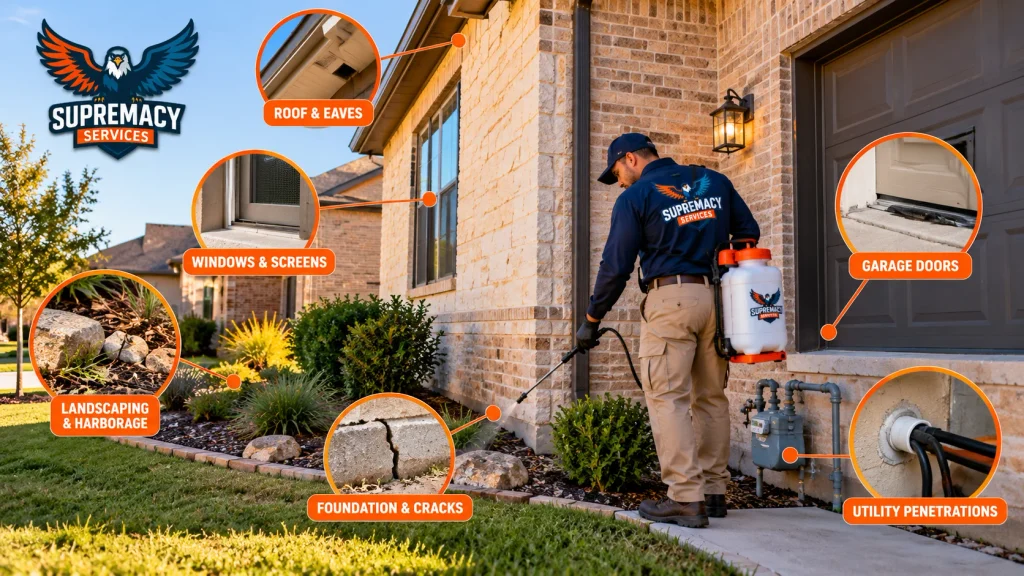
Potential access areas include:
- gaps beneath exterior doors;
- garage-door edges;
- loose-fitting windows;
- utility penetrations;
- cracks and joints;
- roof and eave openings;
- damaged screens.
Treatment without addressing significant entry opportunities can leave the underlying pathway intact.
5. Other insect activity
Scorpions are predators.
Crickets, cockroaches, spiders and other arthropods can provide prey around a property. Heavy general pest activity therefore matters when diagnosing a recurring scorpion problem.
This is one reason professional scorpion management may overlap with broader perimeter pest control.
6. One-time treatment versus an ongoing program
A homeowner dealing with an isolated problem may have different needs from someone experiencing repeated activity throughout warmer periods.
Where recurring service is appropriate, the price per visit and annual cost structure can differ from a stand-alone treatment.
Ask what the quoted price includes rather than comparing only the headline amount.
7. Exclusion or structural work
Pest treatment and physical exclusion are separate components.
Weather-stripping, door sweeps, screen repairs and sealing appropriate gaps can reduce potential pathways into a structure.
More extensive exclusion naturally changes the total project cost because it involves materials and labor beyond pest treatment.
What Does Professional Scorpion Control Include?
A professional scorpion-control program should begin by understanding where the activity is occurring and what is supporting it.
Depending on the property and service plan, the process may involve:
Inspection
A technician evaluates likely activity zones such as:
- foundations;
- garage edges;
- doorways;
- exterior walls;
- landscape borders;
- patios;
- utility penetrations;
- stored materials;
- cracks and structural joints.
Identifying scorpion pressure and harborage
The objective is not simply to find the scorpion that crossed the kitchen floor.
The inspection should look for conditions that allow scorpions to remain close to the structure.
Targeted pest treatment
Where pesticide treatment is appropriate, products should be selected and applied according to their labels.
The EPA emphasizes that pesticide labels specify where, how, how much and how often a product may legally be used.
Managing prey insects
Reducing insects around the structure may reduce an important food source for scorpions.
That makes general pest pressure part of the scorpion-control equation.
Prevention recommendations
A technician may also identify practical changes that could make the property less favorable, such as correcting accessible gaps, relocating debris or improving door seals.
If scorpions keep appearing around your home, schedule a scorpion-control evaluation with Supremacy Services to identify activity zones, entry points and conditions supporting the problem.
Why Scorpion Control Requires More Than Spraying
Scorpion management works best when treatment is combined with prevention, monitoring and habitat modification rather than relying on insecticides alone.
Texas A&M AgriLife specifically notes that scorpions can be difficult to control with insecticides alone and recommends modifying the area surrounding the structure as the first control strategy.
That approach closely follows integrated pest management.
The EPA describes Integrated Pest Management, or IPM, as a combination of monitoring, identification, prevention and appropriate control measures rather than reliance on a single treatment.
For a homeowner, that means thinking in four layers:
| Layer | Goal |
|---|---|
| Inspection | Determine where scorpions are active |
| Habitat reduction | Reduce protected hiding locations |
| Exclusion | Make entry into the structure more difficult |
| Pest management | Address scorpions and relevant prey activity |
Simply killing the scorpion you see addresses the immediate encounter.
It does not necessarily explain where it came from.
One-Time vs. Recurring Scorpion Treatment
When might one-time treatment make sense?
A one-time service may be worth discussing when activity appears limited and there is no history of repeated indoor sightings.
Even then, prevention matters.
If an obvious garage-door gap or exterior hiding area remains unchanged, another scorpion can eventually use the same environment.
When might recurring pest control make more sense?
Recurring service may be considered when:
- scorpions repeatedly appear indoors;
- activity continues around garages or patios;
- the property supports significant insect activity;
- exterior pest pressure is persistent;
- ongoing general pest protection is also desired.
The objective of recurring pest management is not merely to repeatedly spray for scorpions. A good program should continue addressing the pest environment around the property.
Why Are Scorpions a North Texas Pest?
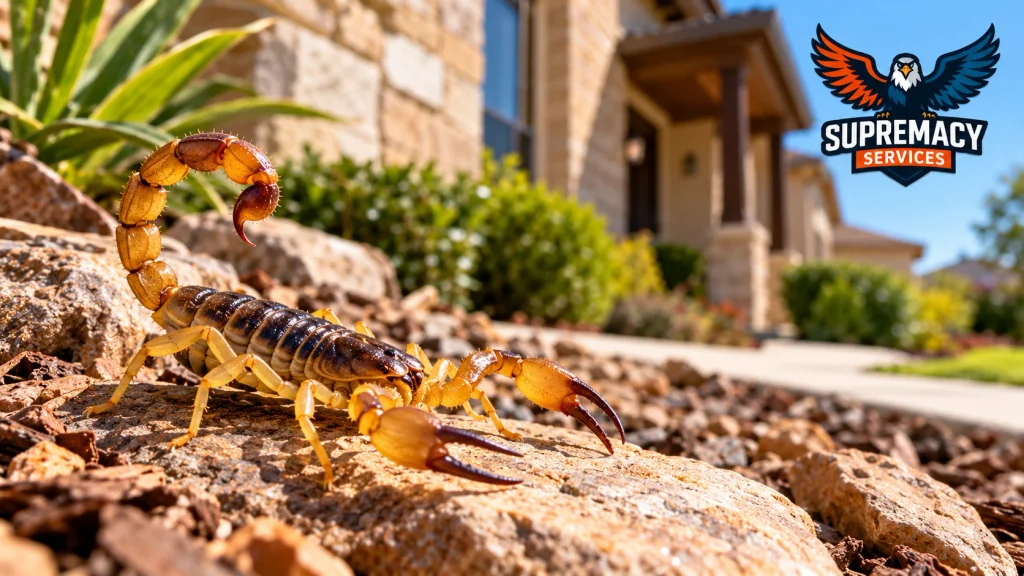
The striped bark scorpion (Centruroides vittatus) is particularly relevant to Texas homeowners.
Texas A&M AgriLife identifies it as the scorpion species occurring throughout the state. It can live around human structures, hide beneath rocks and boards, climb trees and walls and enter homes.
Scorpions are also primarily nocturnal, which is why activity can go unnoticed during the day.
Dallas-Fort Worth properties can provide numerous suitable hiding and travel areas, including garages, landscape materials, exterior walls, stored items and structural gaps.
This does not mean every North Texas home needs scorpion treatment.
The conditions of the individual property matter much more than the ZIP code alone.
DIY vs. Professional Scorpion Control
Some prevention work is reasonable for homeowners to perform themselves.
DIY tasks homeowners can consider
- replace worn weather-stripping;
- install or repair appropriate door sweeps;
- repair window screens;
- remove unnecessary boards and debris;
- keep firewood away from living areas;
- trim vegetation away from the structure;
- reduce clutter in garages;
- inspect obvious utility penetrations;
- monitor where sightings occur.
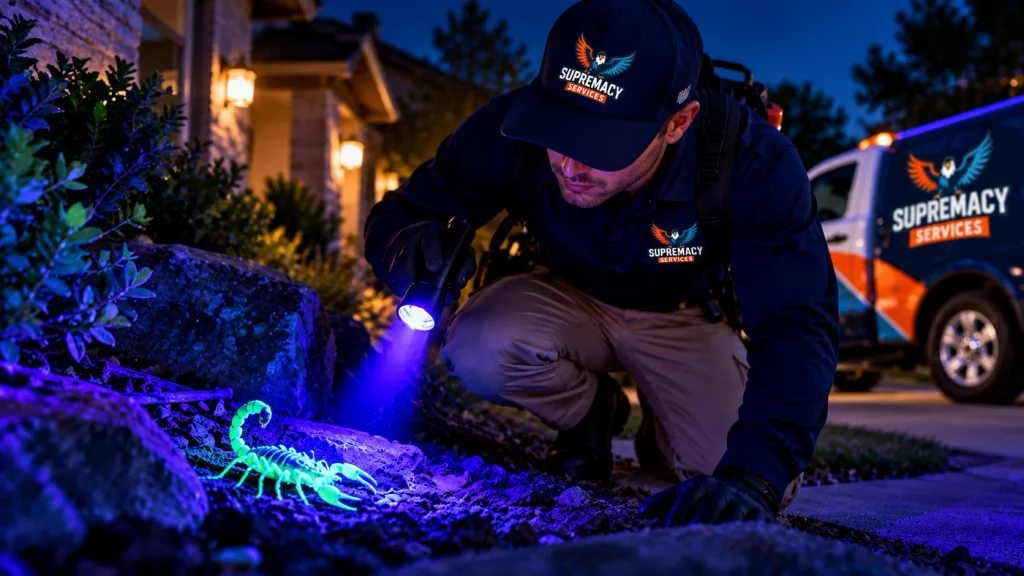
A UV/blacklight inspection after dark can also make scorpions easier to locate because scorpions fluoresce under ultraviolet light.
Be cautious with DIY pesticide applications
Buying more pesticide does not automatically produce better scorpion control.
Use only products labeled for the intended pest and application site, and follow the product label exactly.
EPA states that pesticide labels contain legally enforceable instructions covering how and where the product may be used.
Never assume that a product suitable for one outdoor pest or location is automatically appropriate for another.
When professional service becomes more valuable
Consider professional evaluation when:
- sightings continue despite prevention efforts;
- several scorpions are appearing indoors;
- you cannot determine where they are entering;
- scorpions appear in bedrooms or frequently used living spaces;
- activity occurs in multiple areas;
- the property has extensive exterior hiding locations;
- broader insect activity is significant;
- you are uncomfortable inspecting or treating the affected areas.
Texas regulates structural pest-control work performed for hire through the Texas Department of Agriculture.
How to Prevent Scorpions Around Your Home
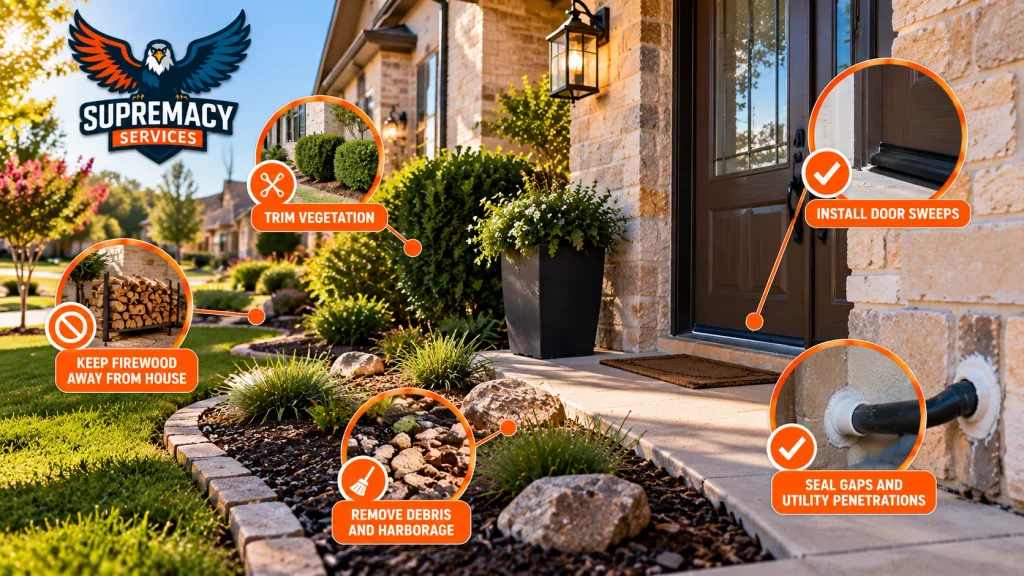
Prevention can be one of the most important parts of long-term scorpion management.
Scorpion-prevention checklist
Around the exterior
- Remove unnecessary boards, stones and debris near the structure.
- Avoid stacking firewood against the house.
- Keep vegetation maintained near exterior walls.
- Trim branches that contact or overhang the structure.
- Reduce clutter around garages and storage areas.
- Monitor areas with significant insect activity.
At entry points
- Check weather-stripping.
- Inspect exterior door sweeps.
- Repair damaged screens.
- Examine gaps around pipes and utilities.
- Inspect cracks and openings around the exterior.
- Check garage-door seals.
Inside
- Avoid leaving shoes and clothing undisturbed on floors in areas with known activity.
- Reduce clutter in garages and storage rooms.
- Be careful when moving boxes or stored materials.
- Record where and when scorpions are found.
Texas A&M recommends many of these habitat and exclusion measures, including removing debris, pruning vegetation away from structures, improving weather-stripping and screens, and sealing appropriate openings.
Is Scorpion Exclusion Worth Paying For?
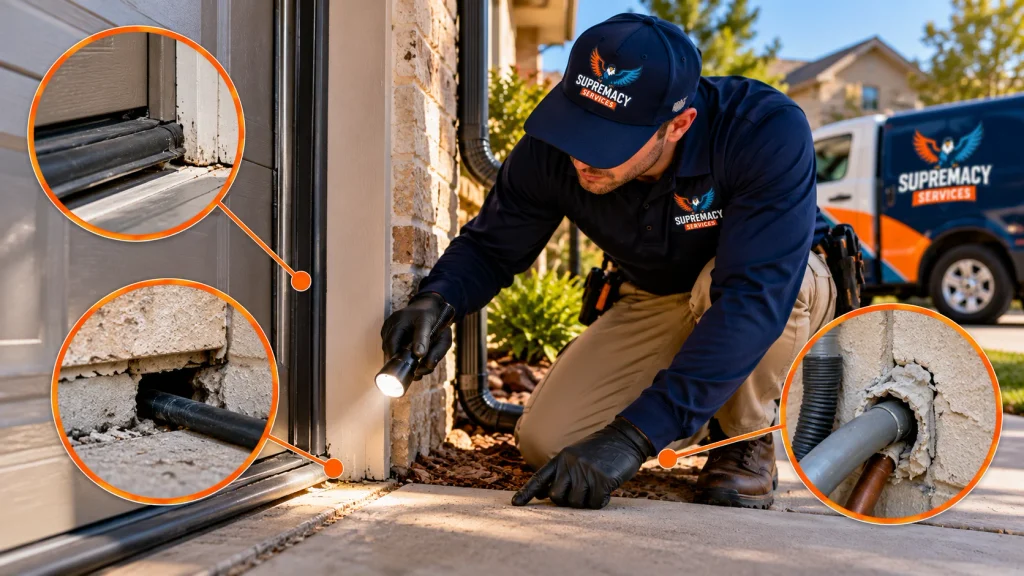
Exclusion can be particularly valuable when recurring indoor sightings are connected to identifiable structural openings.
Pest treatment reduces activity. Exclusion attempts to reduce the routes pests can use to enter the building.
They solve different parts of the problem.
For example, treating exterior pest pressure while leaving a substantial gap beneath a garage door may not address the most obvious physical pathway.
Likewise, sealing a few gaps without addressing significant scorpion and prey activity immediately outside the structure may not solve the entire problem.
The strongest strategy often combines appropriate pest management with practical structural prevention.
What Can Homeowners Do to Keep Treatment Costs Down?
The goal should not simply be finding the cheapest visit. It should be reducing the conditions that cause repeat service to become necessary.
Before a technician arrives:
- Record where scorpions have been seen.
- Note how often sightings occur.
- Photograph specimens when safely possible.
- Identify areas with heavy insect activity.
- Clear unnecessary exterior clutter.
- Make garages and utility areas accessible for inspection.
- Ask whether the quote includes follow-up service.
- Ask whether exclusion work is included or priced separately.
These details can help a professional understand the pattern faster.
What Should You Ask Before Hiring a Scorpion Exterminator?
Price matters, but scope matters just as much.
Ask:
- What areas of the property will you inspect?
- Is exterior treatment included?
- Does the service address other insects that scorpions prey on?
- Is indoor treatment necessary?
- Are follow-up visits included?
- Is exclusion included or separate?
- What prevention steps do you recommend?
- What does the service agreement cover?
- Is the pest-control business appropriately licensed in Texas?
The Texas Department of Agriculture licenses and regulates structural pest-control professionals who provide pest-management services in and around structures.
Scorpion Control Cost vs. General Pest Control
These services can overlap, but they should not automatically be treated as identical.
Supremacy Services’ general pest-control program includes scorpions among common Texas household pests, while its dedicated scorpion service focuses specifically on scorpion pressure, hiding areas, entry routes and related pest conditions.
For a homeowner already dealing with ants, cockroaches, spiders, crickets or other pests, asking whether scorpion management can be incorporated into a broader pest-control program may make more sense than purchasing disconnected treatments.
For persistent or concentrated scorpion activity, a dedicated inspection may be warranted.
When Should You Call a Professional?
One isolated scorpion does not automatically prove that your house has a serious infestation.
Recurring sightings deserve more attention.
Consider scheduling professional service when you are finding scorpions repeatedly, when they appear in multiple rooms, when garage activity continues despite improving seals, or when you cannot identify the conditions allowing them close to the structure.
The important question is not simply:
“How do I kill this scorpion?”
It is:
“Why are scorpions reaching this part of my property, and what needs to change to reduce future encounters?”
That distinction is what turns a reactive treatment into a prevention strategy.
Frequently Asked Questions
How much does scorpion pest control cost in North Texas?
There is no universal North Texas rate. As a national 2026 benchmark, Angi reports professional scorpion removal commonly around $200–$300 per treatment, with prices varying according to home size, severity and treatment requirements. Request a local inspection or quote for property-specific pricing.
Does regular pest control help with scorpions?
It can. Scorpion management may include exterior pest treatment and reduction of insects that serve as prey. Persistent scorpion activity may require additional inspection, targeted treatment and exclusion recommendations.
Is one scorpion enough to call pest control?
Not necessarily. One sighting does not prove a major infestation. Repeated sightings, scorpions in multiple areas or continued indoor activity are stronger reasons to have the property evaluated.
Why do scorpions keep coming back after treatment?
Possible reasons include accessible entry points, protected hiding locations and continued insect prey around the property. Treatment alone may not address every factor supporting recurring activity.
Can scorpions be permanently eliminated from a property?
No responsible pest-control provider should imply that an outdoor property can be made permanently incapable of receiving another scorpion. The practical goal is to reduce scorpion pressure, hiding conditions and opportunities for entry.
Does sealing a house help prevent scorpions?
Yes. Weather-stripping, well-fitting screens and sealing appropriate cracks and penetrations can help reduce potential entry routes. Texas A&M includes structural exclusion among its scorpion-management recommendations.
Should scorpion treatment be inside or outside?
The appropriate treatment depends on the property. Because scorpions frequently originate outdoors, exterior management and entry-point prevention are important. Indoor treatment, when appropriate, should be targeted and performed according to pesticide-label directions.
How often should a home be treated for scorpions?
There is no universal schedule. Frequency depends on scorpion pressure, property conditions, other pest activity, treatment products and whether the homeowner is using a broader recurring pest-management program.
Are scorpions common in North Texas?
Scorpions occur in Texas, and Texas A&M identifies the striped bark scorpion as occurring throughout the state. Whether a particular DFW property experiences frequent activity depends heavily on local habitat, hiding areas, prey and structural access.
Get Professional Scorpion Control in Dallas-Fort Worth
The cost of scorpion pest control should ultimately reflect the problem being solved—not simply how many scorpions were visible on the day of service.
Repeated scorpion sightings may involve exterior activity, prey insects, hiding locations and structural entry points working together.
Supremacy Services provides scorpion-control services throughout Dallas-Fort Worth for homeowners who want the property evaluated rather than simply treating each scorpion as it appears.
Schedule Scorpion Control in DFW →
A professional evaluation can help determine where activity is concentrated, what conditions are contributing to it and which combination of treatment and prevention makes sense for your property.

