

If you have mosquitoes around your Dallas-area home but cannot find any standing water, they may be coming from tiny or hidden water sources, neighboring properties, clogged drainage areas, storm drains, tree holes, irrigation runoff, or nearby vegetation where adult mosquitoes rest.
The water source does not have to look like a pond or puddle. Texas health officials note that mosquitoes can breed in as little as a tablespoon of water, and EPA guidance identifies surprisingly small breeding sites—including plant saucers, toys, tarps and even bottle-cap-sized spaces.
That also means removing obvious standing water is important, but it does not guarantee that your backyard will immediately become mosquito-free.
Table of Contents
- Can You Have Mosquitoes Without Standing Water?
- Where Are the Mosquitoes Coming From?
- Hidden Water Sources Homeowners Often Miss
- Can Mosquitoes Come From a Neighbor’s Yard?
- Why Shady Landscaping Can Make the Problem Worse
- How to Inspect Your Yard
- DIY Mosquito Control vs. Professional Treatment
- What Professional Mosquito Control Includes
- How to Reduce Mosquitoes Around Your Property
- When to Call a Professional
- Frequently Asked Questions
Can You Have Mosquitoes With no Standing Water?
Yes. You can have large numbers of mosquitoes even when you cannot see standing water on your property.
Mosquito larvae require water to develop, but that does not mean the breeding site must be obvious—or even located in your yard.
The mosquitoes biting you may have:
- developed in a tiny hidden water source;
- emerged from a storm drain or drainage area;
- originated on an adjacent property;
- developed in water that has since evaporated or drained;
- traveled into your yard as adults; or
- chosen your landscaping as a cool, humid resting area.
This distinction matters.
Breeding habitat is where immature mosquitoes develop in water. Resting habitat is where adult mosquitoes shelter between periods of activity.
CDC notes that adult Culex mosquitoes commonly rest in grass, shrubs and other thick vegetation where conditions are cool, dark and humid.
So your yard can become an attractive mosquito resting area even when it is not their main breeding site.
Where Are the Mosquitoes Coming From?
If there is no obvious standing water, investigate these seven possibilities first.
| Possible source | Why mosquitoes may be present | What to inspect |
|---|---|---|
| Hidden containers | Tiny amounts of rain or irrigation water can accumulate | Toys, buckets, lids, tarps, patio items |
| Gutters and downspouts | Debris can trap small pockets of water | Sagging or clogged gutter sections |
| Landscaping | Dense vegetation provides shaded adult resting habitat | Shrubs, hedges, groundcover, under decks |
| Irrigation | Overspray or poor drainage may repeatedly create wet areas | Sprinkler zones, valve boxes, low spots |
| Stormwater systems | Water can remain in drains or structures | Nearby drains, ditches and drainage areas |
| Neighboring properties | Mosquitoes do not respect property boundaries | Adjacent yards, vacant lots, common areas |
| Tree holes and natural cavities | Small cavities can retain rainwater | Mature trees, stumps and landscape features |
EPA specifically lists tree holes, tires, buckets, toys, plant saucers, tarps and very small containers among mosquito breeding sites.
1. The Water Is There—You Just Cannot See It
One of the most common explanations is simply hidden standing water.
Walk through the backyard after rain or after your sprinkler system runs. Look underneath and inside objects rather than checking only the lawn.
A few ounces of water trapped somewhere for long enough can matter.
Potential hiding places include:
- flowerpot saucers;
- children’s toys;
- wheelbarrows;
- upside-down trash-can lids;
- folded tarps;
- patio furniture;
- grill covers;
- buckets;
- watering cans;
- clogged gutters;
- decorative containers;
- fence-post caps;
- outdoor equipment;
- tree cavities; and
- drainage components.
Texas DSHS recommends checking and emptying containers at least weekly and specifically calls out gutters, pots, plant saucers, tires and other small water-holding objects.
2. Your Gutters May Be Holding Water

A gutter can look dry from ground level while leaves, roofing debris or an incorrect slope creates small pools farther along the run.
That makes gutters easy to overlook.
Dallas County specifically advises residents to drain or treat gutters and storm drains that collect water.
After rainfall, inspect gutters safely from an appropriate vantage point or have them professionally inspected if access requires working at height.
Also check where downspouts discharge. Water repeatedly collecting beside the foundation or in landscape beds can create another moisture problem.
3. Irrigation May Be Creating Temporary Water
A backyard does not need to stay visibly flooded all day to have recurring wet areas.
Sprinkler overspray, damaged irrigation heads, leaking valves or poor drainage can repeatedly wet:
- low sections of turf;
- landscape edging;
- valve boxes;
- areas beneath shrubs;
- drainage basins; and
- depressions near patios or foundations.
Check your property immediately after the irrigation cycle instead of several hours later. By then, a shallow accumulation may have disappeared.
4. Mosquitoes May Be Breeding Somewhere Nearby
Your property is not a closed ecosystem.
Some mosquitoes can move from breeding habitat elsewhere into your yard. CDC reports that Culex mosquitoes generally do not fly long distances but have been documented traveling as far as approximately two miles.
That does not mean mosquitoes biting you traveled two miles. It means eliminating water on your own property cannot completely control everything happening beyond your fence.
Potential neighborhood sources include:
- neighboring yards;
- neglected swimming pools;
- storm drains;
- drainage ditches;
- vacant properties;
- construction areas;
- retention areas; and
- community landscaping.
This explains why one homeowner can carefully eliminate water and still experience mosquitoes.
5. Your Landscaping May Be Giving Adult Mosquitoes a Place to Rest
This is one of the most important distinctions for homeowners.
Water supports mosquito development. Dense, cool vegetation can support adult mosquito resting behavior.
CDC says adult mosquitoes can rest under plants, dense brush, tall grass, tree leaves, building eaves, decks, porches and other moist or shaded areas.
That means a heavily landscaped Dallas backyard can have significant adult mosquito activity even when an inspection finds few breeding sites.
Pay particular attention to:
- dense hedges;
- shaded shrubs;
- groundcover;
- tall grass;
- areas beneath decks;
- vegetation along fences;
- shaded corners between buildings; and
- the undersides of leafy plants.
If mosquitoes remain concentrated around shrubs, fence lines and shaded outdoor areas after you have removed water sources, consider having the property evaluated for professional mosquito barrier treatment.
6. Storm Drains and Drainage Areas May Be Contributing
Dallas homeowners should also consider infrastructure outside the immediate backyard.
The City of Dallas mosquito-control program reports monitoring known breeding sites, treating storm drains in areas identified through mosquito surveillance and applying larvicides where appropriate.
You should not open or enter municipal drainage infrastructure yourself.
If you notice persistent standing water on City property, Dallas provides municipal channels for reporting mosquito or standing-water concerns.
7. The Original Water May Already Be Gone
Finding mosquitoes today does not necessarily mean you will find their original water source today.
Temporary rainwater can collect and later disappear. Adults that have already emerged remain mobile.
This is one reason a single dry-yard inspection does not always reveal what caused the problem.
Instead, inspect the property repeatedly—especially shortly after:
- rainfall;
- lawn irrigation;
- pool use;
- outdoor cleaning; or
- landscape watering.
Hidden Water Sources Homeowners Often Miss
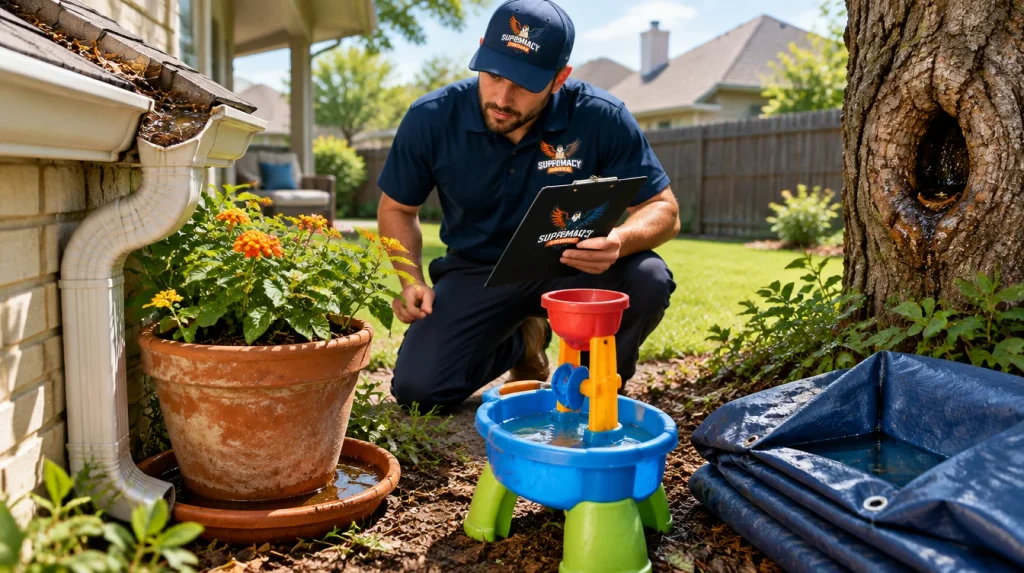
If mosquitoes persist, perform a systematic inspection rather than simply looking for puddles.
Around the House
Check:
- gutters;
- downspout outlets;
- outdoor drains;
- hose reels;
- AC-area depressions;
- trash and recycling containers;
- grill and furniture covers; and
- items stored along exterior walls.
Around Landscaping
Inspect:
- plant saucers;
- decorative pots;
- tree holes;
- irrigation boxes;
- landscape edging;
- low soil depressions;
- wheelbarrows;
- garden equipment; and
- ornamental water features.
Around Outdoor Living Areas
Look at:
- children’s toys;
- play equipment;
- umbrellas and umbrella bases;
- tarps;
- patio furniture;
- fire-pit covers;
- pet bowls;
- birdbaths;
- pool equipment; and
- miscellaneous containers.
Around the Property Perimeter
Check:
- drainage ditches;
- fence lines;
- neighboring vegetation;
- alley drainage;
- storm drains;
- vacant lots; and
- shared common areas.
EPA recommends changing water in birdbaths, fountains, wading pools, rain barrels and plant trays at least weekly and keeping swimming pools properly treated and circulating.
Can Mosquitoes Come From a Neighbor’s Yard?

Yes. Mosquitoes breeding outside your property can move into your yard, so eliminating your own standing water may reduce mosquito production without eliminating every adult mosquito you encounter.
This is particularly relevant when:
- the property borders dense vegetation;
- nearby drainage holds water;
- a neighboring pool is poorly maintained;
- adjacent yards contain water-holding containers; or
- mosquito activity remains high despite thorough source reduction.
Your best response is still to eliminate breeding opportunities you control.
Do not enter a neighbor’s property or attempt to apply pesticides there. Instead, manage your property and use appropriate municipal channels for public-property concerns.
Why Shady Landscaping Can Make the Problem Worse

A yard can be dry and still be attractive to adult mosquitoes.
Shade, dense foliage and humidity provide shelter from heat and drying conditions.
For Dallas and DFW homeowners, inspect the places you would naturally choose to escape direct afternoon sun:
- under decks;
- behind shrubs;
- beneath leafy plants;
- shaded fence lines;
- covered patios; and
- dense groundcover.
Those are also places mosquito-control professionals may inspect when evaluating adult mosquito activity.
Supremacy’s mosquito service currently describes inspecting yards for tall grass, bushes, under-deck areas and small standing-water traps before treating targeted foliage and resting areas.
How to Inspect Your Yard for Mosquito Sources
Use this process before assuming there is no standing water.
Step 1: Inspect After Rain
Walk the property shortly after rainfall.
Look inside objects rather than only across the ground.
Step 2: Run the Irrigation System
Watch each zone operate.
Check for:
- broken heads;
- overspray;
- leaking valves;
- water against foundations;
- saturated landscape beds; and
- low spots.
Step 3: Look Up
Inspect gutters and roof-drainage components.
Do not climb onto a roof or unsafe ladder merely to look for mosquito habitat.
Step 4: Look Under Things
Move lightweight outdoor objects where safe.
Inspect beneath:
- decks;
- furniture;
- planters;
- tarps;
- toys; and
- equipment.
Step 5: Check Dense Vegetation
Mosquitoes seen flying from shrubs when vegetation is disturbed may be resting there rather than breeding in the shrub itself.
Step 6: Inspect the Property Boundary
Look beyond the immediate patio.
Nearby drainage and vegetation may help explain why mosquito pressure continues.
Step 7: Repeat Weekly
EPA recommends regular source reduction rather than treating it as a one-time cleanup.
DIY Mosquito Control vs. Professional Treatment
DIY prevention and professional mosquito treatment solve overlapping but different parts of the problem.
| Approach | Best suited for | Limitation |
|---|---|---|
| Emptying containers | Removing breeding habitat | Cannot control mosquitoes arriving from elsewhere |
| Cleaning gutters | Removing hidden water | Requires ongoing maintenance |
| Landscape maintenance | Reducing shaded resting habitat | May not sufficiently reduce established populations |
| EPA-registered repellent | Protecting individuals from bites | Does not control the yard population |
| Appropriate larvicide | Water that cannot practically be emptied | Must be suitable for the site and used according to label |
| Professional mosquito service | Persistent yard-wide adult mosquito pressure | Does not replace property maintenance/source reduction |
EPA describes successful mosquito management as an integrated approach involving habitat reduction, barriers, larval control where appropriate and adult mosquito control when necessary.
What Homeowners Can Do Themselves
Start with environmental management:
- Empty unnecessary water-holding containers.
- Clean gutters.
- Correct recurring drainage problems where practical.
- Maintain swimming pools.
- Refresh birdbath water frequently.
- Trim excessive vegetation.
- Repair window and door screens.
- Use an EPA-registered personal repellent according to its label.
Dallas County similarly emphasizes its “4Ds”: repellent, appropriate clothing, draining standing water and reducing exposure during periods of mosquito activity.
Be Careful With DIY Pesticide Applications
More pesticide does not mean better mosquito control.
Follow the product label exactly, use only products intended for the application site and avoid indiscriminate spraying.
If the problem continues despite source reduction, the next step should be determining where the mosquitoes are resting and whether professional treatment is justified, rather than repeatedly applying random products around the yard.
What Does Professional Mosquito Control Include?
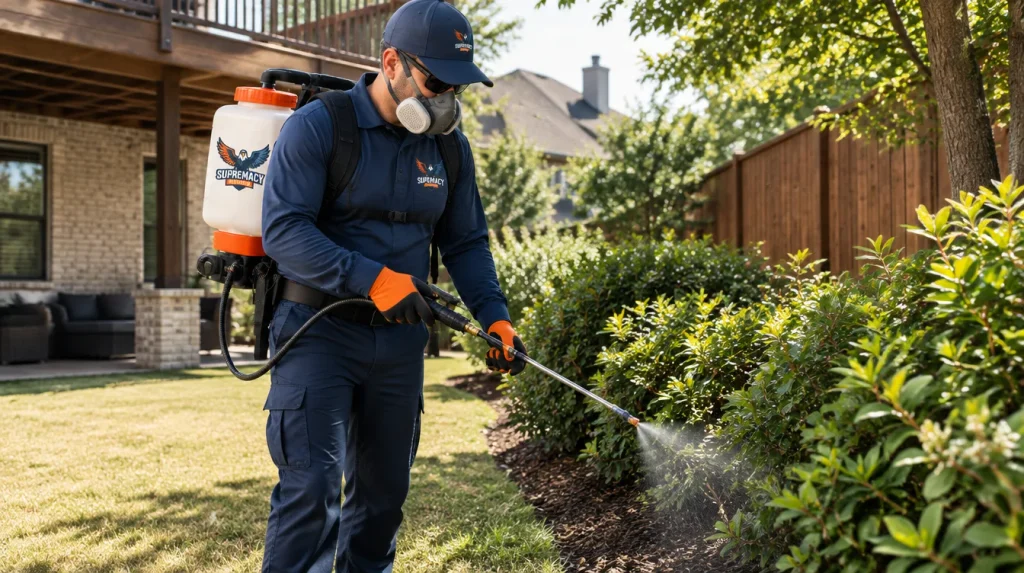
A professional mosquito-control visit should begin with inspection, not simply spraying everything outdoors.
Depending on the property and treatment plan, an evaluation may consider:
- potential breeding locations;
- drainage problems;
- shaded resting areas;
- dense shrubs and vegetation;
- fence lines;
- areas beneath decks;
- landscape features;
- nearby mosquito pressure; and
- water sources that cannot simply be emptied.
Supremacy’s current mosquito barrier service describes a process involving a yard inspection, identification of standing-water traps, treatment of appropriate breeding sites and targeted application to vegetation and other mosquito resting areas.
Still getting bitten after eliminating obvious water? Learn how Supremacy Services’ mosquito barrier misting in Dallas and DFW targets the shaded foliage and resting areas where adult mosquitoes may remain.
How to Reduce Mosquitoes Around Your Property
Use this practical checklist.
Weekly Mosquito Prevention Checklist
Drain
- Empty unnecessary containers.
- Check plant saucers.
- Refresh birdbath water.
- Check toys and outdoor equipment.
- Clear clogged gutters.
Inspect
- Check irrigation.
- Look for low drainage areas.
- Examine tree cavities.
- Check tarps and furniture covers.
- Inspect pool equipment.
Maintain
- Keep pools treated and circulating.
- Trim excessive vegetation.
- Maintain lawns and shrubs.
- Repair damaged screens.
Protect
- Use EPA-registered repellents according to label directions.
- Consider long sleeves and pants when mosquito activity is high.
- Keep doors and window screens in good repair.
EPA and Texas health authorities consistently emphasize source reduction and personal protection as core mosquito-prevention measures.
Dallas and DFW Considerations
Mosquito management is not merely a backyard-comfort issue in North Texas.
Dallas County conducts mosquito surveillance because some mosquitoes can transmit diseases, including West Nile virus. The county advises residents to eliminate or treat standing water and protect themselves from bites.
The City of Dallas also conducts trapping and mosquito collection, monitors breeding sites, applies larvicides where appropriate and treats identified storm-drain locations.
For homeowners, the practical lesson is simple:
Think beyond the obvious puddle.
A mosquito problem can involve your property, surrounding vegetation, neighboring properties and community drainage infrastructure simultaneously.
When Should You Call a Professional?
Consider professional mosquito control when:
- mosquitoes remain heavy after you remove obvious water;
- you cannot identify where they are coming from;
- your yard has extensive dense or shaded vegetation;
- mosquitoes make patios or outdoor living spaces difficult to use;
- activity quickly returns after DIY efforts;
- you suspect multiple breeding or resting areas; or
- you want the property systematically inspected rather than repeatedly guessing.
Professional service should complement—not replace—source reduction.
Even after treatment, homeowners should continue checking gutters, containers, drainage areas and irrigation.
Could It Be Something Other Than Mosquitoes?
Sometimes homeowners identify any small flying insect as a mosquito.
Other insects commonly encountered around moist or landscaped areas can include:
- fungus gnats;
- midges;
- crane flies; and
- other small flies.
If the insects are not biting, identification becomes particularly important before treatment.
Avoid treating the property solely on the assumption that every small flying insect is a mosquito.
Frequently Asked Questions
Why are mosquitoes in my yard if there is no standing water?
The breeding source may be hidden, temporary or located outside your yard. Adult mosquitoes may also use shaded shrubs, grass and other vegetation as resting habitat even when they did not develop on your property.
How little water do mosquitoes need?
Texas DSHS says mosquitoes can breed in as little as a tablespoon of water. That is why tiny containers and overlooked cavities can matter.
Can mosquitoes breed in wet grass?
Mosquito larvae need aquatic habitat rather than simply damp grass. However, dense grass and vegetation can provide cool, humid resting habitat for adult mosquitoes.
Can mosquitoes come from my neighbor’s property?
Yes. Adult mosquitoes can move between properties, so eliminating breeding sources in your own yard reduces local production but cannot guarantee that mosquitoes from nearby areas will never enter.
Do mosquitoes live in bushes?
Adult mosquitoes can rest in shrubs and dense vegetation, particularly in cool, dark and humid locations. The bush itself does not necessarily mean mosquitoes are breeding there.
Can clogged gutters cause mosquitoes?
Yes. Gutters that retain water can provide mosquito breeding habitat. EPA, Texas DSHS and Dallas County all specifically recommend keeping gutters free of standing water.
Should I spray my yard if I see mosquitoes?
Start by inspecting for and removing breeding sources. If mosquito activity remains high, targeted control may be appropriate. Follow pesticide labels exactly or have the property evaluated by a qualified pest-control professional.
Can mosquitoes come from storm drains?
Some drainage structures can retain water suitable for mosquito development. The City of Dallas reports monitoring breeding sites and treating identified storm-drain locations as part of its mosquito-control program.
Why do mosquitoes keep coming back after I remove water?
New mosquitoes may enter from surrounding properties, or adults may already be resting in vegetation around your yard. You may also have overlooked small or recurring water sources created by rain or irrigation.
The Bottom Line
If you have mosquitoes but no visible standing water, do not assume there is nothing left to investigate.
The most likely explanations are hidden water, temporary water after rain or irrigation, gutters or drainage structures, neighboring breeding sites, or adult mosquitoes sheltering in shaded vegetation.
Start with a thorough property inspection and weekly source reduction. Check again immediately after rain and irrigation.
If mosquitoes remain heavy after those steps, the problem may require attention to adult resting areas as well as breeding sources.
Still fighting mosquitoes after checking your yard for standing water? Schedule a mosquito-control evaluation with Supremacy Services to identify likely breeding and resting areas and determine whether targeted mosquito barrier treatment is appropriate for your Dallas–Fort Worth property.

