
For most Dallas homeowners comparing mosquito misting systems vs. barrier treatments, the biggest difference is how the pesticide is delivered.
An automatic mosquito misting system uses permanently installed tubing and nozzles to release insecticide around a property at scheduled intervals or when activated. A professional mosquito barrier treatment, by contrast, is applied periodically by a technician to selected outdoor areas where adult mosquitoes commonly rest.
Neither approach should replace basic mosquito prevention such as eliminating breeding sites and managing standing water. The EPA and CDC recommend an integrated approach that combines source reduction, larval control where appropriate, personal protection, and targeted adult mosquito control when needed.
For many Dallas–Fort Worth properties, professionally applied barrier treatments offer a simpler option because they do not require permanently installed pesticide-delivery equipment. Automatic misting systems may appeal to homeowners seeking automated treatment, but they involve additional equipment, maintenance and pesticide-use considerations.
Table of Contents
- Misting Systems vs. Barrier Treatments: Quick Comparison
- What Is an Automatic Mosquito Misting System?
- What Is a Mosquito Barrier Treatment?
- Which Method Is More Effective?
- Which Uses More Pesticide?
- What About Children, Pets and Pollinators?
- Which Is Better for Dallas Homes?
- What Should Professional Mosquito Control Include?
- DIY vs. Professional Mosquito Treatment
- How to Reduce Mosquitoes Between Treatments
- Frequently Asked Questions
Misting Systems vs. Barrier Treatments: Quick Comparison
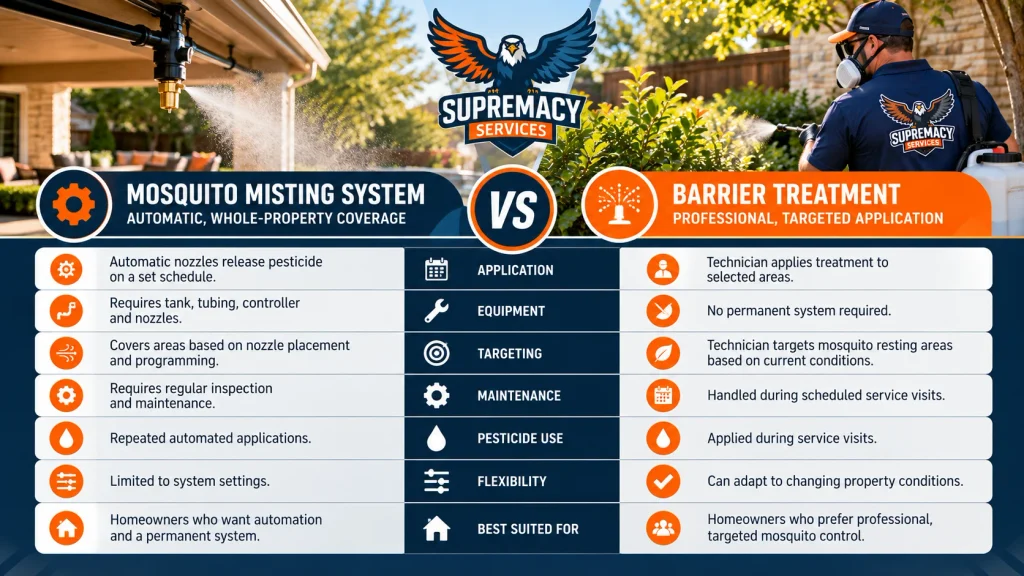
An automatic misting system emphasizes convenience and repeated automated pesticide applications. A barrier treatment emphasizes periodic, targeted applications by a technician. For homeowners who do not want permanent pesticide-delivery equipment installed around their property, barrier treatments are generally the simpler option.
| Factor | Automatic Misting System | Professional Barrier Treatment |
|---|---|---|
| Application | Fixed nozzles automatically or manually release pesticide | Technician applies treatment during scheduled visits |
| Equipment | Tank/reservoir, tubing, controller and nozzles | No permanent pesticide-delivery system required |
| Timing | Timer, remote or manual activation depending on system | Applied during service visits |
| Targeting | Determined largely by nozzle placement and programming | Technician can adjust treatment to current property conditions |
| Maintenance | Equipment requires inspection and maintenance | Service provider maintains application equipment |
| Pesticide use | Can involve repeated automated applications | Application occurs during scheduled treatments |
| Source reduction | Does not eliminate breeding water by itself | Can be combined with inspection and source reduction |
| Upfront commitment | Equipment purchase/installation may be required | Typically service-based |
| Best suited for | Homeowners specifically wanting automation | Homeowners wanting professionally targeted mosquito management |
The correct choice depends on the property, mosquito pressure, landscaping, outdoor-use patterns and the pesticide products being considered.
Important terminology
Supremacy Services currently describes its mosquito service as “mosquito barrier misting.” That should not be confused with the automatic residential misting systems discussed by EPA.
The Supremacy service involves a technician treating selected vegetation, shaded areas and mosquito resting zones. It is not the same as installing a network of automatic pesticide nozzles around a home.
Want a professional option without installing an automatic misting system? Explore Supremacy Services’ mosquito barrier treatment options for Dallas–Fort Worth homes.
What Is an Automatic Mosquito Misting System?

An automatic mosquito misting system is a permanently installed outdoor pesticide-application system.
According to EPA, these systems generally include nozzles mounted around landscaping, fencing or parts of a house, connected by tubing to a supply of insecticide. Depending on the equipment, applications may occur automatically at preset intervals or be activated by a remote control or switch.
Common components include:
- pesticide reservoir;
- pump;
- controller or timer;
- distribution tubing;
- multiple outdoor spray nozzles; and
- sometimes weather or motion sensors.
This convenience is the main attraction: once installed and maintained, the system can apply pesticide without requiring a technician for every activation.
But convenience is also why careful setup matters.
EPA advises homeowners using these systems to follow the pesticide label, properly calibrate equipment, direct nozzles away from eating areas, pools and other water bodies, minimize drift and prevent applications while people or pets are present.
Are automatic mosquito misting systems proven to work?
This is where homeowners should be careful with marketing claims.
EPA states that outdoor residential misting systems have not been studied sufficiently to document their effectiveness in controlling mosquitoes and other yard pests and have not been scientifically demonstrated to prevent mosquito-borne disease transmission.
That does not mean an individual system cannot kill mosquitoes exposed to an appropriately labeled insecticide.
It means homeowners should not interpret automation as proof of superior mosquito control.
What Is a Mosquito Barrier Treatment?
A mosquito barrier treatment is a targeted outdoor pesticide application intended primarily to reduce adult mosquitoes around areas where they rest.
Rather than permanently mounting pesticide nozzles around the property, a trained technician inspects the yard and applies an appropriate labeled product to selected mosquito habitat.
Mosquitoes commonly rest in protected, humid and shaded locations. CDC identifies locations such as vegetation, tall grass, undersides of leaves, decks, porches and other sheltered areas as potential adult mosquito resting sites.
Depending on the property and product label, professional treatment may therefore focus on areas such as:
- shrubs and dense landscaping;
- shaded vegetation;
- areas underneath decks;
- fence lines;
- protected portions of the yard;
- vegetation around outdoor living spaces; and
- other identified mosquito resting areas.
The important word is targeted.
Professional mosquito management should not mean indiscriminately spraying every surface in a backyard.
Barrier treatments don’t solve every mosquito problem
A barrier treatment primarily addresses adult mosquitoes.
If mosquitoes are developing in standing water somewhere on the property, controlling that breeding source remains important.
CDC recommends regularly emptying, scrubbing, turning over, covering or disposing of containers that collect water. Water that cannot be removed may sometimes be appropriate for a labeled larvicide.
That is why the strongest mosquito programs combine treatment with inspection and prevention.
Which Method Is More Effective?

There is no credible basis for saying an automatic misting system is universally more effective than a professionally applied barrier treatment. Effectiveness depends on mosquito species, breeding sources, product selection, application quality, weather, landscaping and reinvasion from surrounding areas.
EPA specifically says automatic residential misting systems have not been sufficiently studied to establish their effectiveness.
A targeted professional treatment has another practical advantage: the application can be adjusted after the property is inspected.
A technician can look for:
- mosquito resting habitat;
- overlooked water sources;
- clogged or poorly draining areas;
- dense vegetation;
- shaded areas;
- containers holding water;
- mosquito activity around patios and pools; and
- conditions that have changed since the previous visit.
A permanently positioned nozzle cannot inspect your property or determine why mosquito pressure changed.
The better question: What is causing the mosquitoes?
If mosquitoes keep returning, simply applying more insecticide may not address the underlying problem.
EPA and CDC favor integrated mosquito management rather than relying exclusively on one control tactic. Source reduction, larval control, adult mosquito control and personal protection all have roles.
That makes property inspection especially important.
Which Uses More Pesticide?
You cannot reliably determine pesticide use simply by comparing “misting system” with “barrier treatment.”
Actual pesticide exposure depends on factors including:
- active ingredient;
- formulation and concentration;
- application rate;
- treated area;
- treatment frequency;
- equipment calibration;
- nozzle placement;
- weather;
- pesticide label requirements.
An automatic system can release pesticide repeatedly, making correct programming and calibration particularly important.
EPA recommends setting misting systems so they do not exceed the maximum daily application rate specified by the pesticide label. EPA also recommends avoiding unnecessary applications during conditions such as high wind or rain.
A professional barrier treatment concentrates pesticide applications into service visits rather than automatically releasing product according to a recurring timer.
That difference may be important to homeowners who prefer applications to occur only after their yard has been assessed.
What About Children, Pets and Pollinators?
The safety of any mosquito pesticide depends on the specific product and whether it is applied according to its EPA-approved label. No mosquito-control pesticide should simply be described as universally “safe.”
EPA notes that pesticides commonly used in residential misting systems can expose people and pets through direct spray, contact with treated surfaces or inhalation. EPA’s assessments indicate that the commonly used chemicals are not expected to create risks of concern when used according to labeling specific to these systems, but excessive use and accidents can create risks.
Pollinators matter too
Some insecticides used against mosquitoes can also affect beneficial insects.
EPA specifically notes that pyrethrins and permethrin can kill non-target insects including honeybees, butterflies and ladybugs. Permethrin is also highly toxic to fish.
CDC advises avoiding adulticide applications directly to blooming plants or plants being visited by bees and butterflies.
For Dallas homeowners, that makes careful application especially important around:
- flowering landscaping;
- vegetable gardens;
- pollinator gardens;
- ponds;
- pools and water features;
- children’s outdoor areas; and
- pet activity areas.
Always follow the product label’s requirements for people, pets, food, water and re-entry into treated areas.
Which Is Better for Dallas Homes?
For many Dallas and DFW homeowners who want professional mosquito control without installing permanent pesticide equipment, a targeted barrier-treatment program is likely the more practical choice. An automatic misting system may make sense for someone who specifically values automation and accepts the installation, maintenance and pesticide-management responsibilities involved.
Dallas also has a genuine reason to take mosquito management seriously.
Dallas County Health and Human Services identifies mosquito-borne illnesses including West Nile virus and recommends mosquito-bite prevention, repellents, maintaining screens and eliminating standing water. The county emphasizes draining or treating standing water as an important component of mosquito prevention.
That means neither treatment option should become an excuse to ignore mosquito habitat.
Choose a barrier treatment when:
- you prefer professional applications;
- you don’t want permanent nozzles and pesticide tubing installed;
- mosquito habitat changes throughout your property;
- you want each treatment based on current yard conditions;
- you want inspection and treatment combined;
- your mosquito problem is concentrated around landscaping or outdoor living areas.
Consider an automatic misting system when:
- automation is a major priority;
- you understand the pesticide being used;
- you’re prepared to maintain and inspect the equipment;
- the system can be correctly calibrated;
- nozzle placement can minimize drift;
- you can comply with all product-label requirements.
Neither option is enough when:
- standing water remains untreated;
- gutters or drainage problems create breeding habitat;
- water-filled containers remain around the yard;
- damaged screens allow mosquitoes indoors;
- the treatment is being applied without identifying the source of mosquito pressure.
Why Dallas Mosquito Control Should Start With the Property
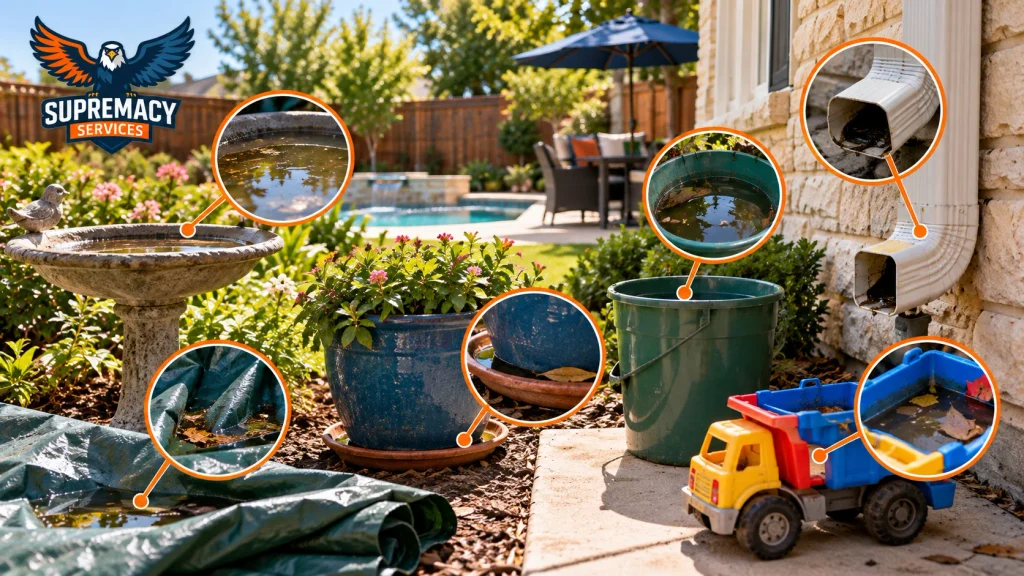
Two houses on the same DFW street can have very different mosquito pressure.
One property might contain dense shaded landscaping and several hidden water-holding containers. Another may have relatively little habitat but receive mosquitoes dispersing from surrounding properties.
Professional inspection can therefore be more useful than simply asking, “What spray should I use?”
A useful mosquito inspection should consider:
Standing water
Check flowerpot saucers, buckets, children’s toys, birdbaths, clogged drainage areas, tarps and other objects capable of retaining water.
CDC recommends checking water-holding items at least weekly.
Vegetation
Dense, shaded and humid vegetation can provide resting habitat for adult mosquitoes.
Drainage
Look for places where irrigation, rain or landscape design allows water to persist.
Neighboring habitat
Mosquitoes do not recognize property boundaries. Even a carefully maintained yard can experience mosquito activity originating nearby.
Outdoor-use areas
Patios, pools, play areas and outdoor kitchens deserve special consideration when determining where mosquito pressure is affecting the household most.
What Should Professional Mosquito Control Include?
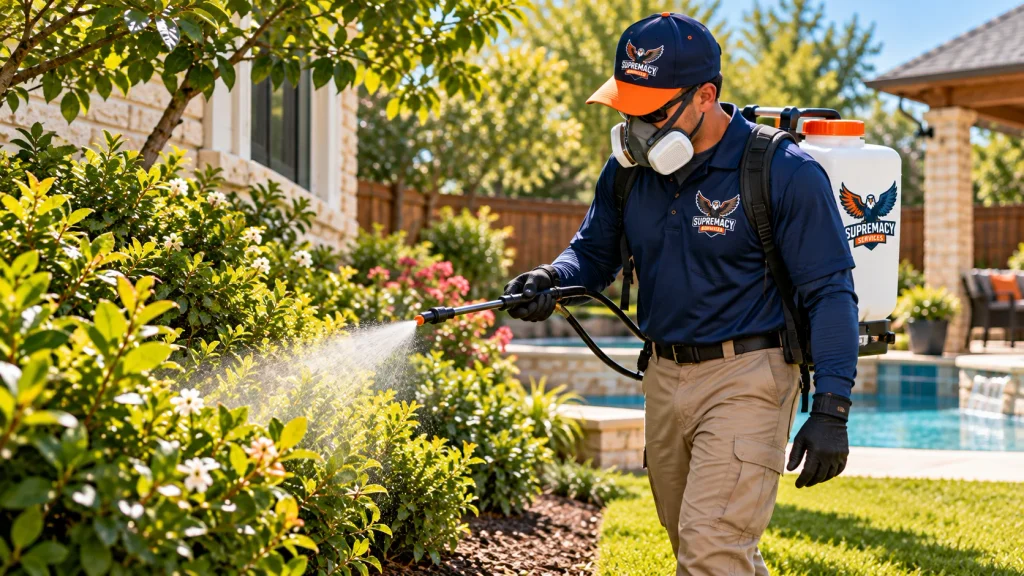
Professional mosquito control should involve more than walking through a backyard spraying pesticide.
A sound program should begin by identifying the conditions contributing to mosquito activity.
A property-specific approach may include:
- Inspect the property. Identify adult mosquito resting habitat and potential breeding areas.
- Reduce breeding sources. Empty or correct removable standing-water sources wherever practical.
- Address unavoidable water appropriately. Where water cannot be drained or removed, determine whether a labeled larvicide or another management method is appropriate.
- Identify adult resting areas. Focus attention on shaded, humid and protected habitat where mosquitoes are likely to rest.
- Apply adult mosquito treatment according to the label. Target appropriate areas rather than spraying indiscriminately.
- Protect sensitive locations. Follow label restrictions around people, pets, food, water, flowering plants and other sensitive areas.
- Reassess mosquito pressure. Persistent activity may indicate overlooked breeding habitat, reinvasion or another condition requiring adjustment.
This integrated approach aligns more closely with EPA and CDC mosquito-management principles than relying exclusively on repeated pesticide applications.
Still getting mosquitoes around your patio, pool or backyard? Supremacy Services can inspect the property and recommend a mosquito-control approach based on the conditions around your Dallas–Fort Worth home.
Automatic Mosquito Misting System vs. Barrier Treatment: Pros and Cons
| Option | Advantages | Considerations |
|---|---|---|
| Automatic misting system | Automated; convenient once installed; programmable | Installation and maintenance; permanent equipment; repeated pesticide release; nozzle placement and calibration matter |
| Professional barrier treatment | No permanent system; technician can inspect property; application can adapt to conditions | Requires recurring service when continued control is needed |
| DIY residual spray | Lower service cost; products readily available | Homeowner must identify target areas, select product and follow label correctly |
| Source reduction | Addresses mosquito breeding habitat; little or no pesticide needed for removable water | Requires regular inspection and participation |
| Integrated approach | Addresses multiple stages and causes of mosquito pressure | Requires more than one tactic |
The strongest strategy is often not choosing one row of this table exclusively.
It is combining appropriate methods.
DIY vs. Professional Mosquito Treatment
Homeowners can perform several valuable mosquito-control tasks themselves.
Good DIY mosquito prevention
Every week during periods of mosquito activity:
- empty containers holding water;
- clean birdbaths;
- turn over unused buckets and toys;
- inspect flowerpot saucers;
- check tarps and outdoor equipment;
- keep gutters and drainage pathways functioning;
- repair window and door screens;
- follow EPA guidance when choosing repellents.
Texas A&M AgriLife Extension also provides homeowner guidance covering mosquito breeding-site management, backyard foggers and residual sprays.
When professional treatment makes sense
Consider professional help when:
- mosquito activity remains high despite source reduction;
- large or densely landscaped areas are difficult to treat;
- you’re unsure where mosquitoes are coming from;
- recurring treatment is needed;
- pesticide-sensitive areas require careful application;
- you prefer not to handle concentrated pesticides or application equipment.
In Texas, businesses and individuals performing structural pest-control work for compensation are subject to Texas Department of Agriculture licensing requirements.
How to Reduce Mosquitoes Between Treatments
Whether you choose professional barrier treatments or another mosquito-control strategy, prevention remains important.
Weekly backyard mosquito checklist
- Empty containers holding rain or irrigation water.
- Scrub water-holding containers before refilling where appropriate.
- Refresh and clean birdbaths.
- Inspect flowerpots and saucers.
- Check children’s toys and outdoor equipment.
- Inspect gutters and drainage.
- Check tarps and covers for trapped water.
- Repair damaged window or door screens.
- Look for persistent wet or poorly drained areas.
- Use an EPA-registered personal repellent according to its label when appropriate.
Dallas County’s mosquito-prevention guidance similarly emphasizes repellents, protective clothing, standing-water management and reducing exposure during periods of high mosquito activity.
So, Which Is Better: A Misting System or Barrier Treatment?
For homeowners who want targeted professional mosquito management without permanently installing pesticide-release equipment, a barrier treatment is usually the more straightforward choice.
Automatic systems offer convenience, but homeowners should weigh that convenience against:
- installation;
- equipment maintenance;
- pesticide storage;
- system calibration;
- repeated applications;
- drift;
- non-target insects;
- nearby water; and
- the fact that EPA says there is insufficient research to document the effectiveness of residential automatic misting systems.
A barrier treatment also isn’t a magic shield.
The best results should come from treating the property as a mosquito ecosystem: reduce breeding habitat, manage unavoidable water appropriately, target adult resting areas when necessary and use personal protection.
That integrated approach is much closer to how EPA, CDC and Dallas County recommend thinking about mosquito management.
Want fewer mosquitoes without installing an automatic pesticide system around your property? Request a mosquito-control inspection from Supremacy Services and learn which treatment approach makes sense for your Dallas–Fort Worth yard.
Frequently Asked Questions
Are mosquito misting systems the same as mosquito barrier treatments?
No. Automatic mosquito misting systems use installed tanks, tubing and nozzles to release pesticide automatically or on command. Barrier treatments are periodically applied to selected outdoor mosquito habitat. The terms are sometimes used loosely in marketing, so homeowners should ask exactly how the treatment is delivered.
Do automatic mosquito misting systems work?
They can expose mosquitoes to insecticides, but EPA says residential misting systems have not been studied sufficiently to document their overall effectiveness for controlling yard mosquitoes. They also have not been scientifically demonstrated to prevent mosquito-borne disease transmission.
How does a mosquito barrier treatment work?
A professional applies an appropriately labeled mosquito-control product to selected outdoor areas where adult mosquitoes are likely to rest. The treatment should be combined with inspection and breeding-site reduction rather than used as the only mosquito-control tactic.
Are mosquito barrier treatments better than misting systems?
Neither method is universally better. Barrier treatments can be attractive to homeowners who want targeted professional applications without installing permanent pesticide equipment. Automatic systems primarily provide convenience and automation.
Do barrier treatments get rid of mosquito larvae?
An adult mosquito barrier application should not automatically be assumed to control larvae. Larvae develop in water and may require removal of the breeding source or an appropriately labeled larvicide.
Why do mosquitoes keep coming back after my yard is treated?
Possible reasons include overlooked breeding water, adult mosquitoes entering from surrounding properties, untreated resting habitat, weather or the need for additional mosquito-management measures.
Can I control mosquitoes without spraying my entire yard?
Yes. Source reduction is fundamental mosquito control. Removing water-holding containers and treating unavoidable breeding water appropriately can reduce mosquito development. Targeted adult mosquito treatment may then be used where necessary.
Are automatic mosquito misting systems safe around pets?
Safety depends on the pesticide, system setup and compliance with its label. EPA recommends preventing misting applications while people, pets or food are present and following all label precautions.
What is the best mosquito-control strategy for a Dallas backyard?
Start with an inspection and source reduction. Remove standing water where possible, manage unavoidable breeding sites appropriately, maintain screens and use targeted adult mosquito treatment when needed. No single mosquito-control tactic addresses every stage of the mosquito life cycle.

