

Spiders are usually attracted to North Texas homes for one main reason: the property gives them access to food and shelter. A steady supply of insects, outdoor lighting that concentrates prey, protected corners, clutter, vegetation near the structure, moisture and easy entry points can all make a home more favorable to spiders.
That does not necessarily mean your house is dirty or that every spider sighting indicates an infestation. Spiders are predators, and many species are beneficial outdoors because they feed on insects. But when you repeatedly find spiders, fresh webs or egg sacs around your Dallas-Fort Worth home, it is worth looking at what is supporting the activity, rather than only removing the spiders you can see.
Table of Contents
- What attracts spiders to a house?
- Other insects—the biggest attraction
- Outdoor lighting
- Protected hiding and web-building areas
- Clutter and stored materials
- Moisture and damp areas
- Landscaping close to the house
- Cracks, gaps and other entry points
- Seasonal and environmental changes
- Where should you look for spider activity?
- How to make your home less attractive to spiders
- DIY vs. professional spider control
- When to consider professional service
- FAQs
What Attracts Spiders to a House?
Spiders are primarily attracted to places where they can find prey and suitable shelter. Around a home, that often means insects gathering near lights, protected eaves and corners, garages and storage areas, vegetation near the structure, and openings that provide access indoors.
Think of a spider problem less as a single-pest problem and more as a small ecosystem.
If moths, flies, mosquitoes and other insects regularly gather around a porch light, a web-building spider has both a feeding opportunity and a convenient place to construct a web. If a garage has abundant insects plus stacks of undisturbed boxes, hunting and hiding spiders may find favorable conditions there as well.
Here are eight conditions worth checking around a North Texas home.
1. Other Insects—the Biggest Attraction
Spiders go where their prey is
Spiders do not enter a house because they want human food in the same way ants or cockroaches might. They are predators.
A property supporting plenty of insects can consequently support spiders that feed on those insects.
Common prey can include:
- flies;
- moths;
- mosquitoes;
- gnats;
- small crawling insects; and
- other arthropods.
This is why repeatedly killing individual spiders may have limited long-term impact. If the underlying insect activity remains unchanged, the property can continue to provide feeding opportunities.
A spider problem can therefore be an insect problem
Look beyond the spider itself.
Are insects gathering around exterior lights every evening? Are flies active around garbage containers? Are small insects appearing near windows? Is there substantial pest activity around landscaping?
Those clues can help explain why spiders repeatedly occupy the same areas.
If spiders and other insects are repeatedly appearing around your property, learn how professional [spider control in Dallas-Fort Worth] can address both active spider areas and the conditions supporting them.
2. Outdoor Lighting
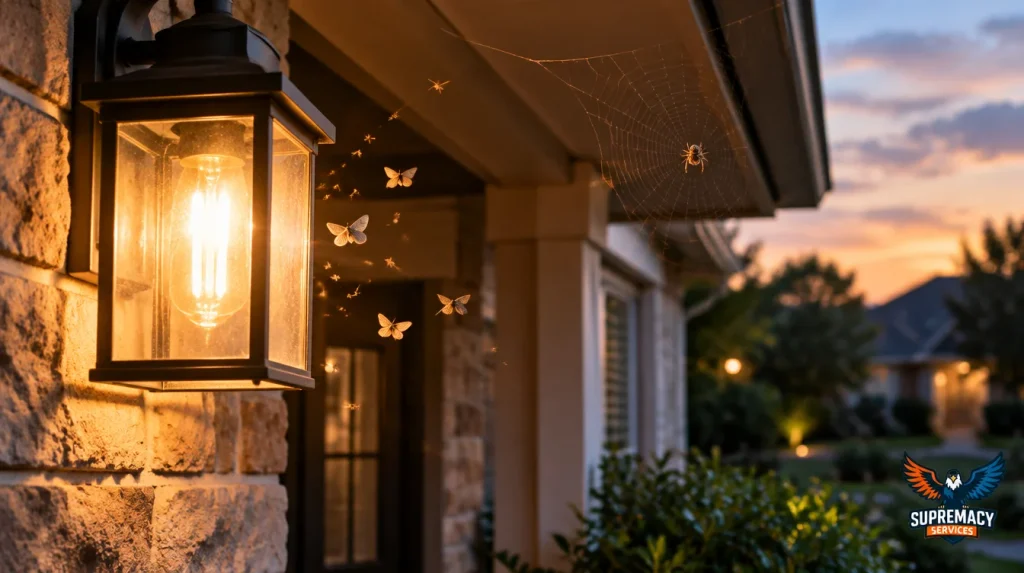
Porch and exterior lights can indirectly attract spiders
Light itself is not necessarily what the spider wants—the insects gathering around the light are the important part.
Exterior lights can concentrate flying insects around doors, windows, patios, garages and eaves. Those locations can then become productive hunting areas for spiders.
Texas A&M AgriLife Extension recommends directing outdoor lighting away from doorways where practical, switching lights off when they are unnecessary and considering yellow “bug” lights that attract fewer insects.
Check spider activity around:
| Location | Why it may become active |
|---|---|
| Porch lights | Flying insects congregate nearby |
| Garage lights | Insects plus sheltered building edges |
| Patio lighting | Prey can concentrate around outdoor living areas |
| Windows near lights | Insects may collect around illuminated glass |
| Eaves above fixtures | Protected locations for webs |
| Entry doors | Light, insects and structural gaps can occur together |
If most of your exterior webs are concentrated around lighting, reducing the insects gathering there may be more useful than repeatedly sweeping down the same webs without addressing the attraction.
3. Protected Hiding and Web-Building Areas
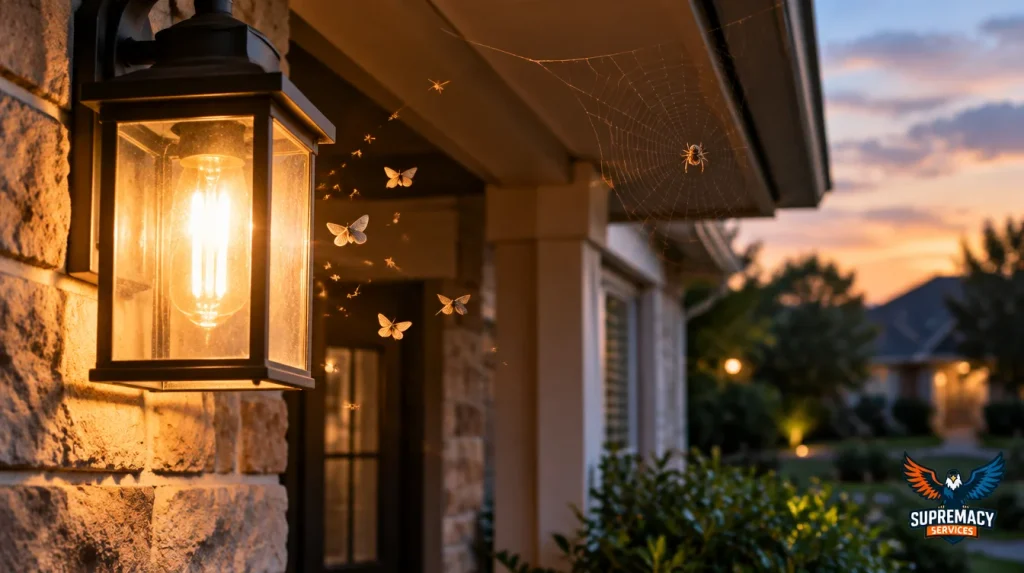
Spiders generally benefit from locations that give them protection and access to prey.
Around North Texas homes, these can include:
- eaves;
- soffits;
- porch ceilings;
- window frames;
- garage corners;
- sheds;
- outdoor furniture;
- utility areas;
- attics;
- closets; and
- other low-disturbance spaces.
Different spiders behave differently. Some construct webs and wait for prey, while others actively hunt.
That distinction helps explain why you may find one spider repeatedly building webs near an exterior light while another is encountered moving across a garage floor.
Why undisturbed areas matter
A protected corner that is rarely cleaned or disturbed can provide somewhere to remain concealed, build a web or leave an egg sac.
This is one reason regular web removal can be useful as part of spider management. Removing webs and egg cases physically disrupts favorable spider sites instead of simply waiting for activity to increase.
4. Clutter and Stored Materials
Clutter creates more hiding opportunities
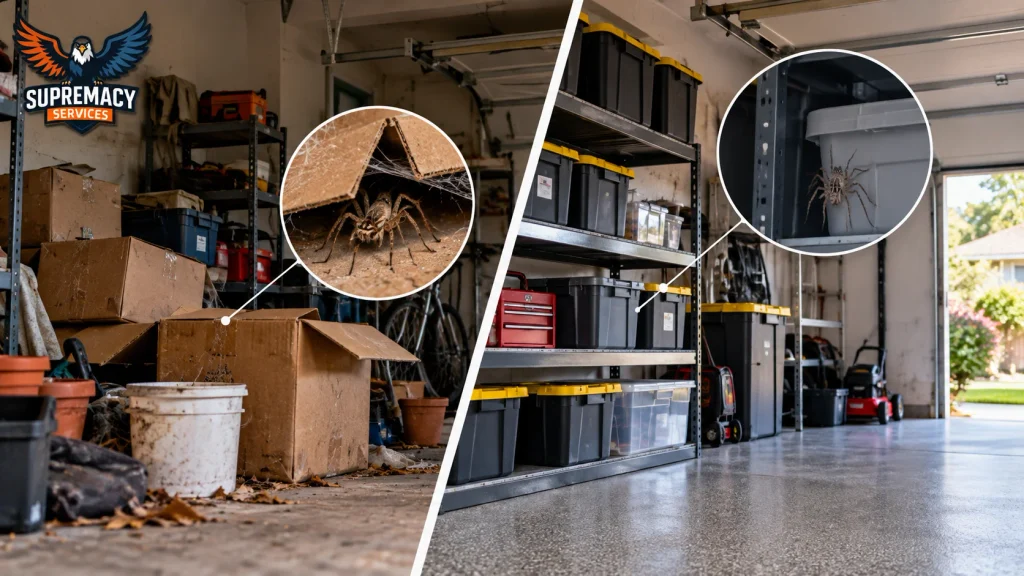
Cardboard boxes, stored equipment, unused furniture, firewood and piles of materials create numerous protected spaces.
Garages, sheds, attics and storage rooms deserve particular attention.
Instead of leaving numerous open cardboard boxes on a garage floor, consider:
- reducing unnecessary storage;
- keeping frequently used storage areas organized;
- sealing cardboard boxes securely;
- using tightly closing plastic storage containers where appropriate;
- keeping items off walls when practical so areas can be inspected; and
- checking stored items before carrying them into living spaces.
Texas A&M specifically recommends reducing clutter and sealing stored cardboard boxes, noting that tight-fitting plastic containers can also help exclude spiders.
Be especially careful when reaching into long-undisturbed storage areas. If you cannot identify a spider, avoid handling it directly.
5. Moisture and Damp Areas
Moisture can support the insects spiders hunt
A spider is not necessarily appearing beside a plumbing leak because it is directly seeking water.
The relationship can be indirect.
Damp environments can support certain insects and other arthropods, creating potential feeding opportunities for spiders. EPA pest-prevention guidance recommends eliminating pest access to food, water and shelter and repairing plumbing leaks as part of an integrated approach.
Investigate areas such as:
- beneath sinks;
- around leaking outdoor faucets;
- poorly drained areas;
- damp garages or utility spaces;
- irrigation overspray;
- plant trays;
- clogged or wet drainage areas; and
- locations where moisture-loving insects are abundant.
If spider activity is concentrated in one damp part of the house, do not stop at the spider. Look for the moisture source and the other pest activity it may be supporting.
6. Landscaping Close to the House
Dense vegetation can create a bridge between outdoor habitat and your home
Shrubs, tree branches and other vegetation immediately against a structure can create sheltered areas and bring outdoor arthropod activity close to windows, eaves and siding.
Texas A&M recommends pruning shrubs and trees that touch the house as part of spider prevention.
Pay particular attention to:
- branches touching the roof;
- shrubs pressed against exterior walls;
- dense vegetation around windows;
- groundcover immediately beside the foundation;
- stored firewood beside the house; and
- outdoor materials that remain undisturbed for long periods.
The objective is not to eliminate landscaping. It is to reduce unnecessary contact and hiding areas immediately against the structure.
7. Cracks, Gaps and Other Entry Points
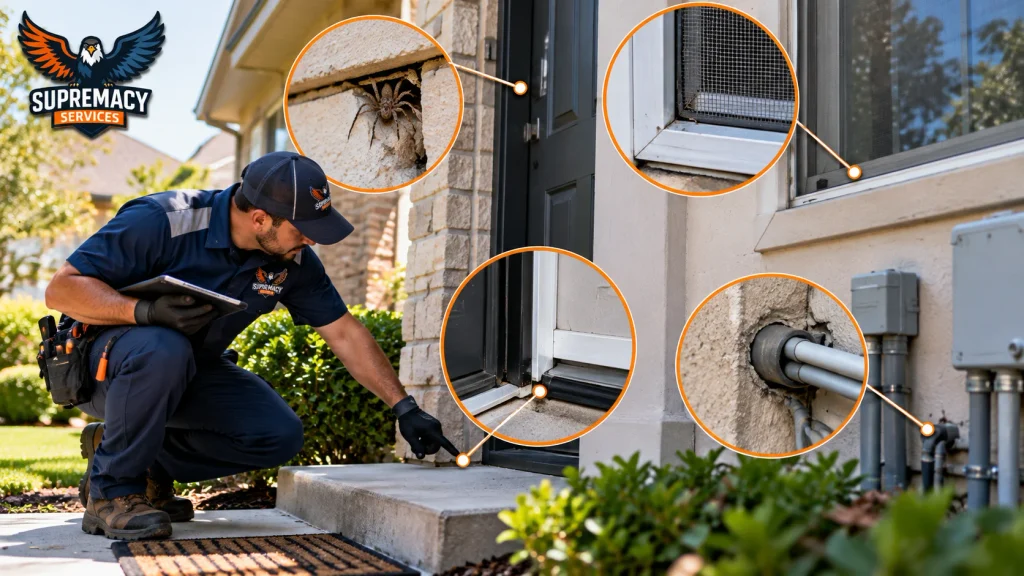
Spiders can exploit the same openings used by other small pests
Even if most spider activity begins outdoors, gaps around a house can make indoor encounters more likely.
Inspect:
- door sweeps;
- weather stripping;
- window screens;
- gaps around window and door frames;
- utility penetrations;
- cracks and crevices;
- garage-door edges; and
- other openings between exterior and interior spaces.
Texas A&M recommends repairing weather stripping around doors and windows and sealing gaps around lighted doors and windows where insects—and the spiders feeding on them—can gather.
EPA likewise recommends exclusion as part of home pest prevention.
This produces a double benefit: sealing openings can reduce spider entry while also reducing access for some of the insects spiders prey on.
8. Seasonal and Environmental Changes
A sudden spider sighting does not automatically mean a spider infestation
Outdoor conditions and prey availability change throughout the year.
Temperature, rainfall, landscaping conditions and insect activity can influence what homeowners notice around a property. Spiders that normally remain unnoticed outdoors may also wander into garages or homes.
For Dallas-Fort Worth homeowners, the better question is therefore not simply, “What month is spider season?”
Ask instead:
What changed around my property?
For example:
- Has insect activity increased around the lights?
- Has vegetation grown against the house?
- Have boxes recently been moved from storage?
- Is a door sweep damaged?
- Have new webs appeared around the same exterior areas?
- Is moisture or irrigation creating increased pest activity?
- Are spiders appearing occasionally, or repeatedly in several rooms?
Those observations are more useful for determining whether you are dealing with an occasional wanderer or conditions that are continually supporting spider activity.
Where Should You Look for Spider Activity?
Use this quick inspection checklist:
| Area | What to look for |
|---|---|
| Exterior lights | Insects, fresh webs and spiders |
| Eaves and soffits | Webbing and egg sacs |
| Window frames | Webs, insects and gaps |
| Door frames | Gaps, damaged weather stripping |
| Garage | Spiders, clutter and insect activity |
| Attic/storage | Undisturbed boxes and sheltered corners |
| Patio/porch | Webs around lights and furniture |
| Landscaping | Vegetation contacting the structure |
| Plumbing/moist areas | Leaks plus insect activity |
| Shed/firewood | Protected hiding spaces |
Finding a spider does not mean every item on this list is a problem. Look for patterns.
Several spiders repeatedly appearing around one window, for example, should prompt you to inspect the window, nearby lighting, insect activity and possible gaps together.
How to Make Your Home Less Attractive to Spiders
The most useful spider-prevention strategy is to reduce food, shelter and access rather than depending on one tactic.
Step 1: Reduce the insects spiders feed on
Investigate why flies, moths, gnats or other insects are abundant around the property.
Pay particular attention to exterior lights, waste areas, standing water and moisture problems.
Step 2: Modify unnecessary exterior lighting
Turn off lights when they are not needed and, where practical, position lighting so insects are not concentrated immediately beside doors and windows.
Step 3: Remove webs and egg sacs
Regular physical removal can disrupt web-building areas.
A vacuum can be useful indoors. For high exterior areas, use an appropriate long-handled web-removal tool rather than taking unnecessary risks on ladders.
Step 4: Reduce clutter
Organize garages, sheds, closets and storage areas.
Seal stored materials and avoid creating long-undisturbed piles.
Step 5: Seal entry points
Repair damaged screens and weather stripping. Inspect gaps around doors, windows and penetrations.
Step 6: Manage vegetation next to the structure
Trim vegetation contacting the house and move firewood or construction materials away from exterior walls.
Step 7: Correct unnecessary moisture
Repair leaks and investigate areas that remain persistently damp.
Step 8: Monitor what happens next
Spider management should be based on what you observe.
EPA’s integrated pest management approach emphasizes monitoring and correct identification before deciding what control action is appropriate.
DIY vs. Professional Spider Control
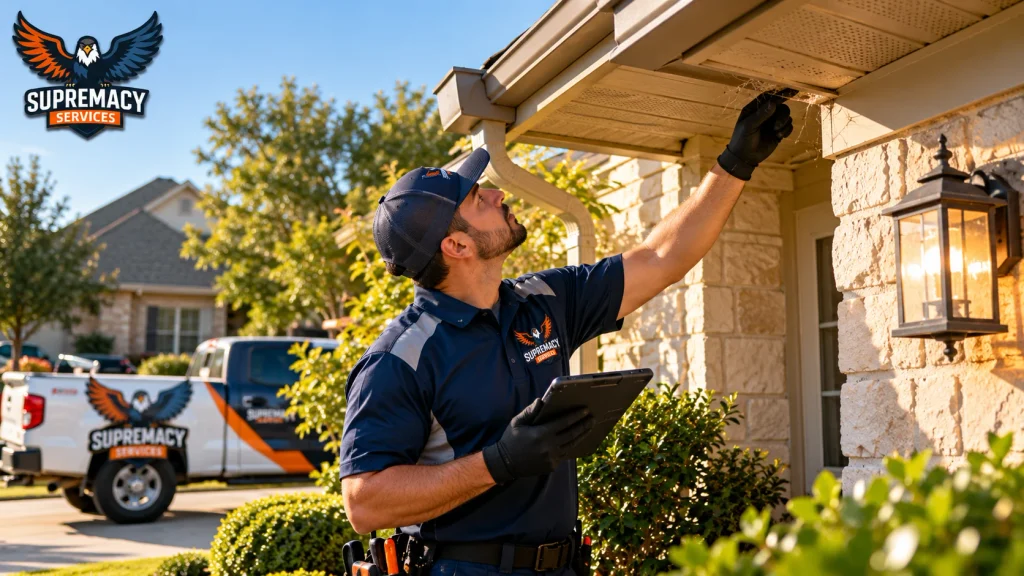
Many occasional spider problems can initially be addressed through sanitation, exclusion and physical removal.
| DIY may be reasonable when… | Professional inspection may be useful when… |
|---|---|
| You occasionally see one spider | Spiders repeatedly appear indoors |
| Activity is limited to a few exterior webs | New webs return quickly after removal |
| Entry gaps are obvious and easy to correct | You cannot determine where activity originates |
| Clutter can be easily removed | Egg sacs are appearing in multiple locations |
| Webs can be safely reached | Activity is occurring in difficult-to-access areas |
| There is no indication of a potentially medically significant spider | You suspect black widow or brown recluse activity |
| Insect activity is minor | Heavy insect activity is also present |
Be cautious with DIY pesticide use
More pesticide is not necessarily better spider management.
Texas A&M notes that sanitation and physical removal are important spider-management methods and advises homeowners to use only pesticide products labeled for the intended pest and location and to follow label directions.
EPA’s IPM guidance similarly favors combining prevention, monitoring and appropriate control methods instead of treating pesticide application as the only solution.
If web removal, exclusion and insect reduction are not stopping recurring activity, Supremacy Services can inspect the property and identify where spiders and their prey are concentrating. Explore our [DFW spider control service].
What Does Professional Spider Control Typically Address?
A professional spider-management visit should look beyond the spider sitting in plain view.
Depending on the property and activity, an inspection may evaluate:
- where spiders and webs are concentrated;
- likely harborage areas;
- egg sacs and recurring web sites;
- exterior insect activity;
- doors, windows and other potential entry points;
- eaves, soffits and roofline areas;
- garages, patios and storage areas;
- landscaping or environmental conditions supporting activity; and
- whether targeted treatment or broader pest management is appropriate.
In Texas, businesses and individuals performing structural pest control for compensation are subject to licensing requirements administered by the Texas Department of Agriculture’s Structural Pest Control Service.
Ask what the technician found, what conditions appear to be supporting the activity and what you can change around the property to help reduce recurrence.
What About Black Widows and Brown Recluse Spiders?
Most spider encounters should not automatically be treated as dangerous-spider encounters.
However, Texas homeowners should know that medically important spiders occur in the state. Identification matters because harmless spiders are frequently mistaken for species of concern.
Do not rely only on size or color to identify an unfamiliar spider.
If you repeatedly find spiders you suspect may be black widows or brown recluses, particularly around sheltered storage areas, garages or other low-disturbance locations, avoid handling them directly and consider obtaining a reliable identification.
Texas A&M AgriLife Extension provides Texas-specific spider identification and management information.
Does Seeing Spiders Mean Your House Is Dirty?
No. Seeing spiders does not automatically mean a home is dirty.
A clean home can still provide spiders with prey, access and protected locations. Outdoor lights, gaps around doors, landscaping, garages and normal insect activity can all contribute.
Cleaning and decluttering help because they reduce hiding places and make inspection easier—not because spiders are proof of poor housekeeping.
Frequently Asked Questions
What attracts spiders to your house the most?
A reliable supply of insect prey is one of the most important factors. Protected hiding or web-building locations and easy access into the structure can make a property even more favorable.
Does leaving the porch light on attract spiders?
It can contribute indirectly. Exterior lights attract many flying insects, creating feeding opportunities for spiders. Texas A&M recommends directing unnecessary lighting away from doorways and turning it off when it is not needed.
Are spiders attracted to moisture?
Moist areas can indirectly support spider activity by supporting insects and other arthropods that spiders eat. Investigate leaks or persistent dampness when spider and insect activity occur together.
Why are there spiders around my windows?
Windows can combine several favorable conditions: nearby exterior lighting, insects attracted to the glass or lights, protected frame edges and small structural gaps.
Does clutter attract spiders?
Clutter creates sheltered, low-disturbance hiding places. Reducing unnecessary boxes and stored materials makes those areas easier to inspect and less favorable for concealed activity.
Why do I keep finding spiders in my garage?
Garages can provide easy exterior access, insects, sheltered corners and stored materials. Inspect door seals, boxes, lighting and insect activity rather than focusing only on the spider itself.
Will removing spider webs get rid of spiders?
Web removal helps disrupt activity and can remove egg sacs, but recurring webs suggest that favorable conditions remain. Look for prey, shelter and nearby harborage as well.
Should I spray every spider I see?
Not necessarily. Occasional spiders can often be physically removed. EPA recommends an integrated pest-management approach based on identification, monitoring, prevention and appropriate control rather than unnecessary pesticide use.
How can I prevent spiders from entering my house?
Repair screens and weather stripping, seal gaps, reduce insects around entrances, manage exterior lighting, remove clutter and keep vegetation from contacting the structure.
When should I call pest control for spiders?
Consider professional help when spiders or webs repeatedly return, multiple spiders are appearing indoors, egg sacs are common, the source cannot be identified, insect activity is substantial, or you suspect medically significant spiders.
Reduce What Is Attracting the Spiders—not Just the Spider You See
Finding a spider in your Dallas-Fort Worth home does not necessarily mean you need an immediate treatment.
But recurring spiders usually deserve a closer look at the environment around the house.
Start with the fundamentals: prey, shelter and access.
Reduce insect activity. Reconsider lighting around entrances. Remove webs and clutter. Repair screens and weather stripping. Trim vegetation away from the structure. Correct moisture problems and monitor where activity returns.
If spiders continue appearing despite those changes, the next step is identifying the locations and conditions that are keeping the property attractive.
Final CTA:
Seeing recurring spiders, webs or egg sacs around your North Texas home? [Schedule a spider-control inspection with Supremacy Services] to identify active areas, entry points and the pest activity helping spiders stay established.

