

Mosquitoes can become especially noticeable around North Texas backyards when three things come together: water for breeding, sheltered places for adult mosquitoes to rest, and warm conditions that support mosquito activity.
The source is not always a pond or neglected swimming pool. Mosquitoes can develop in much smaller collections of water around a property. Texas health officials specifically advise homeowners to inspect buckets, plant saucers, gutters, trash containers, bird baths, pools and other places capable of holding water. Texas DSHS notes that mosquitoes can breed in very small quantities of water.
For Dallas–Fort Worth homeowners, reducing a mosquito problem therefore starts with investigating the property rather than simply spraying whichever mosquitoes happen to be flying around the patio.
Table of Contents
- Why are there so many mosquitoes in my backyard?
- What attracts mosquitoes to a North Texas yard?
- Where are mosquitoes breeding around your house?
- Why are mosquitoes worse after rain?
- Why are mosquitoes hiding in bushes and landscaping?
- How can you reduce mosquitoes in your backyard?
- DIY mosquito control vs. professional service
- What does professional mosquito control include?
- When should you call a mosquito-control professional?
- North Texas mosquito prevention checklist
- Frequently asked questions
Why Are There So Many Mosquitoes in My Backyard?
A backyard with heavy mosquito activity usually provides suitable breeding habitat, resting habitat or both.
Mosquitoes require water during their immature development. Different species use different aquatic habitats, ranging from temporary puddles and clogged drainage areas to tiny water-holding containers. EPA guidance identifies buckets, tires, toys, plant saucers, tarps and even very small containers as potential breeding locations.
Adult mosquitoes also need places to rest when they are not actively searching for hosts.
That means a yard can have two separate problems:
| Backyard condition | Why it matters |
|---|---|
| Standing water | Can provide mosquito breeding habitat |
| Clogged gutters | Can retain unnoticed water |
| Plant saucers | Small containers can hold breeding water |
| Bird baths | Water can support immature mosquitoes if neglected |
| Buckets and toys | Rainwater can accumulate unnoticed |
| Poor drainage | Can create persistent wet areas |
| Dense vegetation | Can provide sheltered adult resting areas |
| Debris and clutter | Can conceal small water-holding containers |
| Unmaintained pools | Can become potential mosquito habitat |
| Open rain barrels | Can provide protected breeding habitat |
This explains why two houses on the same Dallas street can experience very different mosquito pressure.
Property conditions matter.
What Attracts Mosquitoes to a North Texas Yard?
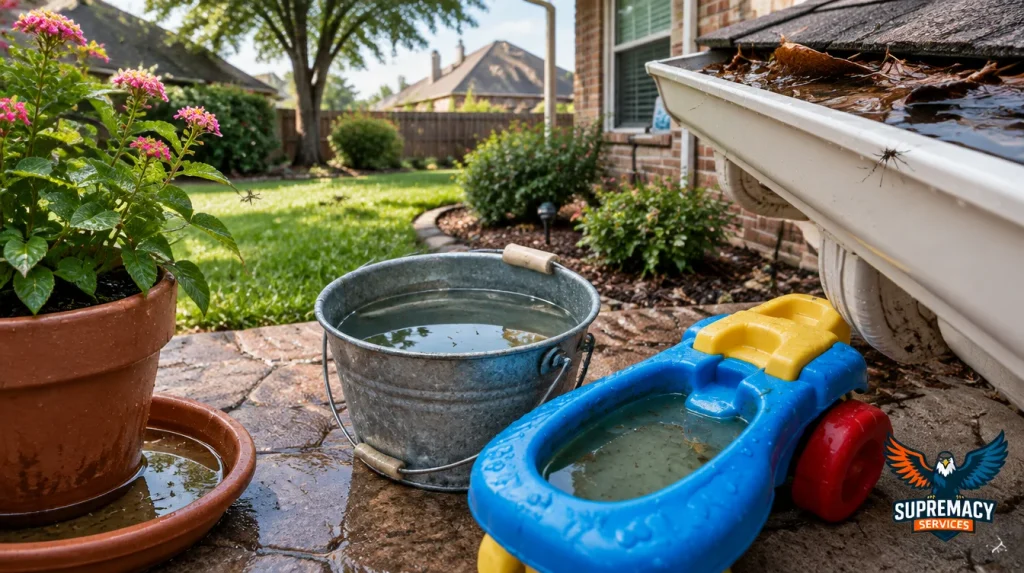
For long-term mosquito management, think less about what “attracts” a mosquito from miles away and more about what allows mosquitoes to breed, rest and remain around your property.
1. Standing Water
Standing water should be the first thing you investigate.
Dallas County Health and Human Services recommends draining standing water around homes because mosquito larvae develop in water. Its guidance specifically identifies flowerpots, kiddie pools, bird baths, ponds, gutters and other water-holding locations as areas homeowners should inspect.
Some breeding sites are obvious.
Others are remarkably easy to overlook.
Check:
- buckets;
- watering cans;
- children’s toys;
- wheelbarrows;
- tarps;
- clogged gutters;
- plant saucers;
- bird baths;
- pet-water containers;
- unused fountains;
- pool covers;
- trash-can lids;
- drainage catch points;
- rain barrels;
- discarded containers.
EPA guidance likewise recommends emptying or changing water in common backyard containers at least weekly where appropriate.
2. Clogged Gutters
Your gutters may be above eye level, but that does not make them irrelevant.
Leaves and debris can interfere with drainage and leave small pockets of standing water.
Texas DSHS specifically recommends keeping gutters clear of debris and standing water as part of mosquito prevention.
If mosquitoes seem abundant but you cannot locate water at ground level, inspect the roof drainage system.
3. Plant Saucers and Containers
A beautiful patio can accidentally contain several mosquito-development sites.
Flowerpot saucers, decorative containers and watering equipment can catch rain or irrigation water.
Because these objects are intentionally located near patios and outdoor seating, mosquitoes emerging nearby may immediately become noticeable to homeowners.
4. Bird Baths and Decorative Water Features
You do not necessarily need to remove a bird bath.
You do need to manage it.
Texas DSHS recommends changing water in bird baths several times each week, while EPA recommends routinely replacing water in outdoor containers and water features.
For water that cannot practically be emptied, an appropriately labeled larvicide may be an option.
5. Poor Yard Drainage
Look carefully after irrigation or rainfall.
Does water remain in:
- low lawn areas;
- landscape beds;
- clogged drainage channels;
- depressions beside patios;
- containers;
- drainage structures?
Persistent water deserves investigation.
The solution may sometimes be drainage or landscape correction rather than simply applying more insecticide.
Why Are Mosquitoes Worse After Rain?
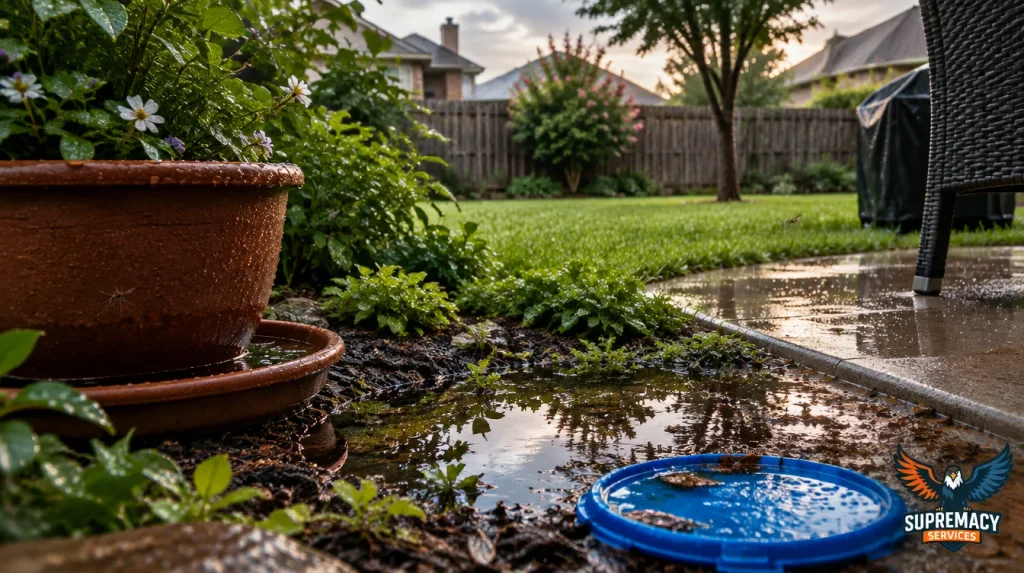
Rain can create many temporary water sources at the same time.
A storm may fill flowerpots, toys, tarps, gutters, containers and low spots throughout a neighborhood. These newly filled sites can create opportunities for mosquito development.
The important distinction is this:
Rain itself is not the backyard breeding site—the water left behind can be.
After rainfall, perform a quick inspection rather than waiting until mosquitoes become unbearable.
10-Minute Post-Rain Mosquito Check
Walk your property and:
- Dump water from movable containers.
- Check plant saucers.
- Inspect children’s toys.
- Look beneath tarps and covers.
- Check gutters and downspouts.
- Inspect wheelbarrows and garden equipment.
- Look for water sitting on pool covers.
- Check low landscape areas.
- Inspect bird baths and decorative water features.
- Look for containers hidden behind sheds, fences and landscaping.
This is one of the simplest mosquito-prevention routines a North Texas homeowner can establish.
Why Do Mosquitoes Hide in Bushes and Landscaping?
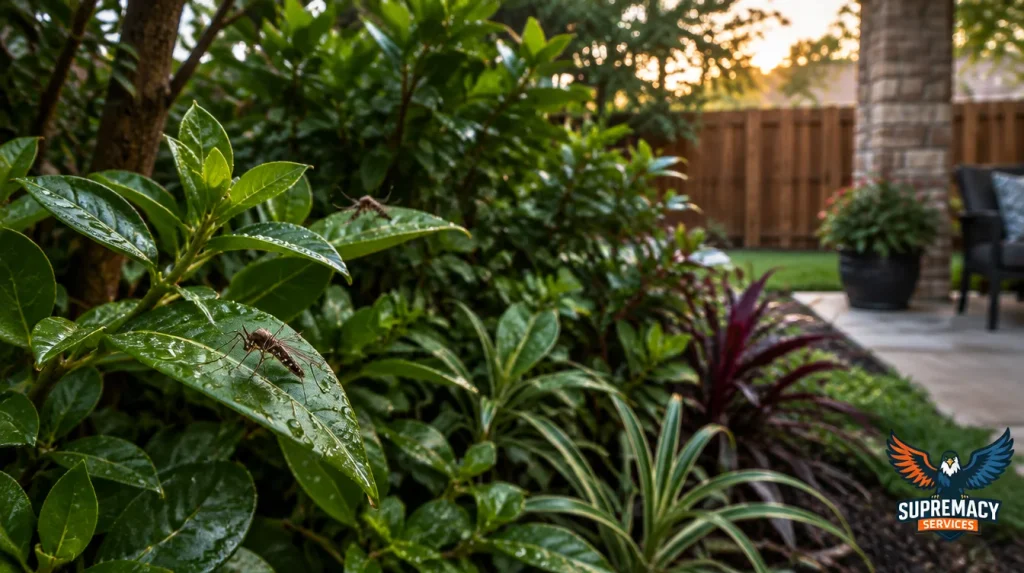
Adult mosquitoes can use shaded, protected vegetation as resting habitat.
Texas A&M AgriLife recommends reducing tall grass, brush and excessive foliage as one way of reducing adult mosquito resting areas around homes.
That does not mean landscaping itself is automatically a mosquito problem.
The concern is a yard that combines:
dense vegetation + shade + moisture + nearby breeding water.
Pay particular attention to:
- thick shrubs;
- overgrown groundcover;
- vegetation around patios;
- shaded fence lines;
- vegetation surrounding drainage areas;
- dense plants near outdoor seating.
Routine landscape maintenance can therefore be part of mosquito management.
Why Do Mosquitoes Keep Coming Back After You Spray?
Spraying adult mosquitoes without addressing breeding sites can provide an incomplete solution.
If water around the property continues producing new mosquitoes, killing some adults does not eliminate the underlying source.
EPA describes successful mosquito management as an integrated approach that can combine habitat removal, structural protection, larval control and, when warranted, adult mosquito control.
A better sequence is:
Find water → eliminate or manage breeding habitat → reduce resting habitat → protect against bites → use targeted treatment where appropriate.
This is also why indiscriminately spraying an entire yard is not the same thing as managing the conditions sustaining mosquito pressure.
Still dealing with mosquitoes after removing obvious standing water? Explore Supremacy Services’ professional mosquito-control options for Dallas and DFW properties.
Where Are Mosquitoes Breeding Around Your House?
Use this inspection checklist before assuming the problem originates somewhere else.
Patio
Check:
- plant saucers;
- decorative pots;
- furniture covers;
- umbrellas and bases;
- children’s toys;
- water-filled containers.
Lawn
Check:
- drainage depressions;
- irrigation runoff;
- forgotten containers;
- equipment capable of collecting rain.
Landscaping
Check:
- plant trays;
- decorative containers;
- dense vegetation;
- irrigation leaks;
- poorly draining beds.
Roofline
Check:
- clogged gutters;
- drainage problems;
- flat areas holding water where safely observable.
Do not climb onto a roof unless you can do so safely.
Pool Area
A properly maintained swimming pool is very different from neglected or stagnant water.
EPA advises keeping pool water treated and circulating.
Also inspect:
- pool covers;
- pool toys;
- abandoned inflatables;
- buckets;
- equipment covers.
Around the Shed or Garage
These areas frequently contain objects that homeowners rarely inspect.
Turn buckets upside down and store equipment so it cannot collect rainwater.
How Much Water Do Mosquitoes Need to Breed?
Potential mosquito habitat can be much smaller than many homeowners expect.
Texas DSHS warns that mosquitoes can breed in as little as a tablespoon of water, which is why small containers deserve attention rather than only obvious ponds or pools.
This changes how you should inspect a yard.
Do not ask only:
“Where is the big puddle?”
Ask:
“What around this property can hold water?”
That includes objects you might otherwise ignore.
How Can You Reduce Mosquitoes in Your Backyard?
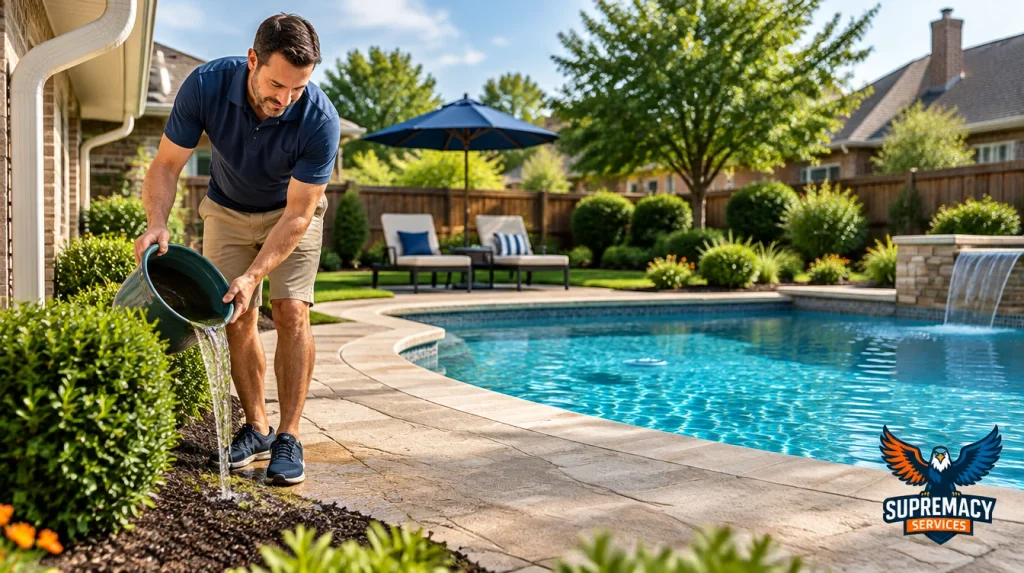
The most effective homeowner strategy begins with source reduction.
Step 1: Dump Standing Water
Walk the property at least weekly and after significant rainfall.
Empty containers that do not need water.
Texas DSHS recommends emptying or removing common water-holding containers at least weekly.
Step 2: Correct Water-Holding Problems
Some mosquito habitat cannot simply be dumped.
Examples include:
- recurring drainage problems;
- clogged gutters;
- irrigation leaks;
- low landscape areas;
- permanently installed water features.
Correct the underlying issue where practical.
Step 3: Manage Water That Cannot Be Removed
Some permanent water features require management rather than elimination.
EPA identifies Bacillus thuringiensis israelensis, commonly called Bti, as a larvicide used against developing mosquito larvae in appropriate aquatic habitats. Products must be used according to their labels and for approved sites.
Do not assume every pesticide or larvicide is appropriate for every water source.
The product label determines where and how it may be used.
Step 4: Maintain Landscaping
Reduce unnecessary dense brush and overgrowth, especially near frequently used outdoor spaces.
This can reduce protected resting areas without requiring homeowners to eliminate landscaping entirely.
Step 5: Maintain Screens
Mosquito control is not limited to the yard.
EPA recommends repairing or installing door and window screens to reduce mosquitoes entering buildings.
Step 6: Protect Yourself From Bites
When mosquito activity remains high, use an EPA-registered repellent according to its label.
EPA notes that registered repellents have undergone review of supporting safety and effectiveness data for their labeled uses.
Dallas County also recommends protective clothing and mosquito repellent as part of its mosquito-bite prevention guidance.
Do Citronella, Bug Lights and Backyard Gadgets Solve Mosquito Problems?
Some products may provide localized or temporary bite protection, but they should not distract homeowners from breeding-site management.
EPA explains that spatial repellents include products such as lanterns, torches, tabletop diffusers, candles and coils. Coverage and performance can depend on the product and environmental conditions such as wind.
A device around your patio also does not drain the clogged gutter behind your house.
If mosquitoes are being produced on the property, identify that source first.
DIY vs. Professional Mosquito Control
Many mosquito-prevention tasks belong firmly in the DIY category.
| Situation | DIY action may be appropriate | Professional evaluation may help |
|---|---|---|
| Water in buckets | Dump and store correctly | Usually unnecessary |
| Dirty bird bath | Clean/change water | Usually unnecessary |
| Clogged gutter | Clean safely | Use appropriate contractor if inaccessible |
| Plant-saucer water | Empty regularly | Usually unnecessary |
| Small manageable breeding sources | Remove/manage them | Usually unnecessary |
| Persistent heavy mosquito pressure | Continue source reduction | Yes |
| Source cannot be located | Inspect systematically | Yes |
| Large shaded yard with recurring activity | Maintain landscaping | Professional assessment may help |
| Treatment around extensive vegetation | Limited homeowner options | Professional service may be appropriate |
| Mosquitoes return despite prevention | Recheck water sources | Professional inspection may help |
What Homeowners Can Do Themselves
Homeowners can make a meaningful difference by:
- eliminating standing water;
- maintaining gutters;
- fixing drainage problems;
- maintaining pools;
- managing bird baths;
- trimming excessive vegetation;
- maintaining screens;
- using registered repellents according to label directions.
When Professional Treatment Makes More Sense
Professional service becomes more relevant when mosquito pressure remains substantial despite source reduction or when the property has extensive vegetation, difficult-to-manage habitat or recurring adult activity around outdoor living spaces.
Texas regulates mosquito-control work performed for compensation. The Texas Department of Agriculture identifies mosquitoes within the structural pest-control “Pest” category and requires appropriate licensing for nuisance mosquito-control services performed for hire.
If you’ve removed standing water but mosquitoes still make your patio difficult to use, schedule a mosquito inspection with Supremacy Services to identify likely breeding and resting zones around your property.
What Does Professional Mosquito Control Include?
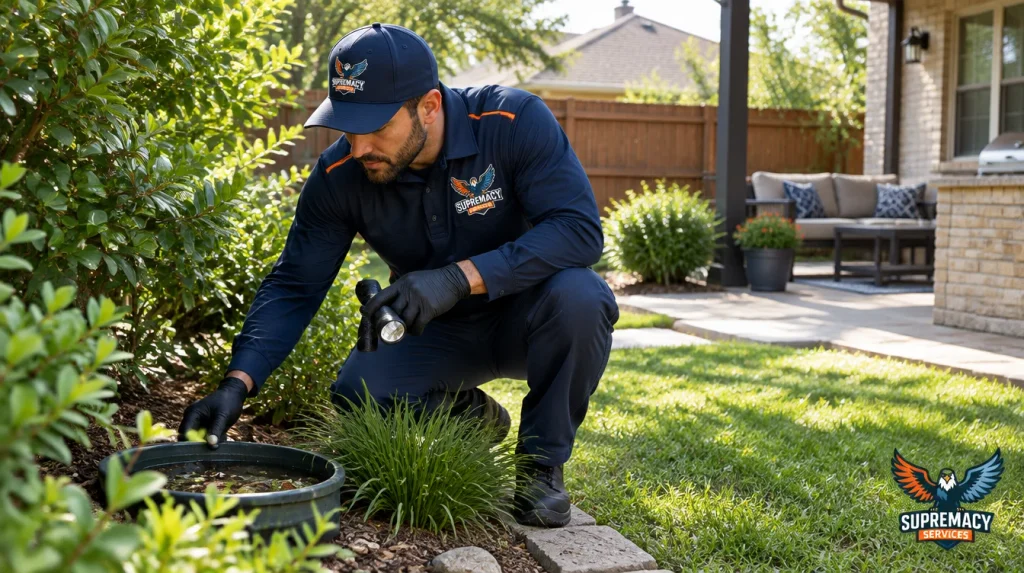
A good mosquito-management strategy should consider the property as a system rather than simply spraying open lawn.
Depending on the service and property, an assessment may examine:
- potential water-holding containers;
- drainage conditions;
- vegetation and shaded resting zones;
- patios and outdoor living areas;
- fence lines;
- pool surroundings;
- gutters or other water-retention areas;
- recurring mosquito activity;
- neighboring environmental conditions;
- appropriate treatment zones.
Supremacy’s existing mosquito service describes barrier applications targeting trees, bushes, shrubs and shady mosquito-resting areas, along with source-elimination considerations.
Treatment recommendations should be property-specific and consistent with pesticide labels and applicable Texas requirements.
Can Mosquitoes Be Coming From Your Neighbor’s Yard?
Yes, mosquito activity in your backyard does not prove every mosquito originated on your property.
Adult mosquitoes can move beyond the specific site where they developed.
That means excellent mosquito prevention on one property can reduce local breeding without creating an invisible wall around the yard.
This is why mosquito management works best when homeowners eliminate what they can control while recognizing that surrounding properties, drainage areas and neighborhood conditions may also contribute.
Do not use that possibility as a reason to ignore your own property.
Start with the breeding habitat you can eliminate.
Are Mosquitoes Just Annoying, or Are They a Health Concern in Dallas?
Mosquito prevention is not only about itchy bites.
Texas DSHS monitors mosquito-borne illnesses including West Nile virus and other diseases. In May 2026, DSHS announced Texas’s first confirmed human West Nile case of the year and again encouraged Texans to remove standing water and take precautions against mosquito bites during warmer months.
Dallas County also maintains mosquito-prevention and West Nile resources and advises residents to drain standing water, use appropriate repellents, wear protective clothing and consider mosquito activity patterns when spending time outdoors.
This does not mean a mosquito in your yard is infected.
It means bite prevention and mosquito-source reduction have a legitimate public-health purpose in addition to improving backyard comfort.
North Texas Backyard Mosquito Prevention Checklist
Every Week
- Empty unnecessary standing water.
- Inspect plant saucers.
- Refresh and clean bird baths appropriately.
- Check children’s toys.
- Inspect buckets and gardening equipment.
- Check outdoor covers and tarps.
- Maintain pools and hot tubs.
- Check pet-water containers.
- Look for irrigation leaks.
After Rain
- Walk the property.
- Dump newly collected water.
- Inspect hidden containers.
- Check drainage areas.
- Check pool covers.
- Look for clogged gutters.
- Inspect low spots.
Periodically
- Clean gutters.
- Correct persistent drainage problems.
- Trim excessive vegetation.
- Repair damaged window screens.
- Check rain barrels and water-storage containers for appropriate screening.
- Reassess areas where mosquitoes are repeatedly concentrated.
Mosquitoes vs. Other Small Flying Insects
Not every tiny flying insect around your backyard is necessarily a mosquito.
You may also encounter:
- gnats;
- midges;
- drain-associated flies;
- crane flies;
- other small flies.
Correct identification matters because different insects develop in different environments and require different management strategies.
If you’re seeing swarms but very little biting activity, identification should come before treatment.
When Should You Call a Mosquito-Control Professional?
Consider professional mosquito service when mosquitoes remain consistently heavy after you’ve eliminated accessible standing water and corrected obvious backyard conditions.
Professional assessment is particularly reasonable when:
- the backyard becomes difficult to use because of frequent biting;
- mosquito activity returns repeatedly;
- you cannot identify the source;
- the property contains extensive dense vegetation;
- water cannot easily be eliminated;
- you need help identifying breeding or resting areas;
- DIY control provides only brief relief;
- outdoor entertaining areas remain heavily affected.
The goal should not simply be “spray more.”
The useful question is:
What is allowing mosquitoes to remain around this property, and which combination of source reduction, habitat management and targeted control makes sense?
Frequently Asked Questions
Why are there suddenly so many mosquitoes in my backyard?
Rain, newly accumulated standing water, drainage problems and favorable resting habitat can all contribute to a sudden increase. Inspect the property for water-holding containers and wet areas first.
What attracts mosquitoes to my yard?
Conditions that support mosquito breeding and resting are especially important. Standing water can provide breeding habitat, while protected vegetation can provide adult resting areas.
Can mosquitoes breed in very small amounts of water?
Yes. Texas DSHS warns that mosquitoes can breed in as little as a tablespoon of water, so small containers should not be overlooked.
How often should I check my yard for standing water?
At least weekly is a practical baseline, with another inspection after significant rainfall. Texas DSHS specifically recommends emptying or removing many common water-holding containers at least weekly.
Why do mosquitoes stay around bushes?
Dense, shaded vegetation can provide protected resting habitat for adult mosquitoes. Reducing excessive brush and overgrowth can make those areas less favorable.
Will spraying my backyard eliminate mosquitoes permanently?
Not necessarily. Adult mosquito treatment does not automatically eliminate breeding habitat. Integrated mosquito management includes source reduction and, where appropriate, larval and adult control.
Do mosquitoes breed in swimming pools?
Properly treated and circulating pools are different from neglected or stagnant water. EPA recommends keeping swimming-pool water treated and circulating as part of mosquito prevention.
Can mosquitoes come from a neighbor’s property?
Yes. Adult mosquitoes can move away from their development sites, so mosquito activity on your property does not necessarily mean every mosquito originated there. You should still eliminate breeding opportunities on your own property.
What should I do if I cannot remove standing water?
Where water cannot reasonably be emptied or covered, an appropriately labeled larvicide may sometimes be used. Follow the product label carefully and make sure the product is approved for the specific application.
When should I hire professional mosquito control?
Consider professional service when heavy mosquito activity continues despite source reduction, the breeding source cannot be identified or the yard contains extensive resting habitat that requires a more comprehensive treatment strategy.
Take Back Your North Texas Backyard
A mosquito problem usually becomes easier to understand once you stop looking only at the mosquitoes flying around you and start looking at the conditions supporting them.
Walk the yard.
Find the water.
Check the gutters.
Inspect containers.
Manage dense resting areas.
Maintain screens and protect yourself from bites.
And if mosquitoes continue overwhelming your Dallas–Fort Worth outdoor space after those changes, a professional inspection can help identify the conditions you may have missed.
Mosquitoes still taking over your backyard? Request a mosquito-control assessment from Supremacy Services for a property-specific plan designed around your Dallas–Fort Worth outdoor space.

