
If your main water line is leaking, repair is usually appropriate when the damage is isolated and the rest of the pipe remains in good condition. Replacement becomes more reasonable when deterioration affects much of the line, leaks keep recurring, the pipe material is failing, or repairing one section would only postpone another failure.
For Dallas homeowners, the decision should be based on the condition of the entire service line—not simply the location of the current leak.
That distinction matters. A small, accessible break does not automatically justify replacing an entire water line. At the same time, repeatedly repairing an extensively deteriorated line can become expensive and disruptive.
This guide explains how plumbers evaluate water line repair vs replacement in Dallas, the warning signs to watch for, what influences cost, how Dallas-area conditions can affect buried pipes, and what homeowners should expect before approving either option.
Table of Contents
- Water Line Repair vs Replacement: Quick Comparison
- What Is Your Main Water Line?
- When Can a Water Line Be Repaired?
- When Should a Water Line Be Replaced?
- 7 Signs Your Water Line May Be Failing
- What Causes Water Lines to Fail in Dallas?
- Repair vs Replacement Comparison
- How Much Does Water Line Repair or Replacement Cost?
- Traditional vs Trenchless Replacement
- How a Plumber Determines Which Option You Need
- Could It Be Something Other Than the Main Water Line?
- DIY vs Professional Water Line Work
- How to Reduce the Risk of Future Water Line Problems
- FAQs
Water Line Repair vs Replacement: Quick Comparison
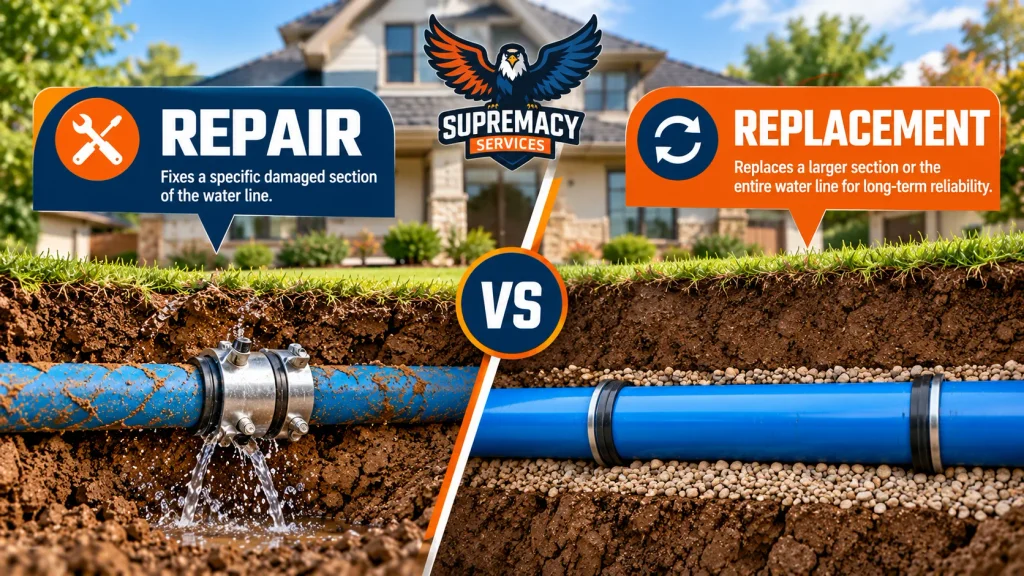
Repair fixes a specific damaged section of pipe. Replacement removes, bypasses or renews a larger portion—or all—of the failing service line.
The correct choice depends primarily on the extent of damage and the overall condition of the existing pipe.
| Situation | Repair May Make Sense | Replacement May Make More Sense |
|---|---|---|
| One isolated leak | ✓ | |
| Otherwise sound pipe | ✓ | |
| Accessible damaged section | ✓ | |
| First significant failure | ✓ | |
| Multiple previous leaks | ✓ | |
| Widespread corrosion/deterioration | ✓ | |
| Several weak sections | ✓ | |
| Obsolete or badly deteriorated material | ✓ | |
| Long-term reliability is questionable | ✓ | |
| Repair cost approaches replacement cost | ✓ |
These are guidelines rather than automatic rules. The pipe should be evaluated before deciding.
The simplest way to think about it
Ask one question:
Are you dealing with one bad section of an otherwise serviceable water line, or a bad water line that happens to be leaking in one section?
The first situation often favors repair.
The second deserves serious consideration of replacement.
What Is Your Main Water Line?
Your home’s water service line carries potable water from the municipal supply toward your home’s plumbing system.
For Dallas Water Utilities customers, the service connection has public and private portions. Dallas Water Utilities states that the utility maintains the public side and meter, while the property owner is responsible for maintaining the private portion from the meter onto the property.
That distinction is important when an underground leak develops.
If the failure is on the homeowner’s private service line, repairs may generally be the property owner’s responsibility. If you are uncertain where the problem lies, confirm the location before authorizing excavation or replacement.
When Can a Water Line Be Repaired?
A localized water line repair is generally worth considering when the plumber can isolate one damaged area and determine that the surrounding pipe remains in usable condition.
Common examples include:
- an isolated crack or split;
- damage concentrated around a fitting or connection;
- accidental physical damage;
- a localized failure without evidence of widespread deterioration;
- a relatively sound line with no history of recurring leaks.
Repairing the damaged section preserves the serviceable parts of the existing line and may reduce excavation and restoration.
One leak does not automatically mean you need a new line
A homeowner who discovers water pooling in the front yard may understandably assume the entire pipe has failed.
That is not necessarily the case.
The visible leak is only the symptom. The important question is why the pipe failed and what condition the surrounding line is in.
A plumber should determine whether the failure appears isolated before recommending a complete replacement.
If you suspect an underground service-line problem, Supremacy’s water line repair and replacement service can be used to diagnose the line and determine whether targeted repair or replacement is appropriate.
When Should a Water Line Be Replaced?
Replacement becomes more compelling when the problem is systemic rather than localized.
A complete or substantial water line replacement may deserve consideration when:
1. The line has developed repeated leaks
One isolated repair can be reasonable.
A sequence of leaks along different portions of the same aging line is different. Repeated failures can indicate that deterioration extends beyond the section currently leaking.
At that point, ask for the cost and expected outcome of both another repair and replacement.
2. Significant corrosion or deterioration is present
A repair restores one failed section. It does not restore the remaining pipe.
If inspection shows widespread corrosion, thinning, scaling or other deterioration, replacing only the visible failure can leave other vulnerable sections in service.
3. The existing pipe has multiple weak areas
The number of previous repairs matters.
A pipe containing several patched sections may eventually reach the point where continuing to repair individual failures is less attractive than renewing the line.
There is no universal number of repairs that automatically requires replacement. Condition matters more than an arbitrary threshold.
4. Water pressure problems accompany deterioration
Low pressure throughout the home can have many causes, so it should not be treated as proof of a broken main water line.
However, when testing confirms that the service line is leaking, restricted or deteriorated, pressure problems become another factor in the repair-versus-replacement decision.
5. The economics no longer favor another repair
The cheapest immediate solution is not always the least expensive long-term solution.
Homeowners should compare:
Cost of current repair + likelihood of another failure + future excavation/restoration
against:
Cost of replacement + expected condition of the renewed line
A reputable assessment should explain both options when both are technically reasonable.
7 Signs Your Water Line May Be Failing
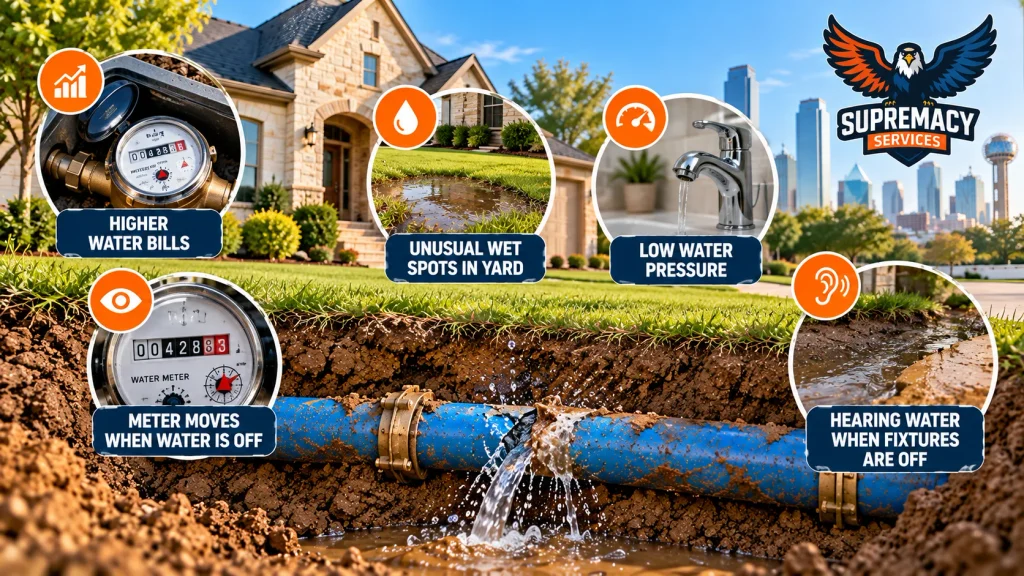
A buried water line can leak for some time before the exact location becomes obvious.
Watch for these signs.
1. Your water meter moves when everything is off
One useful homeowner test comes from EPA WaterSense.
Turn off faucets, irrigation, appliances and other water-using fixtures, note the meter reading, avoid using water for two hours, and check it again. EPA says a changed meter reading can indicate a leak.
This confirms unexplained water use; it does not tell you where the leak is.
2. Your water bill increases unexpectedly
An unusual increase in consumption without a corresponding change in household use can indicate a hidden leak.
Compare usage with previous billing periods rather than relying solely on the dollar amount, because rates and seasonal consumption can vary.
Dallas Water Utilities also maintains a leak-adjustment program for qualifying situations after repairs are completed, although the program does not reimburse plumbing repair costs.
3. Part of your yard stays unusually wet
Persistent wet or soft ground along the path between the water meter and house deserves investigation—particularly when rainfall or irrigation cannot explain it.
Do not assume every damp area is a water-line leak. Irrigation leaks and drainage problems can create similar symptoms.
4. Water pressure drops throughout the house
A single weak faucet often points toward a fixture-specific problem.
A noticeable pressure change affecting many fixtures deserves broader investigation. Possible causes include supply-line problems, valves, pressure-regulating equipment and utility-side conditions.
5. You hear water when fixtures are off
Water movement when the home should be using no water can indicate hidden consumption.
Combine this observation with a meter test rather than using sound alone to diagnose a buried line.
6. The line has already needed several repairs
Repair history is valuable diagnostic information.
Tell the plumber where previous leaks occurred, when they were repaired and whether different sections have failed. Multiple failures can change the economics of another localized repair.
7. Water appears near the meter or service-line route
Water surfacing between the meter and home may indicate a service-line problem.
Because responsibility depends on where the failure occurs, locating the leak accurately matters. Dallas Water Utilities identifies the meter and public/private portions separately.
What Causes Water Lines to Fail in Dallas?
There is rarely one universal cause. Buried service lines can fail because of pipe condition, installation, external forces or combinations of those factors.
Pipe age and deterioration
Pipe materials do not remain in identical condition indefinitely.
Corrosion, deteriorating joints and previous repairs can eventually make older sections more vulnerable.
Age by itself, however, is not enough to condemn a line. Actual condition matters.
Ground movement
North Texas homeowners should also understand soil movement.
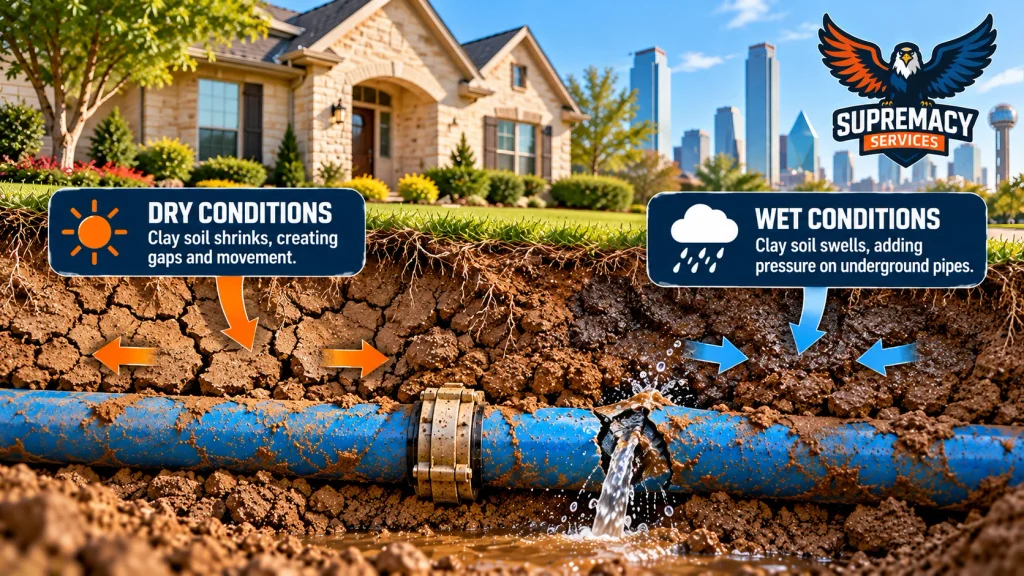
Texas A&M resources explain that clay soil can swell when wet and shrink when dry, and research on expansive soils documents damage to service piping associated with differential soil movement.
That does not mean every Dallas water-line failure is caused by clay soil. It means ground movement is a legitimate factor for a plumber to consider when investigating buried infrastructure.
Installation or connection problems
Improper bedding, poor connections, inadequate support or other installation issues can contribute to premature failures.
The failure pattern should be evaluated rather than simply replacing the visibly broken fitting.
Physical damage
Excavation, landscaping and construction work can damage buried lines.
Before digging around underground utilities, proper utility-location procedures should always be followed.
Corrosion
Metallic piping may deteriorate through corrosion depending on the material and conditions surrounding the pipe.
Where corrosion is widespread rather than concentrated at one fitting, replacement can become more practical than repeated patches.
Unusual pressure conditions
Water pressure can contribute to stress on plumbing components, but homeowners should not assume high pressure caused a leak without testing.
Pressure should be measured as part of the diagnosis when appropriate.
Repair vs Replacement Comparison
| Factor | Targeted Repair | Water Line Replacement |
|---|---|---|
| Scope | Failed section | Large section or complete private service line |
| Best suited for | Localized damage | Widespread or recurring problems |
| Initial project size | Usually smaller | Usually larger |
| Excavation | Often limited | Depends on route and method |
| Existing pipe remains | Mostly yes | Much less or none |
| Addresses widespread deterioration | No | Yes |
| Future leak risk | Depends on remaining pipe | Reduces dependence on deteriorated original line |
| Decision should depend on | Local condition | Whole-line condition |
Which option lasts longer?
That question cannot be answered responsibly without knowing the condition of the original pipe.
A correctly performed repair can solve an isolated defect. But it cannot make the unrepaired portions of an old, deteriorated line new.
Replacement addresses a larger portion of that risk, but it also involves a larger project.
The goal should therefore be the least invasive solution that reliably addresses the actual condition of the line—not automatically the smallest repair or the largest replacement.
How Much Does Water Line Repair or Replacement Cost?
There is no responsible single price for a Dallas water line repair or replacement without knowing the site conditions.
Costs can change substantially based on:
- length of damaged pipe;
- repair versus complete replacement;
- pipe material and diameter;
- depth;
- accessibility;
- leak-location work;
- excavation requirements;
- driveway, sidewalk or patio crossings;
- landscaping;
- replacement method;
- permit and inspection requirements;
- restoration after excavation.
A 2026 Dallas cost guide from Angi provides market estimates for main water-line repairs, but those figures should be treated as third-party planning estimates rather than Supremacy pricing or a guaranteed local quote.
Why replacement can cost more upfront
Replacement normally involves more pipe, labor and site work than repairing one localized failure.
But initial price is only part of the decision.
If a deteriorated line has already failed repeatedly, homeowners should compare the cumulative cost of additional repairs with replacing the vulnerable line.
Get repair and replacement options in writing
The Texas State Board of Plumbing Examiners recommends obtaining written estimates and making sure homeowners understand exactly what work will be performed. The Board also notes that it does not regulate the prices plumbers charge.
For a significant water-line project, a useful proposal should identify:
- what was found;
- where the damage is;
- repair scope;
- proposed replacement scope, if applicable;
- pipe material;
- excavation or trenchless method;
- restoration responsibilities;
- permit considerations;
- warranty terms;
- total quoted price.
That makes competing proposals easier to compare accurately.
Traditional vs Trenchless Water Line Replacement
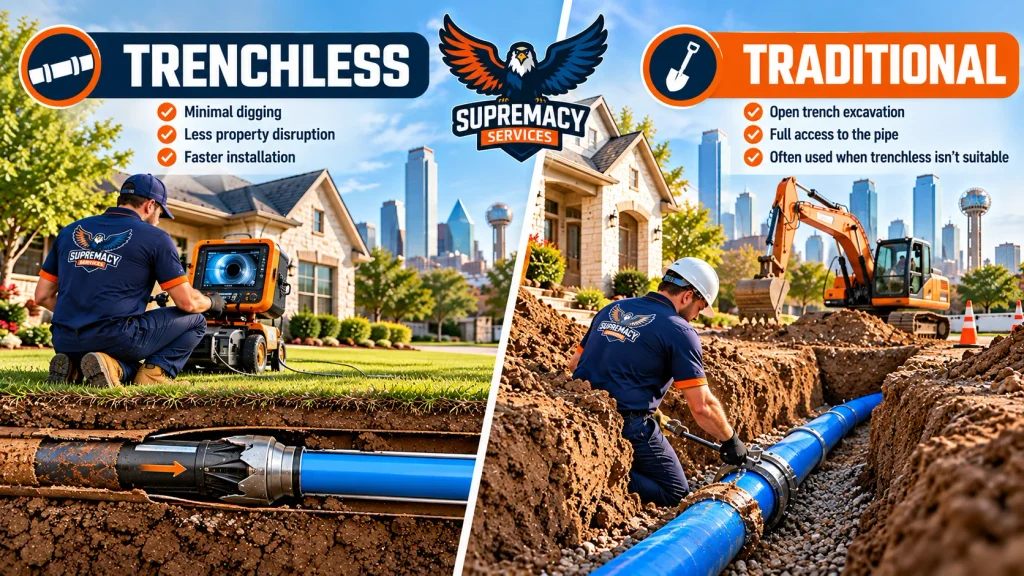
Water line replacement does not always mean opening a continuous trench across the entire yard.
Depending on the existing line, route, pipe condition and site, trenchless methods may reduce the amount of surface excavation required.
Supremacy’s current water-line service identifies both traditional excavation and trenchless options, including pipe bursting, where feasible.
Traditional excavation
Traditional replacement exposes the pipe by excavation.
It may be appropriate when:
- the damaged line is readily accessible;
- the route needs to change;
- trenchless installation is unsuitable;
- the existing line or surrounding conditions prevent trenchless work.
The plumbing cost should be considered alongside surface restoration if landscaping, paving or other improvements must be disturbed.
Trenchless replacement
Trenchless approaches can reduce surface disruption by using limited access points instead of opening the entire route.
However, trenchless is an option, not an automatic solution.
A plumber must evaluate whether the existing pipe, route, connections and surrounding utilities make the proposed method suitable.
How a Plumber Determines Which Option You Need
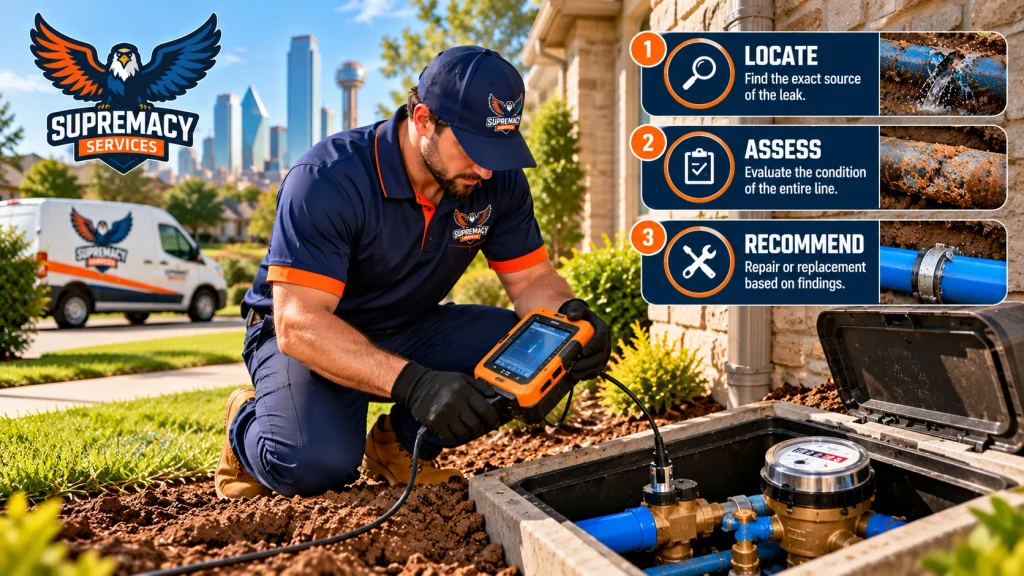
A repair-versus-replacement recommendation should follow diagnosis—not precede it.
A typical evaluation may involve the following steps.
Step 1: Confirm that a leak exists
The plumber reviews symptoms, water use and meter behavior and performs appropriate testing.
Step 2: Determine where the leak is
Locating the failure helps distinguish an underground service-line problem from an interior supply leak, irrigation issue or utility-side problem.
If the source remains unclear, professional water leak detection can help narrow down the problem before excavation.
Step 3: Evaluate the pipe condition
The plumber considers:
- material;
- visible deterioration;
- previous repairs;
- type of failure;
- surrounding conditions;
- pressure where relevant;
- accessibility.
Step 4: Identify whether the failure is isolated
This is the key repair-versus-replacement question.
If evidence points toward one isolated defect in otherwise serviceable piping, repair may be sufficient.
If deterioration appears broader, replacement deserves consideration.
Step 5: Compare viable repair methods
Ask whether the proposed approach is:
- localized repair;
- partial replacement;
- full service-line replacement;
- traditional excavation;
- trenchless replacement.
Step 6: Compare total project consequences
Do not compare plumbing prices in isolation.
Ask what happens to:
- lawn;
- irrigation;
- landscaping;
- sidewalks;
- patios;
- driveway areas;
- access points.
The least expensive plumbing proposal can become less attractive if it creates substantial restoration work.
Step 7: Pressure-test and verify the completed work
After repair or replacement, the system should be appropriately tested and inspected as required for the work performed.
Could It Be Something Other Than the Main Water Line?
Yes.
Several problems can mimic a main water-line failure.
Irrigation leak
Wet ground or unexplained water use can originate from an irrigation system rather than the home’s domestic water service.
Interior plumbing leak
A leaking supply pipe behind a wall or beneath the home can also cause unexplained meter movement.
Supremacy has a separate water leak detection service focused on identifying difficult-to-locate leaks.
Fixture leak
Running toilets and leaking faucets can waste significant amounts of water without any underground service-line failure.
EPA recommends checking fixtures as part of household leak detection.
Sewer line problem
A water service line and sewer line perform completely different jobs.
The water line delivers pressurized potable water to the home.
The sewer line carries wastewater away.
Recurring drain backups, widespread slow drains and sewage odors point toward drainage or sewer investigation rather than automatically toward the incoming water service.
Utility-side problem
Pressure or service issues can sometimes originate upstream of the homeowner’s private line.
Before undertaking a major replacement, the location and ownership of the affected section should be established.
DIY vs Professional Water Line Work
Homeowners can perform basic observations safely:
- monitor water bills;
- check the water meter;
- look for unexplained wet areas;
- note pressure changes;
- document previous repairs;
- turn off fixtures and check for unexplained consumption.
Those steps can help establish whether further investigation is needed.
Excavating and repairing a buried water service line is different.
Texas regulates plumbing work and plumbing professionals. The Texas State Board of Plumbing Examiners advises consumers to verify the Responsible Master Plumber associated with a plumbing company and to check with the local municipality regarding permit and inspection requirements.
For a buried supply line—particularly around other underground utilities, pavement or a municipal connection—professional diagnosis and code-compliant work are appropriate.
Dallas Permits, Responsibility and Water-Leak Adjustments
Three local considerations are worth checking before work begins.
Know which portion of the line belongs to you
Dallas Water Utilities states that property owners maintain the private portion of the service line from the meter onto their property, while DWU maintains the public portion and meter.
Confirm permit requirements for your project
Requirements depend on the work being performed and jurisdiction.
The Texas State Board of Plumbing Examiners specifically recommends checking with the local municipal plumbing inspection department to determine whether the proposed work requires a permit and inspection.
DFW homeowners outside Dallas should check their own municipality rather than assuming Dallas requirements apply.
Keep documentation after a qualifying leak
Dallas Water Utilities operates a leak-adjustment program for qualifying water leaks that substantially increase consumption. DWU requires repair information, and the program is intended to adjust eligible water consumption charges—not reimburse plumbing repair expenses.
Keep invoices and repair documentation.
How to Reduce the Risk of Future Water Line Problems
Not every buried-pipe failure is preventable, but early detection can limit wasted water and help identify problems sooner.
Monitor your water consumption
Unexpected changes deserve investigation.
Compare similar billing periods rather than waiting for visible water to appear.
Learn where your shutoff valve is
Knowing how to stop water flow can be valuable during a significant plumbing emergency.
Do not wait for a burst pipe to locate the valve.
Use your water meter as a diagnostic tool
The meter can provide one of the simplest clues that water is flowing when it should not be.
EPA WaterSense recommends comparing readings during a period when no water is being used.
Consider leak-monitoring technology
EPA notes that leak-detection and flow-monitoring devices can identify unusual water-use patterns, alert homeowners to moisture and, depending on the system, potentially activate a shutoff valve.
Keep records of previous underground repairs
Record:
- repair date;
- location;
- pipe material;
- cause if established;
- section replaced;
- contractor;
- warranty information.
If another failure occurs, that history helps determine whether you are dealing with an isolated problem or a pattern.
Questions to Ask Before Approving Repair or Replacement
Before authorizing a major project, ask:
- Where exactly is the failure?
- Is it on my private service line?
- What caused the failure?
- Is the problem isolated or widespread?
- What condition is the remaining pipe in?
- What material is currently installed?
- Have other sections been repaired?
- Can this section reasonably be repaired?
- What would justify replacing the entire line?
- Are both traditional and trenchless options feasible?
- What surfaces must be disturbed?
- Who handles restoration?
- Are permits or inspections required?
- What warranty applies to the proposed work?
A contractor should be able to explain why the recommended scope is appropriate.
Frequently Asked Questions
Is it better to repair or replace a water line?
Repair generally makes sense for an isolated failure in an otherwise serviceable pipe. Replacement becomes more reasonable when deterioration is widespread, leaks recur or the remaining pipe has a high risk of additional failure.
How do I know if my main water line needs replacing?
Repeated leaks, widespread corrosion or deterioration, several previous repairs and evidence that multiple sections are failing can all support replacement. Diagnosis of the overall line condition should come before the decision.
Can a leaking underground water line be repaired?
Yes. Many isolated underground water-line leaks can be repaired without replacing the entire service line. The suitability of repair depends on the location, cause and condition of the remaining pipe.
Does one water-line leak mean I need replacement?
No. One leak does not automatically mean the entire line is bad. An isolated damaged section may be repairable if the rest of the pipe remains in acceptable condition.
How many leaks are too many before replacing a water line?
There is no universal number. Two leaks in an otherwise healthy line may represent a different situation from two leaks caused by widespread deterioration. Consider the pipe’s condition, material, repair history and cost of future access rather than relying on a fixed number.
Can you replace a water line without digging up the whole yard?
Sometimes. Trenchless methods such as pipe bursting can reduce excavation for suitable projects. Whether trenchless replacement is possible depends on the existing pipe, route, connections, access and surrounding utilities.
Who is responsible for the water line from the street to my Dallas home?
Dallas Water Utilities states that the utility maintains the public portion and meter, while property owners are responsible for the private service-line portion extending from the meter onto their property.
Can I determine whether I have a leak using my water meter?
Yes. EPA recommends recording the meter when no water is being used and checking it again after two hours. A changed reading indicates water is being used somewhere, although further diagnosis is needed to locate the source.
Should I get another opinion before replacing a main water line?
For a significant replacement project, understanding the diagnosis, proposed scope and written estimate is sensible. The Texas State Board of Plumbing Examiners recommends obtaining estimates and ensuring warranties and costs are documented in writing.
Need Help Deciding Between Water Line Repair and Replacement?
The right answer is not automatically “repair” or “replace.”
It depends on where the failure occurred, why it happened, the condition of the remaining service line, previous leak history, accessibility and the long-term economics of each option.
If your Dallas or DFW home has unexplained water use, low pressure, a wet yard or a suspected underground leak, Supremacy Services can inspect the problem and determine whether a localized repair, partial replacement or complete water-line replacement is appropriate.
Schedule a water line inspection with Supremacy Services to identify the problem before deciding how much pipe actually needs to be replaced.

