
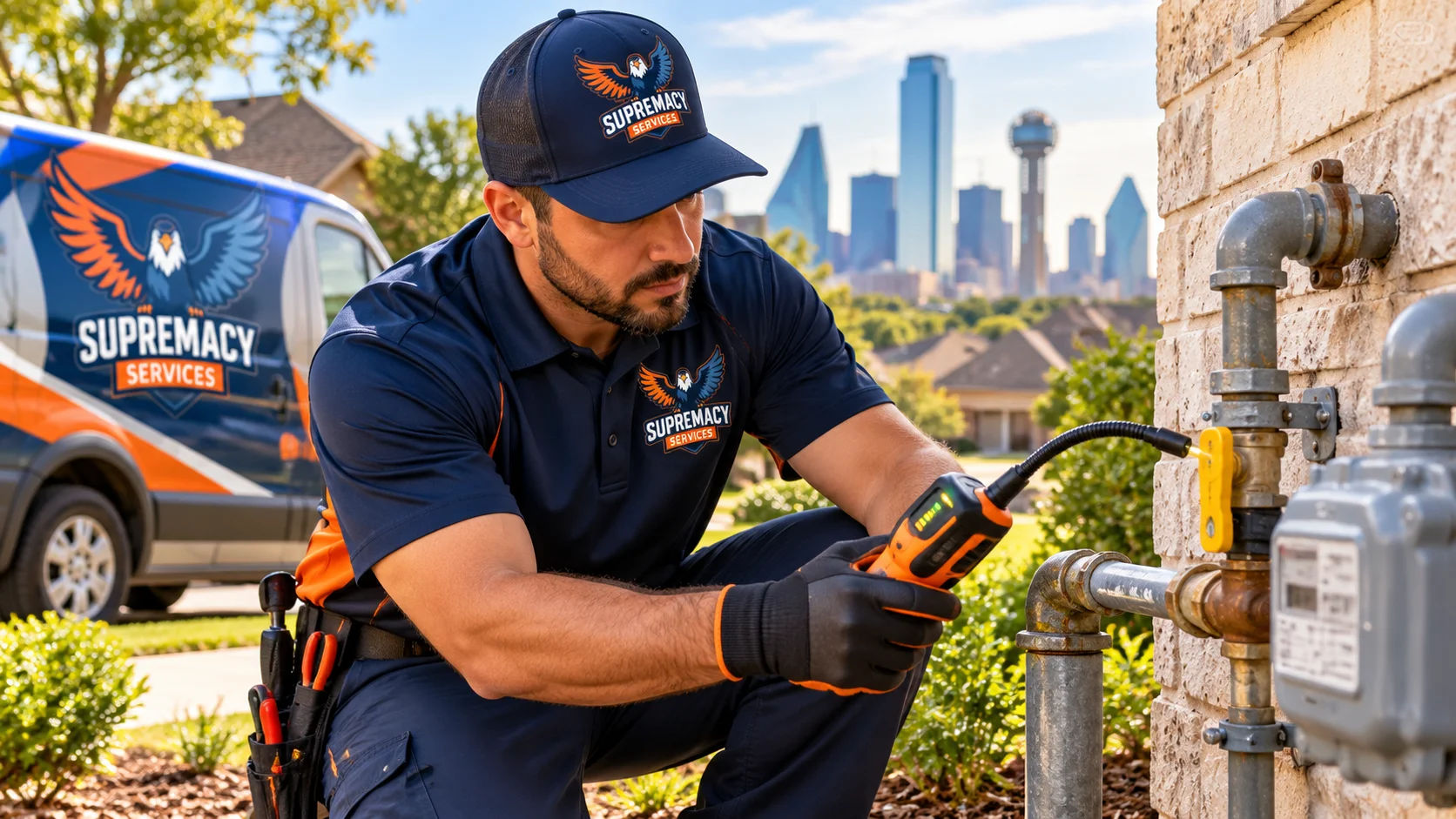
Gas line repair costs in Dallas can range from a relatively modest repair at an accessible fitting to several thousand dollars when buried piping, multiple leaks or extensive replacement is involved. Recent published DFW contractor pricing guides put simple repairs broadly in the $250–$1,200 range, while larger buried-line repairs and whole-home replacement can run into the thousands. These figures should be treated as market planning ranges, not Supremacy Services pricing.
The biggest cost factors are where the leak is located, how much piping must be repaired, whether the pipe is underground or concealed, accessibility, testing requirements, permits and whether the existing gas system can safely be repaired or needs partial or complete replacement.
More importantly, a suspected natural gas leak is a safety issue before it is a pricing question.
If you smell natural gas, leave the area immediately. Do not try to locate the leak yourself or operate switches, phones or anything that could create a spark while inside the affected area. From a safe location, call 911 and your gas utility. Atmos Energy lists its 24-hour emergency number as 866-322-8667.
Table of Contents
- How Much Does Gas Line Repair Cost in Dallas?
- Gas Leak Detection Costs
- What Affects Gas Line Repair Cost?
- Signs You May Have a Gas Leak
- What to Do If You Smell Gas
- Repair vs. Replacement
- How Professionals Find Gas Leaks
- Dallas Permits and Gas Testing
- What Professional Gas Line Repair Includes
- DIY vs. Professional Repair
- How to Reduce Future Problems
- Frequently Asked Questions
How Much Does Gas Line Repair Cost in Dallas?
Dallas homeowners should expect gas line costs to vary substantially according to the location and extent of the problem. An exposed leaking connection may require a relatively limited repair, while an underground leak or deteriorated system can require excavation and substantial pipe replacement.
There is no responsible flat price that applies to every property.
Published 2026 DFW market guides provide useful planning ranges:
| Type of work | Approximate DFW market planning range |
|---|---|
| Basic gas leak testing | $150–$450 |
| Accessible single-point repair | $250–$1,200 |
| More extensive/buried leak repair | $1,200–$3,500+ |
| New line to an appliance | Roughly $400–$2,000+ |
| Extensive/whole-home replacement | Roughly $3,500–$10,000+ |
Important: These are third-party market estimates rather than Supremacy Services quotes. Actual pricing depends on the specific property, diagnostic findings, pipe length and diameter, accessibility, materials, permits, inspections and repair method.
That distinction matters because two homes with what appears to be the same gas odor can have completely different problems. One might have a leaking accessible fitting near an appliance; another could have a leak somewhere along a buried yard line.
A proper inspection should determine the problem before the homeowner is asked to choose between repair and replacement.
Is gas leak detection included in the repair price?
Not necessarily.
Companies structure diagnostic and repair pricing differently. Some include testing in a repair package, while others price leak detection, pressure testing, excavation and repairs separately.
Ask for an itemized explanation of what the estimate includes, particularly:
- diagnostic or service-call charges;
- pressure testing;
- electronic leak detection;
- excavation or access work;
- replacement pipe and fittings;
- labor;
- permit fees;
- required inspections;
- restoration of walls, flooring or landscaping;
- final testing; and
- coordination required before gas service can be restored.
If testing confirms a problem on your home’s gas piping, learn about Supremacy Services’ Dallas gas line repair and replacement service before deciding whether a localized repair or a larger replacement is appropriate.
How Much Does Gas Leak Detection Cost?
Gas leak detection in Dallas can range from a basic inspection of accessible piping to a more involved investigation requiring pressure testing, electronic detection and isolation of different branches of the gas system.
Recent Dallas-area published pricing examples generally place basic or standard detection in the low hundreds of dollars, with complex systems costing more.
The price can increase when a property has:
- numerous gas appliances;
- multiple piping branches;
- underground gas lines;
- detached structures;
- outdoor kitchens;
- pool heaters;
- generators;
- inaccessible piping;
- intermittent leaks; or
- multiple suspected leak locations.
A homeowner should distinguish between emergency utility leak response and a plumber’s subsequent diagnostic and repair work.
If you smell gas, do not remain in the property searching for the source simply to avoid a diagnostic charge.
What Affects Gas Line Repair Cost?

The largest cost variables are repair scope, location, accessibility, pipe condition, line length, excavation and code/inspection requirements.
1. Location of the leak
A fitting that can be reached directly is usually less complicated to repair than piping underneath a slab, behind finished construction or underground.
Accessibility affects both diagnosis and labor.
2. Amount of damaged piping
A localized defect may allow a section of pipe or fitting to be replaced.
If testing reveals deterioration or leakage at several locations, repeatedly repairing individual points may make less sense than replacing a larger portion of the system.
3. Underground vs. exposed piping
Buried lines can add costs for:
- locating the line;
- excavation;
- protecting nearby utilities;
- trenching or boring;
- approved underground piping systems;
- backfilling; and
- landscape or hardscape restoration.
Homeowners should also remember that excavation around utilities carries its own safety requirements.
4. Pipe length and diameter
A longer replacement naturally requires more material and labor.
Diameter matters as well because gas piping must be sized for the connected appliance load and system configuration rather than simply matched by appearance.
This becomes particularly relevant when adding equipment such as a tankless water heater, generator, range, pool heater or outdoor kitchen.
5. Number of gas appliances
A property with a furnace and water heater has a simpler gas distribution layout than a property also supplying fireplaces, cooktops, dryers, pool equipment, generators and outdoor appliances.
More branches can make isolation and leak diagnosis more involved.
6. Pipe condition
The visible leak may not always be the only issue.
A professional may recommend evaluating more of the system when testing suggests multiple leakage points or broader deterioration.
That does not automatically mean the entire house needs repiping. The decision should be based on the condition and test results of the actual system.
7. Access and restoration
Opening a wall, excavating a yard or reaching piping in a difficult crawlspace can add labor.
Before approving the project, ask whether the quoted price includes restoring any surfaces disturbed during access.
8. Permit and inspection requirements
Dallas has specific requirements for fuel-gas work and testing. Depending on the circumstances, permit and inspection requirements can therefore become part of the project’s total cost and timeline.
What Are the Warning Signs of a Gas Leak?
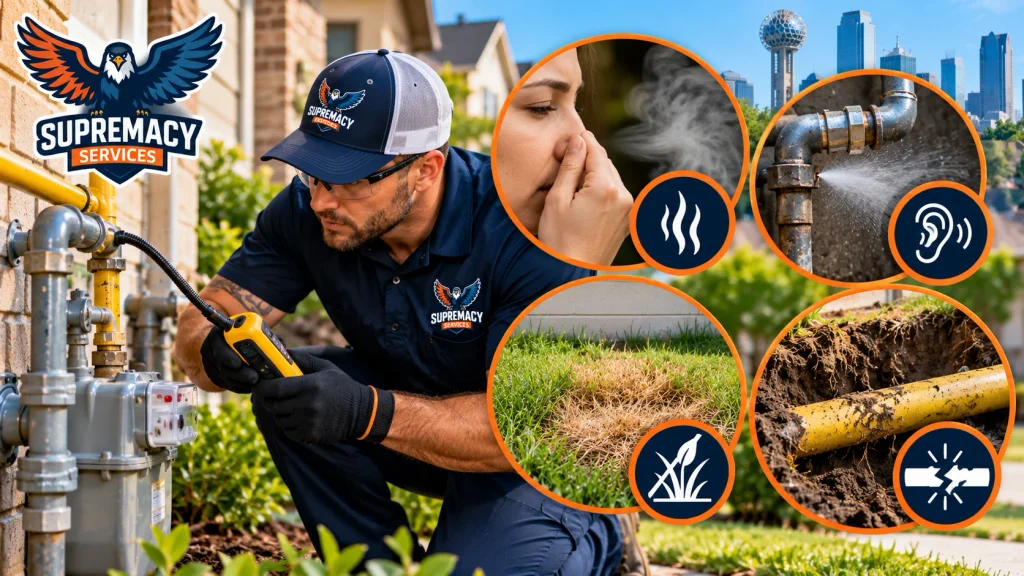
A sulfur-like or rotten-egg odor, unusual hissing, blowing dirt or unexplained dead vegetation near buried piping can indicate a natural gas leak.
PHMSA identifies smell, sound and visible environmental changes among the ways a pipeline release may be recognized.
Potential warning signs include:
- a distinctive sulfur or rotten-egg-type odor;
- hissing or roaring near gas piping;
- blowing dirt near an underground line;
- continuous bubbling in standing water;
- dead or discolored vegetation in an otherwise healthy area; or
- visible damage to gas piping or the meter area.
Natural gas itself is odorless. Gas distribution systems use odorant to make leaks easier to recognize.
However, absence of an odor should not be treated as proof that there is no leak. PHMSA notes that odor is not always a reliable detection method in every situation.
What about a high gas bill?
Unexpected consumption can justify further investigation, but a high bill alone does not prove that the gas piping is leaking.
Weather, heating demand, appliance usage and billing-cycle differences can also affect consumption.
If increased usage occurs alongside an odor, damaged piping or another warning sign, treat the safety concern seriously.
What Should You Do If You Smell Natural Gas?

Leave the affected area immediately and contact emergency services and your gas utility from a safe location. Do not remain inside trying to identify where the smell originates.
Atmos Energy’s guidance says customers who smell natural gas should leave immediately and, from a safe distance, call 911 and Atmos Energy at 866-322-8667.
While in the affected area, do not:
- switch lights on or off;
- use a phone;
- smoke;
- light matches or candles;
- operate equipment that may create a spark;
- start or stop a nearby vehicle; or
- attempt to locate or repair the leak yourself.
Do not treat an emergency gas odor as a normal plumbing appointment.
Once the immediate emergency has been addressed and the property is safe to evaluate, a qualified plumbing professional can diagnose and repair customer-owned piping where appropriate.
Gas Line Repair vs. Replacement
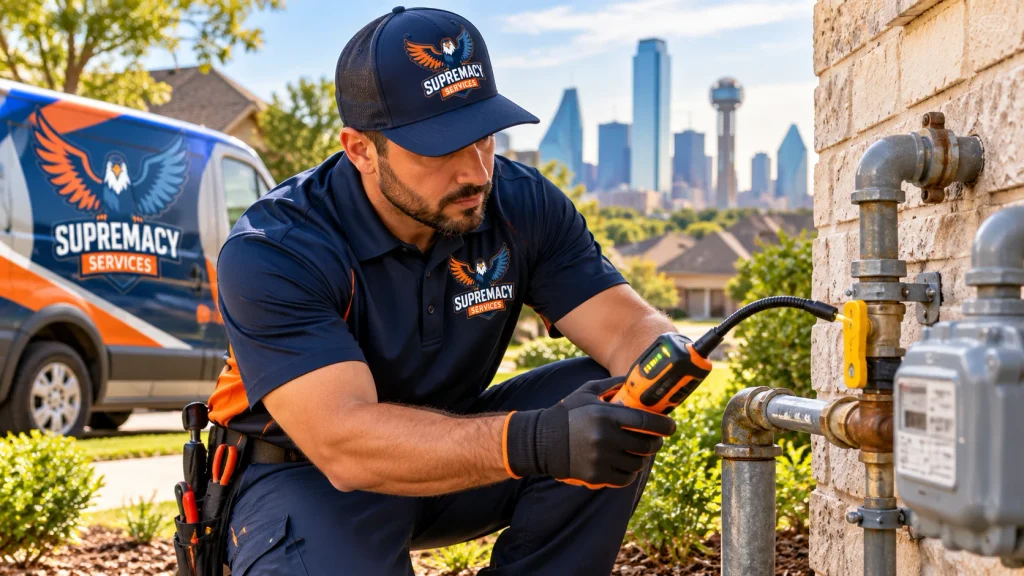
Repair is generally appropriate when the defect is isolated and the surrounding piping remains serviceable. Replacement becomes more reasonable when damage is extensive, several leaks are present, the pipe is badly deteriorated or the system must be redesigned for new gas demand.
| Situation | Localized repair may make sense | Replacement may make sense |
|---|---|---|
| Single accessible leaking fitting | ✓ | |
| Short damaged pipe section | ✓ | |
| Multiple leakage points | ✓ | |
| Broad pipe deterioration | ✓ | |
| Damaged underground section | Possibly | Possibly |
| New appliance requires system changes | Possibly | Possibly |
| Existing piping cannot adequately serve planned load | ✓/redesign | |
| Remodeling requires rerouting | ✓/reroute |
The important point is that replacement should follow diagnosis, not simply the age of the house.
Partial replacement
Sometimes only one branch or section needs replacement.
For example, a problem affecting the line serving one appliance does not necessarily mean all gas piping throughout the property must be replaced.
Whole-system replacement
A more extensive repipe may be considered when inspection and testing reveal systemic problems rather than a single failed component.
Because this can become a substantial project, homeowners should ask the plumber to explain:
- what failed;
- how the failure was confirmed;
- which sections require replacement;
- whether alternatives exist; and
- what testing and inspections will follow.
If you’re comparing a spot repair with partial or complete replacement, schedule a gas line assessment with Supremacy Services so the scope can be based on testing rather than guesswork.
How Do Plumbers Find Gas Leaks?
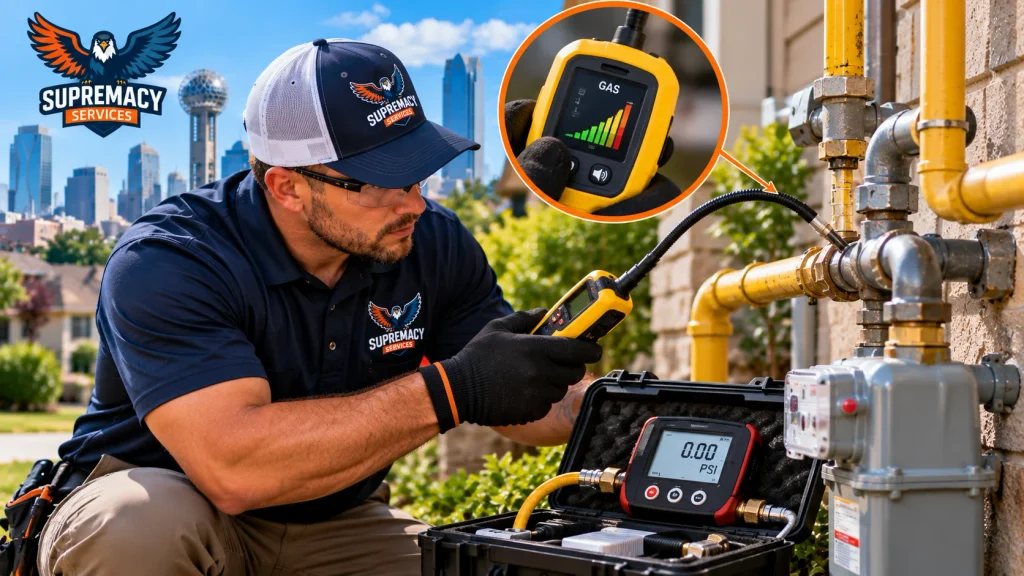
Professional gas leak diagnosis can combine visual inspection, approved leak-detection instruments, pressure testing and isolation testing to determine whether the system leaks and narrow down the affected section.
The appropriate procedure depends on the property and circumstances.
Electronic gas detection
Sensitive instruments can detect combustible gas and help investigate suspected leakage.
Professional instruments are especially valuable because smell alone should not be used to prove that a system is leak-free.
Pressure testing
Pressure testing evaluates whether the piping system maintains the required test pressure.
In Dallas, the City’s published gas-test guidelines establish specific procedures for gas tests associated with restoring or establishing service.
Isolation testing
If a system contains several branches, technicians may need to isolate sections to narrow down where pressure loss is occurring.
This can be particularly useful in larger homes and properties with several gas appliances.
Inspection of fittings and appliance connections
Connections, valves, fittings and accessible piping can also be evaluated for signs of leakage or deterioration.
The goal is not simply to establish that gas is escaping. It is to determine where the problem is and what must be repaired before the system can safely return to service.
Do Gas Line Repairs Require a Permit in Dallas?
Depending on the work and circumstances, Dallas fuel-gas work can require a plumbing permit and City inspection.
The City of Dallas currently references the 2021 International Fuel Gas Code with Dallas amendments as part of its adopted construction-code framework.
Dallas’ published Gas Test Guidelines state that when specified conditions require gas testing and inspection, a plumbing permit must be obtained by a qualifying homeowner or a licensed plumbing contractor with a current Responsible Master Plumber license who is registered with the City.
The City’s November 2025 guidelines also specify that the applicable fuel-gas piping test uses an approved diaphragm test gauge and a 3 psi test witnessed by a Dallas plumbing inspector for at least 15 minutes for the circumstances covered by those guidelines.
That is an important reason not to assume that repairing the visible leak is the final step.
Depending on why gas service was interrupted and the scope of work, the process can involve:
Diagnosis → repair → required pressure test → City inspection/release → utility reconnection
Atmos Energy also advises customers whose service was turned off for a leak to have necessary piping or appliance repairs completed, satisfy applicable city inspection or permit requirements, and then arrange reconnection.
What about other DFW cities?
Dallas requirements should not automatically be applied to Plano, Frisco, Richardson, Carrollton, Fort Worth or another municipality.
Permitting and inspection procedures can differ by jurisdiction. A contractor should determine the requirements for the city where the property is actually located.
Dallas and DFW Considerations
Gas-line work in North Texas should be evaluated according to the actual property rather than generalized assumptions about every Dallas home.
Several local circumstances can affect a project.
Buried piping and excavation
Gas piping serving outdoor kitchens, detached structures, pool equipment or other exterior appliances may cross yards or landscaped areas.
Any excavation adds access considerations and the need to account for underground utilities.
Before digging, underground utilities should be located through the appropriate utility-location process.
Remodeling and new appliances
A Dallas homeowner replacing an electric range with gas, installing a gas tankless water heater or adding a generator may need more than a simple branch-line extension.
The existing system should be evaluated to determine whether it is appropriately configured for the proposed additional demand.
Severe weather and property damage
Storm damage, uprooted trees, construction and other physical disturbances can damage or expose gas infrastructure.
Atmos Energy specifically advises customers to leave the area and report exposed or damaged gas lines rather than attempting to handle them.
What Happens During Professional Gas Line Repair?
A gas-line project generally involves several distinct stages.
Step 1: Establish immediate safety
If there is an active suspected leak, emergency safety procedures come first.
Step 2: Diagnose the system
Once conditions permit professional work, the plumber determines what part of the customer-owned system needs attention.
Testing may include pressure testing and leak-detection equipment depending on the circumstances.
Step 3: Explain the repair scope
The homeowner should receive an explanation of:
- the suspected or confirmed failure;
- repair versus replacement options;
- access requirements;
- permit and inspection requirements;
- expected restoration work; and
- price.
Step 4: Complete the repair
The defective fitting, valve or pipe section is repaired or replaced according to the approved scope.
More extensive projects may involve rerouting or replacing larger sections of piping.
Step 5: Test the repaired system
Gas piping should not simply be repaired and assumed safe.
Required testing verifies system integrity.
Step 6: Complete required inspection procedures
Where the City requires inspection, the applicable process must be completed before service is restored.
Step 7: Coordinate restoration of service
When the utility has shut off service, reconnection follows the utility’s required process after repair and applicable inspection requirements have been satisfied.
Gas Leak or Something Else?
Not every unusual odor in a home comes from natural gas.
| Symptom | Possible source |
|---|---|
| Sulfur/rotten-egg-type odor | Possible odorized natural gas |
| Sewer odor near drain | Dry trap or sewer/drain issue |
| Musty odor | Moisture or microbial growth |
| Burning smell near furnace | HVAC/electrical issue requiring evaluation |
| Hissing near gas piping | Possible gas leak |
| Hissing at plumbing fixture | Water-supply issue |
| Dead vegetation over buried gas route | Possible underground leak |
| Wet yard | More commonly water or drainage related |
Do not use this table to dismiss a possible gas leak. If natural gas is reasonably suspected, follow emergency gas-safety procedures first.
Can You Repair a Gas Line Yourself?
Gas leak diagnosis and gas-piping repair are not appropriate trial-and-error DIY projects.
There is a significant difference between noticing a warning sign and proving that a fuel-gas system is safe.
Proper gas work may require:
- correct pipe sizing;
- approved piping and fittings;
- specialized detection equipment;
- pressure testing;
- knowledge of fuel-gas code requirements;
- permits;
- inspections; and
- utility coordination.
Texas also regulates plumbing work and plumbing licensing. The Texas State Board of Plumbing Examiners states that Journeyman Plumbers may install, change, repair, service or renovate plumbing under the supervision of a Responsible Master Plumber.
Dallas does provide a homeowner-permit pathway under qualifying conditions for certain residential work, but a homeowner pulling a permit is still responsible for meeting the applicable plumbing-code requirements.
For most homeowners, professional gas-line work is the practical choice because the question is not merely whether the pipe appears fixed—it is whether the complete affected system can pass the required safety testing.
How Can Homeowners Help Prevent Gas Line Problems?
You cannot prevent every piping failure, but several practices reduce avoidable risk.
Do not ignore minor warning signs
A recurring gas odor should never be normalized.
Follow emergency procedures when gas is suspected.
Protect exposed piping
Do not use gas piping as a support for stored materials or equipment.
Report visible physical damage rather than attempting a temporary repair.
Call before digging
Landscaping, fencing and outdoor construction can put buried utilities at risk.
Have underground utilities located before excavation.
Have new gas appliances properly connected
Adding a range, dryer, generator, pool heater, fireplace or tankless water heater can change the demands on a gas system.
The new installation should be evaluated as part of the entire piping system rather than treating the new appliance connection as an isolated fitting.
Maintain gas appliances
Gas piping and the appliances it supplies are related but distinct systems.
Manufacturer-recommended appliance inspection and maintenance can identify equipment problems that might otherwise be mistaken for piping problems.
Questions to Ask Before Approving a Gas Line Estimate
A useful estimate should make the scope understandable.
Ask:
- Where was the leak or failure found?
- How was it confirmed?
- Is this a localized repair or a larger piping problem?
- Does any additional section need testing?
- Does the estimate include pressure testing?
- Are permits and inspection included?
- Is excavation required?
- Who handles utility coordination?
- Does the quote include restoration?
- What could cause the price to change once work begins?
- What documentation will I receive after testing or inspection?
Price matters, but comparing two gas-line estimates is difficult unless both estimates cover the same work.
Frequently Asked Questions
How much does a gas line repair cost in Dallas?
Simple accessible repairs may cost a few hundred dollars, while buried-line repairs and extensive replacement can cost several thousand. Recent published DFW contractor guides place common single-point repairs broadly around $250–$1,200, but the actual price depends on diagnosis, access, pipe condition, labor, permits and repair scope.
How much does gas leak detection cost in Dallas?
Published Dallas-area market examples generally place basic leak testing in the low hundreds of dollars, while complex investigations involving buried lines, multiple branches or several appliances can cost substantially more. Always confirm whether the diagnostic fee is separate from repair work.
Who should I call if I smell gas in Dallas?
Leave the affected area immediately. From a safe distance, call 911 and your gas utility. Atmos Energy currently lists 866-322-8667 as its 24-hour emergency number for suspected natural gas leaks.
Can a plumber repair a gas line after Atmos Energy shuts off the gas?
A qualified plumbing professional can perform applicable customer-side repairs. If service was shut off because of a leak, permit, testing, inspection and utility reconnection procedures may apply before service is restored.
Does Dallas require a pressure test after gas-line work?
The City of Dallas publishes Gas Test Guidelines describing circumstances in which gas piping must be tested and inspected. For the situations covered by those guidelines, Dallas specifies an approved diaphragm gauge and a 3 psi test witnessed by a City plumbing inspector for at least 15 minutes.
Is repairing an underground gas line more expensive?
It can be. Underground work may require line locating, excavation, additional labor, approved underground materials and property restoration. The actual difference depends on depth, distance and accessibility.
Should I repair or replace an old gas line?
Age alone should not determine the decision. A localized problem may be repairable, while multiple leaks, substantial deterioration or a system that requires major reconfiguration may make partial or full replacement more practical. Testing should guide the recommendation.
How long does gas line repair take?
An accessible localized repair may be completed relatively quickly, while underground replacement or extensive repiping can take considerably longer. Permit, inspection and utility reconnection requirements can also affect how soon gas service returns.
Can I use a home gas detector to find the leak myself?
A consumer detector can provide an additional warning, but it should not be used as permission to remain inside a building with a suspected leak or as proof that the piping system is safe. If gas is suspected, leave and report the emergency from a safe location.
Who is responsible for the gas line around my Dallas home?
Responsibility depends on which part of the distribution and customer-owned piping system is involved. Atmos Energy states that customer-owned gas piping and appliances are the customer’s responsibility and recommends qualified professional inspection and repair where necessary.
Gas Line Repair in Dallas: Know the Problem Before Choosing the Solution
Gas line repair cost in Dallas is ultimately determined by what failed, where it failed and how much of the system must be repaired to restore safe operation.
A single accessible leak can be very different from an underground failure or a system with several compromised sections. That is why online prices should be treated as budgeting guidance rather than a substitute for diagnosis.
If you smell gas now, leave the area and contact emergency services and your gas utility from a safe location.
For non-emergency gas-line diagnosis, repair or replacement, contact Supremacy Services for professional gas line service in Dallas and the DFW Metroplex. A proper evaluation can determine whether you need leak detection, a localized repair, a new appliance line or more extensive gas piping replacement.

