
Wildlife trapping in Dallas can range from a relatively straightforward animal-removal visit to a much larger project involving multiple traps, return visits, attic cleanup and repairs to the openings animals used to enter the home.
As a current market reference—not a Supremacy Services price quote—Angi’s 2026 Dallas cost data puts professional wildlife removal at about $606 on average, with a reported range of approximately $225–$1,003. Its Dallas estimate for raccoon removal is roughly $415–$620. Actual quotes can fall outside these ranges because the species, number of animals, accessibility, required follow-up and exclusion work can substantially change the scope.
The most important thing for Dallas homeowners to understand is that trapping and complete wildlife control are not necessarily the same service. Catching an animal addresses the immediate intruder. Finding and securing the entry points addresses how it got inside.
Table of Contents
- How Much Does Wildlife Trapping Cost in Dallas?
- What Determines the Cost?
- Wildlife Trapping Cost by Animal
- What Does Professional Wildlife Trapping Include?
- Trapping vs. Wildlife Exclusion
- Signs You May Need Wildlife Removal
- DIY vs. Professional Wildlife Trapping
- Texas Wildlife Trapping Rules
- How to Prevent Wildlife From Returning
- What to Expect From a Wildlife-Control Visit
- Frequently Asked Questions
How Much Does Wildlife Trapping Cost in Dallas?
Current third-party Dallas market data places many professional wildlife-removal projects somewhere around $225–$1,003, with an average near $606. Treat those figures as general market benchmarks rather than a guaranteed price for your property.
A technician usually cannot determine the true project cost from the words “animal in my attic” alone.
A home with one readily accessible animal and no significant entry damage presents a very different project from a home with wildlife entering through several roof openings, nesting material in the attic and damaged vents or soffits.
Cost components homeowners should ask about
| Cost component | What it covers | Why it affects the quote |
|---|---|---|
| Inspection | Identifying species, activity and entry points | Larger or difficult properties require more investigation |
| Trap setup | Equipment and strategic trap placement | Species and location determine trapping method |
| Monitoring/follow-ups | Checking or resetting traps | Multiple visits increase labor |
| Animal handling | Removal after capture | Requirements differ by species |
| Exclusion | Closing wildlife entry points | Number, size and location of openings matter |
| Cleanup | Removal of nesting/debris where offered | Larger contaminated areas require more work |
| Repairs | Repairing damaged vents, soffits or other openings | Damage can range from minor to extensive |
If you are hearing or seeing wildlife around your home, schedule a professional wildlife inspection to identify the animal, entry points and appropriate removal plan before deciding what work is actually necessary
What Determines Wildlife Trapping Cost?
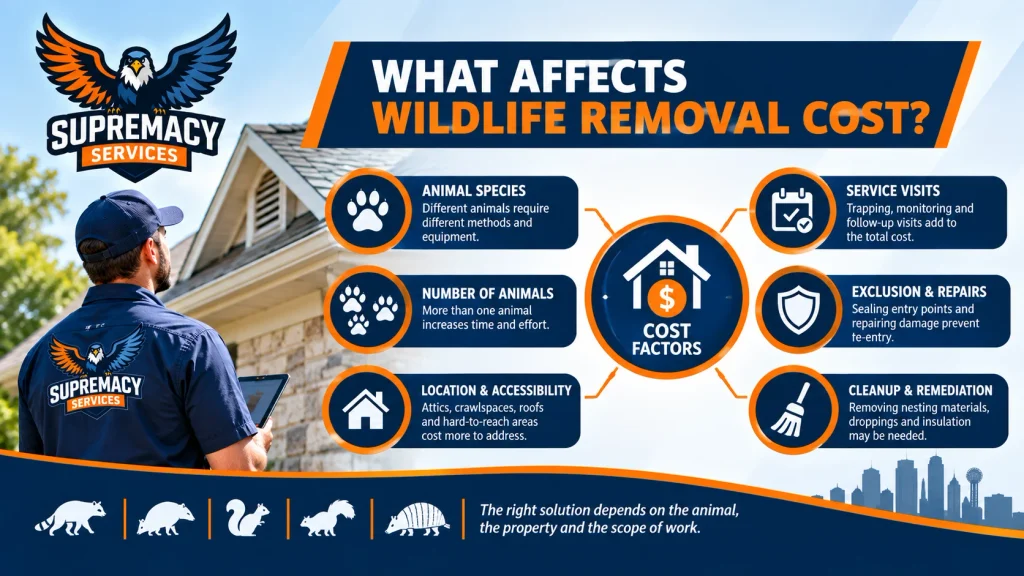
The biggest cost drivers are generally the animal involved, how many animals are present, where they are located, how many service visits are required, and whether the home needs exclusion or cleanup afterward. Current Dallas market guidance similarly identifies nesting location and the number of follow-up visits among important price factors.
1. Type of wildlife
A squirrel in an accessible area does not necessarily require the same equipment or handling process as a raccoon, skunk or animal beneath a structure.
Species identification matters for more than pricing. Texas wildlife regulations differ depending on the animal and what is done with it after capture.
2. Number of animals
One captured animal does not always mean one animal was present.
A professional inspection should look for evidence of continued activity, nesting and potential young before the job is considered complete.
3. Where the animal is located
Accessibility can dramatically affect labor.
Common problem areas include:
- attics;
- soffits and rooflines;
- chimneys;
- crawlspaces;
- garages;
- areas beneath decks or structures;
- wall or ceiling cavities;
- yards and landscaping.
An animal moving through an attic may be much easier to address than one whose exact location inside a wall cannot immediately be established.
4. Number of visits required
Wildlife control frequently involves a process rather than a single appointment.
Trap placement, monitoring, capture and verification can require return visits depending on the situation.
5. Entry-point repairs
This is where comparing quotes becomes particularly important.
A quote for trapping only should not automatically be compared with a quote covering trapping + exclusion + repairs + cleanup.
They are different scopes of work.
6. Attic or structural contamination
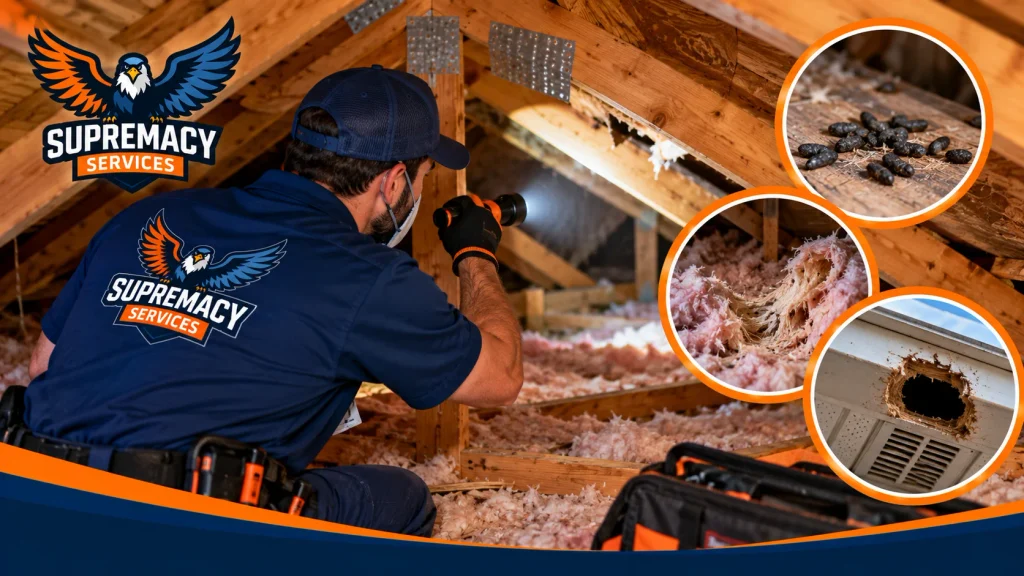
Nesting material, droppings, damaged insulation or other debris may create additional cleanup needs.
The amount of remediation should be determined from actual conditions rather than assumed simply because an animal entered the attic.
Does Wildlife Trapping Cost Differ by Animal?
Yes. Wildlife-removal prices can vary by species because the equipment, location, number of animals, handling requirements and amount of property damage differ.
For example, current Dallas market data from Angi estimates raccoon-removal projects at approximately $415–$620, while its broader wildlife-removal range is considerably wider. These are third-party market estimates, not Supremacy pricing.
| Animal | Common homeowner concern | Potential additional work |
|---|---|---|
| Raccoon | Attic or roof activity | Entry repair, attic assessment |
| Opossum | Attic, garage or crawlspace activity | Exclusion and cleanup |
| Squirrel | Scratching around roof/attic | Roofline entry sealing |
| Skunk | Activity beneath structures or around yard | Species-appropriate removal strategy |
| Armadillo | Digging around lawn or landscaping | Identifying recurring access/activity |
| Rats/mice | Attics, walls and interior spaces | Rodent trapping plus comprehensive exclusion |
Rats and mice deserve their own distinction. Supremacy already has a dedicated Rodent Control & Exclusion service page, so homeowners primarily dealing with rats or mice should be directed there rather than treating every rodent problem as general wildlife trapping.
What Does Professional Wildlife Trapping Include?
A professional wildlife-control plan generally begins with identification and inspection, followed by an appropriate removal strategy and an assessment of how the animal gained access.
Supremacy’s current wildlife service describes its process as a property/roofline inspection, live trapping where appropriate, animal handling and subsequent entry sealing and cleanup.
A practical process looks like this:
Step 1: Identify the animal. Tracks, droppings, noises, damage and visual sightings help determine what is present.
Step 2: Find the entry points. Roof intersections, soffits, vents, chimneys, gaps and foundation-level openings should be inspected.
Step 3: Determine the removal strategy. The appropriate approach depends on species, location and applicable rules.
Step 4: Monitor the situation. Additional activity should be ruled out before openings are permanently closed.
Step 5: Exclude future wildlife. Vulnerable openings are repaired or secured where appropriate.
Step 6: Assess cleanup needs. Nesting material, droppings, odors or damaged materials may need attention depending on the infestation.
Wildlife Trapping vs. Exclusion: What’s the Difference?
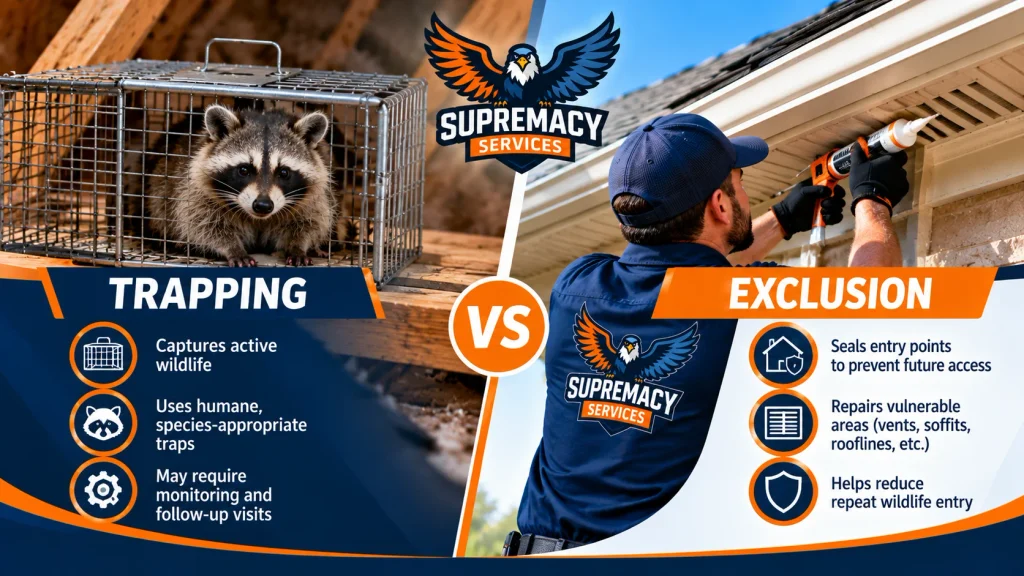
Trapping removes an animal that is currently causing a problem. Exclusion addresses the openings and conditions that allow wildlife to enter the structure.
| Trapping | Exclusion |
|---|---|
| Addresses active wildlife | Addresses access into the building |
| Uses species-appropriate capture/removal methods | Seals or repairs entry points |
| May require monitoring | Usually follows an inspection |
| Solves the immediate animal problem | Helps reduce repeat entry |
| May be only one part of the job | Focuses on longer-term prevention |
This distinction is critical when homeowners compare wildlife-removal prices.
A $300 trapping proposal and a $900 trapping-and-exclusion proposal cannot fairly be compared from price alone without examining what each includes.
Why exclusion can matter after trapping
Imagine a raccoon entered through a damaged roof vent.
Removing that raccoon eliminates the immediate animal. Leaving the damaged vent unchanged leaves the access route available.
That is why Supremacy’s commercial wildlife page emphasizes both removal and exterior entry sealing rather than presenting trapping as the entire solution.
Need to know whether your problem requires trapping alone or trapping plus exclusion? Request a wildlife inspection from Supremacy Services to identify active wildlife and potential entry points
What Are the Signs You May Need Wildlife Removal?
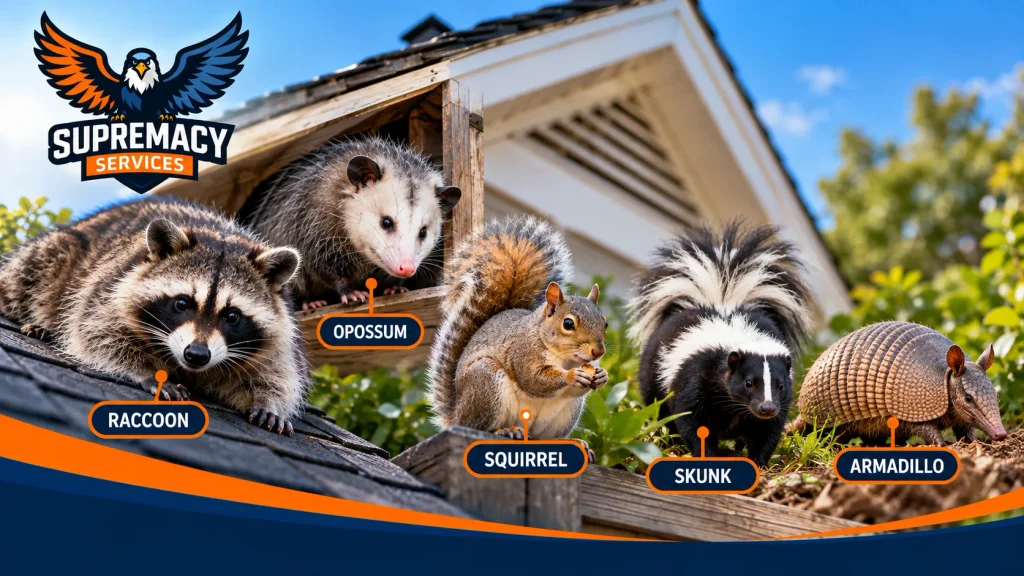
Common clues include unexplained attic noises, visible animal entry, damaged vents or soffits, nesting material, droppings, disturbed insulation and recurring animal activity around potential openings.
Pay particular attention to:
- scratching, movement or heavier thumping overhead;
- damaged roof or attic vents;
- gaps around soffits or fascia;
- nesting material;
- droppings in attic or garage spaces;
- insulation that appears disturbed;
- repeated animal sightings near one part of the house;
- unusual odors;
- digging around foundations or landscaping.
The type and timing of noises can provide clues, but sound alone is not enough for reliable species identification.
Wildlife or rodents?
Small scratching sounds inside walls or attics can sometimes indicate rats or mice rather than larger wildlife.
Supremacy maintains a separate rodent-control service specifically focused on mice and rats, including trapping and exterior exclusion.
Can You Trap Wildlife Yourself in Texas?
Homeowners should check the rules for the specific species and intended method before attempting wildlife capture, transport or relocation.
Texas law is more nuanced than simply buying a live trap and releasing an animal elsewhere.
For example, Texas Parks and Wildlife states that landowners or their agents may take nuisance fur-bearing animals on their land under specified circumstances without a hunting or trapping license. But relocation is subject to additional requirements, including authorization and permission involving the release property. TPWD also states that transporting live raccoons, foxes and coyotes within Texas is prohibited under rabies-quarantine rules.
TPWD separately states that anyone trapping and relocating nuisance fur-bearing animals must obtain authorization from its Wildlife Division.
That makes DIY relocation particularly important to research before, not after, an animal has been captured.
DIY may also create practical problems
Even where a particular capture method is lawful, homeowners must still consider:
- correct species identification;
- young animals that may remain behind;
- safe trap placement;
- handling risks;
- what can legally be done after capture;
- whether additional animals are present;
- locating the original entry point.
The trap itself is often the simplest part of a wildlife problem.
What Texas Wildlife Rules Should Dallas Homeowners Know?
Texas wildlife laws vary according to species, circumstances, method and what happens to the animal after capture.
TPWD currently states that nuisance fur-bearing animals may be taken by landowners or their agents under specific conditions, while capture and relocation require additional authorization. Texas also restricts transport of certain live rabies-vector species, including raccoons.
For nongame wildlife, TPWD publishes separate rules. Its current regulations identify animals including armadillos among nongame species and specify applicable requirements for take.
Texas also regulates structural pest-control businesses. The Texas Department of Agriculture says businesses performing structural pest control for compensation are subject to licensing requirements, and its definition includes inspection, recommendations and control of pest animals in and around structures.
Homeowner takeaway: don’t assume every wild animal can legally be trapped, transported and released wherever you choose. Check the current rule for the particular species and situation.
How Can Dallas Homeowners Reduce Future Wildlife Problems?
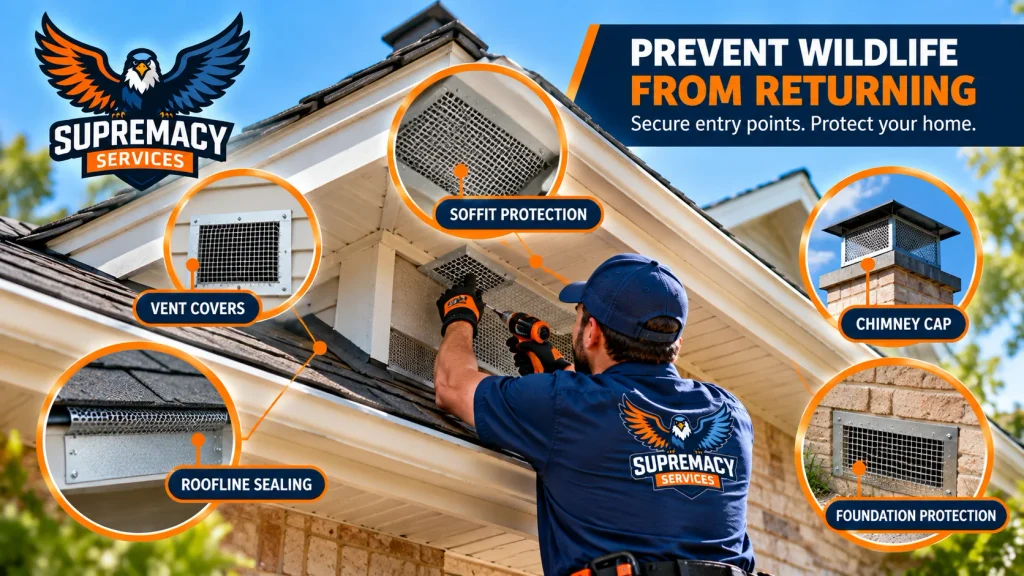
The most effective prevention strategy is usually to reduce access to the structure and correct vulnerable openings identified during inspection.
Check areas such as:
Roof and soffit openings
Inspect damaged soffits, fascia, roof transitions and other openings where animals could gain access.
Vents
Damaged or unsecured vents can create access into attic or structural spaces.
Chimneys
Appropriate chimney protection can help prevent animal entry while maintaining the ventilation the system requires.
Foundation and crawlspace openings
Inspect damaged covers, gaps and other accessible openings around the lower structure.
Food attractants
Secure trash and avoid unintentionally providing easily accessible food sources around the property.
Tree and roof interaction
Branches touching or overhanging roofs can provide wildlife with easier access to parts of a home’s exterior.
The objective isn’t to make a property “wildlife-proof” in an absolute sense. It is to identify and correct realistic entry vulnerabilities.
What Should You Expect From a Professional Wildlife-Control Visit?
A good wildlife-control visit should help answer five questions:
- What animal is causing the problem?
- Where is it active?
- How is it getting into or around the property?
- What removal method is appropriate?
- What needs to change to reduce the chance of recurrence?
Before approving work, ask whether your quote includes:
- inspection;
- trap setup;
- trap monitoring;
- follow-up visits;
- captured-animal handling;
- exclusion;
- minor entry-point repairs;
- cleanup;
- attic remediation;
- warranty or follow-up terms, where offered.
Getting these details in writing makes price comparisons much more meaningful.
Questions to Ask Before Accepting a Wildlife-Trapping Quote
Use this checklist:
☐ What animal do you believe is present?
☐ How was the species identified?
☐ How many traps or removal devices are expected?
☐ Are follow-up visits included?
☐ What happens after an animal is captured?
☐ Does the price include exclusion?
☐ Which entry points need repair?
☐ Is attic cleanup actually necessary?
☐ Are repairs included or separately quoted?
☐ What could cause the final price to change?
This helps prevent a low initial trapping price from being mistaken for the total cost of resolving the wildlife problem.
Frequently Asked Questions
How much does wildlife trapping cost in Dallas?
Current third-party Dallas market data from Angi reports wildlife removal at about $606 on average, with a broad range of approximately $225–$1,003. Actual prices vary according to species, location, follow-up visits and additional services.
Is wildlife trapping the same as wildlife removal?
Not necessarily. Trapping focuses on capturing an active animal. Complete wildlife control may also include inspection, follow-up, exclusion, repairs and cleanup.
Does wildlife trapping include sealing entry holes?
It depends on the provider and proposal. Ask specifically whether exclusion is included rather than assuming entry-point repairs are part of the trapping price.
How much does raccoon removal cost in Dallas?
Angi’s current Dallas market guide estimates approximately $415–$620 for raccoon removal. This is a third-party market estimate rather than a Supremacy Services quote.
Can I relocate a raccoon after trapping it in Texas?
Texas places restrictions on the transport of live raccoons. TPWD’s nuisance fur-bearing animal guidance states that transporting live raccoons within the state is prohibited under rabies-quarantine rules. Check current TPWD requirements rather than assuming relocation is permitted.
Why do wildlife-removal companies inspect the attic?
The inspection can help identify the animal, evidence of additional wildlife, nesting areas, possible entry points and damage that may affect the removal and exclusion plan.
Why does wildlife exclusion cost extra?
Exclusion can involve locating and repairing multiple openings around rooflines, vents, soffits or other parts of a structure. Its scope therefore depends heavily on the condition and construction of the individual property.
Are rats and mice considered wildlife trapping?
For service and SEO purposes, they are better treated separately. Supremacy has a dedicated Rodent Control & Exclusion service specifically targeting rat and mouse problems.
How do I compare two wildlife-removal quotes?
Compare the scope rather than the bottom-line number alone. Determine whether inspection, trapping, follow-up visits, animal handling, exclusion, repairs and cleanup are included in each proposal.
Finding an animal is only the first part of solving a wildlife problem. Identifying what is present, how it entered and whether other animals remain helps determine whether trapping alone is sufficient or whether exclusion and cleanup should also be considered.
For Dallas and DFW homeowners dealing with activity in an attic, roofline, crawlspace or around the home, request a wildlife inspection from Supremacy Services to determine the appropriate removal and exclusion plan.

