

If you are budgeting for electrical rewiring in Dallas, the price can vary considerably depending on the size and age of the house, how easily electricians can access the existing wiring, the number of circuits being replaced, and whether the electrical panel or service also needs upgrading.
Current Dallas market data published by Angi estimates rewiring labor and materials at roughly $2–$4 per square foot, but that figure should be treated as a planning benchmark rather than a quote. Whole-home projects can move well beyond simple square-foot estimates when finished walls must be opened, old wiring is difficult to reach, additional circuits are required, or panel and service work becomes part of the project.
For Dallas homeowners, there is another important consideration: rewiring is regulated electrical work. Texas generally requires people performing non-exempt electrical work to be properly licensed, while the City of Dallas requires permits for electrical work unless a specific exemption applies.
This guide explains what determines the cost, what a professional rewire includes, when rewiring may actually be necessary, and how to compare estimates without focusing only on the lowest number.
Table of Contents
- How Much Does Electrical Rewiring Cost in Dallas?
- What Affects the Cost of Rewiring a House?
- What Does Whole-House Rewiring Include?
- Signs Your Dallas Home May Need Rewiring
- Partial Rewiring vs. Whole-House Rewiring
- Rewiring vs. an Electrical Panel Upgrade
- Dallas Permits and Electrical Requirements
- Can You Rewire a House Yourself?
- What to Expect During a Professional Rewire
- How to Compare Rewiring Estimates
- FAQs
How Much Does Electrical Rewiring Cost in Dallas?
A Dallas house rewire does not have one reliable flat price. Current local market estimates put basic rewiring labor and materials around $2–$4 per square foot, but actual whole-home pricing depends heavily on access, circuit count, wall repair, panel work, permits and the condition of the existing electrical system.
That distinction matters.
A contractor who can route new cable through accessible attic spaces and wall cavities may face a very different job from one rewiring a multi-story house with finished walls, limited access and extensive existing electrical modifications.
For that reason, homeowners should treat online cost figures as budgeting ranges rather than estimates for their particular property.
| Cost factor | Why it matters |
|---|---|
| Home size | Larger houses generally require more cable, circuits, devices and labor |
| Number of circuits | More circuits mean additional cable runs, breakers and terminations |
| Wall and ceiling access | Finished or difficult-to-access cavities can increase labor |
| Existing wiring | Old, damaged or extensively modified wiring may complicate replacement |
| Panel condition | The existing panel may or may not be suitable for the finished system |
| Service capacity | Major electrical changes can reveal the need for broader service work |
| Outlet/switch count | More devices increase materials and installation time |
| Permitting/inspection | Dallas electrical work can require permits and inspections |
| Drywall/plaster restoration | Wall repair may be separate from the electrician’s proposal |
| Remodel coordination | Rewiring during an open-wall renovation may simplify access |
A Better Way to Budget
Instead of asking only, “What is the price per square foot?”, ask:
What exactly is being replaced, what is included in the proposal, and what work will be required to access the wiring?
Two estimates can differ substantially while both are reasonable if one includes panel work, new devices, permitting and wall restoration and the other does not.
If you suspect your home needs extensive wiring replacement, Supremacy Services’ whole-home rough wiring and rewiring service can be used to evaluate the existing system and determine the appropriate scope before you budget around a generic online number.
What Affects the Cost of Rewiring a House?
1. Size of the Home
Square footage matters because larger homes normally contain longer cable runs and more outlets, lighting circuits and dedicated appliance circuits.
However, square footage alone cannot tell you what a rewire should cost.
A compact home with difficult plaster walls and extensive electrical modifications can require more labor than a larger home undergoing an open-wall renovation.
2. Accessibility of Existing Wiring

Accessibility can be one of the largest cost variables.
Wiring that can be reached through an attic, unfinished space or open renovation area is generally easier to replace than wiring concealed behind finished surfaces.
The electrician may need to create strategic access openings when existing cable cannot be removed or new cable cannot be safely routed through the existing pathways.
Before signing a proposal, determine whether drywall, plaster, painting and finish repairs are included or excluded.
3. Partial vs. Whole-Home Rewiring
Not every electrical problem means the entire house needs new wiring.
A localized damaged circuit may require repair or replacement of only that circuit. A remodeling project might require new wiring only in the affected area.
A full rewire becomes a different scope because electricians must evaluate and replace electrical distribution throughout the property.
4. Number of Circuits and Electrical Loads
Modern homes can contain dedicated circuits for equipment such as:
- air-conditioning systems;
- electric ranges and ovens;
- clothes dryers;
- EV chargers;
- workshops;
- pool equipment;
- home offices; and
- other high-demand equipment.
The required circuit design therefore depends on how the house is actually used—not simply its age or square footage.
5. Electrical Panel and Service Condition
A house can have wiring problems without needing a panel replacement, and it can need a panel upgrade without needing a complete rewire.
During a rewiring assessment, an electrician should evaluate whether the existing panel and service are suitable for the proposed circuits and electrical load.
That prevents homeowners from unnecessarily treating two related but different projects as one.
6. Permits and Inspections
The City of Dallas identifies a specific Residential Electrical Permit category and electrical inspections including rough-wall, rough-ceiling, service and final inspections.
Permit requirements therefore need to be accounted for when defining the project schedule and price.
What Does Whole-House Rewiring Include?

Whole-house rewiring generally means replacing or substantially renewing the branch wiring that distributes electricity from the home’s electrical distribution system to outlets, switches, lights and equipment. The exact scope should always be written into the contractor’s proposal.
A professional project may include:
- evaluating the existing wiring and panel;
- identifying circuits and electrical loads;
- planning new cable routes;
- obtaining required electrical permits;
- installing new branch-circuit wiring;
- replacing applicable boxes, switches and receptacles;
- installing required grounding and protective devices;
- connecting circuits at the electrical panel;
- testing the completed circuits;
- coordinating required inspections; and
- identifying any wall or finish restoration required afterward.
The important word is may.
Do not assume that panel replacement, drywall repair, painting, fixtures or other remodeling work is automatically included in a “whole-house rewire.”
Ask for those items to be identified explicitly.
Signs Your Dallas Home May Need Rewiring

Frequent electrical problems, damaged conductors, ungrounded systems or widespread obsolete wiring can justify a professional wiring evaluation, but individual symptoms do not automatically prove that a complete rewire is necessary.
Have the system evaluated if you notice:
- repeated breaker trips without an obvious appliance overload;
- persistent flickering or dimming;
- damaged or deteriorated wiring;
- burning odors, scorching or unusual heat around electrical devices;
- loose or damaged receptacles;
- widespread two-prong receptacles indicating that grounding deserves investigation;
- circuits that cannot reliably support normal household loads;
- extensive undocumented electrical alterations; or
- electrical problems uncovered during a major renovation.
Burning Smells or Heat Require Faster Attention
A burning smell, visible scorching, sparking or unusual heat should not be treated as a routine remodeling decision.
Stop using the affected circuit or device and have the condition evaluated by a qualified electrician.
The goal is to diagnose the actual fault—not assume that rewiring the entire house is automatically the answer.
Partial Rewiring vs. Whole-House Rewiring

| Partial rewiring | Whole-house rewiring |
|---|---|
| Targets specific damaged or outdated circuits | Addresses wiring throughout most or all of the house |
| Less disruptive when the problem is localized | More extensive access and planning |
| Common during room renovations | More relevant when problems are widespread |
| May retain serviceable existing circuits | Replaces much more of the branch-circuit system |
| Lower scope does not automatically mean simple | Requires broader permitting, testing and coordination |
A professional electrical assessment should determine which approach is justified.
Replacing serviceable wiring simply because another circuit failed can waste money. Conversely, repeatedly patching a system with widespread deficiencies can postpone a larger underlying problem.
Rewiring vs. an Electrical Panel Upgrade
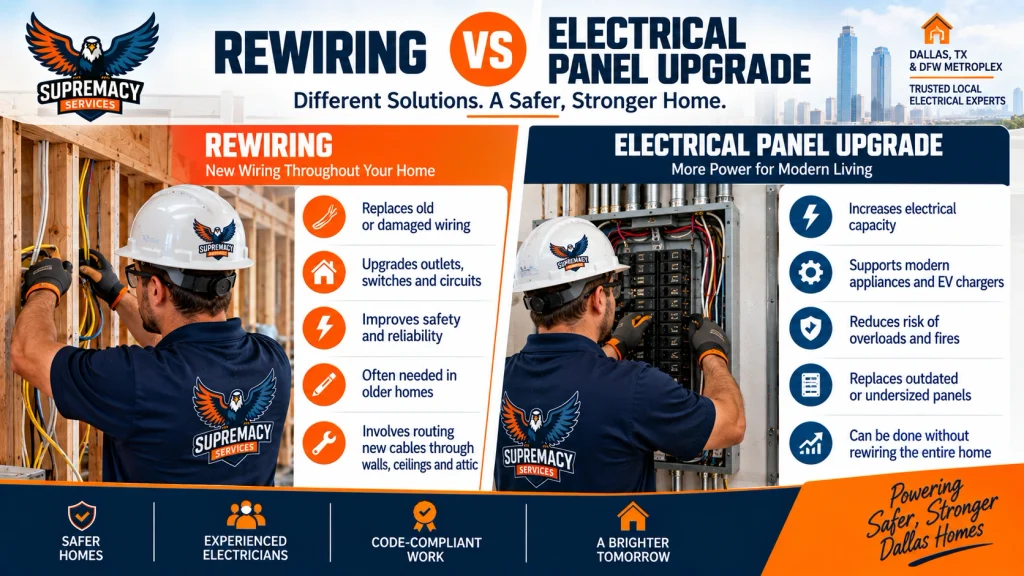
Rewiring replaces electrical conductors and circuits throughout the home. A panel upgrade replaces or expands the equipment that distributes power to those circuits. They are related projects, but they are not the same service.
This distinction is particularly important for searchers comparing electrical upgrade costs.
| Rewiring | Panel upgrade |
|---|---|
| Focuses on wiring/circuits | Focuses on distribution equipment |
| May affect many rooms | Usually concentrated around the panel/service |
| Often involves routing cable through walls | Typically involves replacing or modifying panel equipment |
| May be partial or whole-home | Can occur without replacing household wiring |
| Panel evaluation is part of planning | Wiring evaluation may reveal separate deficiencies |
Supremacy Services maintains a dedicated electrical panel upgrade service for homeowners whose primary problem is panel capacity or condition rather than widespread branch wiring.
Dallas Permits and Electrical Requirements
Electrical rewiring should not be treated like an ordinary DIY cosmetic renovation.
The Texas Department of Licensing and Regulation states that people performing non-exempt electrical work in Texas must be licensed and that this work must be performed through a licensed electrical contractor. TDLR defines electrical work to include installing, maintaining or extending electrical wiring systems.
The City of Dallas also states that electrical work must be performed by a licensed electrician unless a homeowner demonstrates the required knowledge and expertise to the Chief Electrical Inspector. Dallas further states that permits are required for electrical work unless exempted under the applicable city code.
Dallas’ permitting directory includes a Residential Electrical Permit and inspections for rough wiring and final electrical work.
What About the Electrical Code?
Homeowners should verify the current adopted requirements for their project rather than relying on an old blog article or assuming a particular edition of the National Electrical Code applies.
The City of Dallas Electrical Section publishes its current code information and local amendments.
That is particularly important because municipal code adoption changes over time.
Can You Rewire a House Yourself?
Whole-house rewiring is generally not an appropriate DIY project for most homeowners.
The City of Dallas specifically states that electrical work must be performed by a licensed electrician unless a homeowner demonstrates sufficient knowledge and expertise to the Chief Electrical Inspector. Required permits still apply unless the work qualifies for an exemption.
A rewire involves much more than pulling cable.
It requires correct conductor sizing, circuit protection, grounding and bonding, box installation, routing, termination, load considerations, code compliance, testing and inspection.
Mistakes can remain concealed inside walls.
For homeowners, the safer role is usually to understand the scope, compare written proposals, ask questions and verify licensing rather than attempt the electrical installation themselves.
What to Expect During a Professional Rewire
Step 1: Electrical Assessment
The electrician evaluates the existing wiring, panel, circuits, grounding and areas where problems have been reported.
Step 2: Define the Scope
The contractor determines whether the property needs:
- isolated circuit repair;
- partial rewiring;
- renovation wiring;
- whole-house rewiring;
- panel work; or
- a combination of services.
Step 3: Create a Written Estimate
The proposal should identify what is being replaced and clearly state exclusions.
Step 4: Permitting
Required permits should be obtained before regulated work begins.
Step 5: Routing and Installation
New circuits are routed through accessible cavities, attic areas and other approved pathways.
Where access is limited, openings may be necessary.
Step 6: Device and Panel Connections
Circuits are terminated at the appropriate outlets, switches, fixtures, equipment and distribution equipment.
Step 7: Inspection and Testing
Required inspections are completed and circuits are tested before the project is considered finished.
Step 8: Restoration
Any drywall, plaster, texture or paint affected by access openings is restored according to the responsibilities established in the contract.
How to Compare Rewiring Estimates
Do not compare only the bottom-line price.
Use this checklist:
- Is the scope partial or whole-home?
- How many circuits are being replaced?
- Are outlets and switches included?
- Is panel work included?
- Are permit and inspection costs included?
- Who handles permit coordination?
- Is drywall/plaster repair included?
- Is painting included?
- What happens to abandoned old wiring?
- Is cleanup included?
- What testing is performed?
- What workmanship warranty is provided?
- Is the contractor properly licensed for the work?
When two bids differ substantially, ask both contractors to explain the scope line by line.
The cheapest proposal can simply contain fewer services.
Dallas/DFW Considerations
Dallas contains housing from many construction eras, so electrical conditions can vary significantly from one neighborhood and property to another.
Rather than assuming that every “older Dallas house” requires rewiring, base the decision on the actual electrical system.
Remodeling also creates an opportunity to coordinate electrical work while walls are already accessible. If a kitchen, addition or major interior renovation is planned, having the wiring evaluated before finishes are installed can reduce unnecessary reopening of completed surfaces.
Likewise, homeowners adding substantial new electrical loads—such as an EV charger or major electric equipment—should have both the circuits and panel capacity evaluated.
How to Keep Rewiring Costs Under Control
You cannot safely reduce a rewiring budget by cutting required electrical work, but you can make the project easier to price and coordinate.
Get the Scope Diagnosed First
Do not request a “whole-house rewire” simply because one breaker trips.
Diagnosis comes before replacement.
Coordinate With Planned Renovations
If walls will already be open, discuss wiring before drywall and finishes are completed.
Compare Equal Scopes
Ask contractors to identify the same major inclusions so you are not comparing a bare electrical quote with a turnkey proposal.
Separate Optional Improvements
If you are also considering smart switches, lighting changes, EV charging or other upgrades, request them as identifiable line items.
That makes the essential rewiring cost easier to understand.
When Should You Call an Electrician?
Arrange professional evaluation when electrical symptoms are recurring, affect multiple areas of the house, involve visible damage, or suggest overheating.
You should also consider an assessment before a major renovation when existing wiring will become inaccessible again after walls are closed.
Supremacy Services provides residential electrical diagnostics and rough wiring, repair and rewiring services in Dallas and the DFW area for homeowners who need the underlying condition assessed before deciding between repair, partial rewiring and a larger electrical upgrade.
Frequently Asked Questions
How much does it cost to rewire a house in Dallas?
Current Dallas market estimates published by Angi put rewiring labor and materials around $2–$4 per square foot, but whole-home quotes can vary substantially according to access, circuit count, home condition, panel work, permits and restoration requirements.
How much does it cost to rewire a 2,000-square-foot house?
A simple multiplication of a published $2–$4-per-square-foot Dallas market benchmark would imply roughly $4,000–$8,000, but homeowners should not treat that calculation as a contractor quote. Finished-wall access, circuit complexity, panel/service work and repairs can materially change the total.
Does rewiring include a new electrical panel?
Not necessarily. Panel replacement and house rewiring are separate scopes. Ask whether panel or service work is specifically included in the written proposal.
Can I rewire only part of my house?
Yes, when the electrical problem or renovation is limited to particular circuits or areas and the remaining system is suitable to remain in service. An electrician should determine the appropriate scope.
Does Dallas require a permit for house rewiring?
Dallas states that permits are required for electrical work unless the work falls under an applicable exemption. The city has a Residential Electrical Permit category and electrical inspection requirements.
Do electricians have to be licensed in Texas?
Texas requires people performing non-exempt electrical work to be appropriately licensed, and TDLR states that such work must be performed through a licensed electrical contractor.
How long does whole-house rewiring take?
There is no reliable universal duration. Home size, access, number of circuits, inspections, wall openings and other project conditions affect the schedule. A contractor should provide a project-specific timeline after evaluating the house.
Do you have to remove drywall to rewire a house?
Not always. Electricians can sometimes route wiring through accessible attics and existing cavities, but strategic openings may be required when pathways are inaccessible. Ask how access openings and restoration will be handled before work begins.
Is an electrical panel upgrade the same as rewiring?
No. A panel upgrade changes the equipment distributing electricity to the circuits; rewiring replaces or modifies the conductors supplying outlets, lights and equipment throughout the home.
Get a Rewiring Assessment Before You Budget Around a Generic Price
The most useful rewiring estimate is not the one with the neatest price-per-square-foot calculation. It is the one based on your home’s actual wiring, access, circuits, electrical loads and panel condition.
If you are seeing recurring electrical problems or planning a major Dallas-area renovation, schedule an electrical wiring assessment with Supremacy Services to determine whether you need a repair, partial rewire, whole-home rewire or related panel work.
That gives you a defined scope before you make a major investment in the electrical system.

