
VRF HVAC maintenance cost in Dallas varies considerably because commercial VRF systems are not priced like a single conventional rooftop unit. The number of indoor units, outdoor modules, system capacity, controls, accessibility, maintenance frequency and condition of the refrigerant network can all affect what a Dallas business ultimately pays.
For budgeting purposes, published 2026 Dallas-area commercial HVAC maintenance pricing commonly runs from several hundred dollars per conventional unit annually, while larger buildings and complex systems such as VRF may cost several thousand dollars per year to maintain. One Dallas-area source places annual maintenance for office buildings with four to eight RTUs or VRF equipment at approximately $2,000–$5,000, while another DFW commercial contractor lists general planned maintenance agreements at roughly $420–$1,150 per conventional unit per year. These figures are market references—not Supremacy Services pricing—and a VRF system should normally be quoted after the contractor inventories the actual equipment.
That distinction matters. A building with one outdoor VRF module and several indoor units is fundamentally different from a multi-floor property with multiple outdoor modules, dozens of fan coils, branch controllers and centralized controls.
For Dallas property owners and facility managers, the more useful question is therefore:
What will it cost to properly maintain this specific VRF system—and what does that maintenance include?
This guide explains how to build that budget.
What Is VRF HVAC Maintenance?
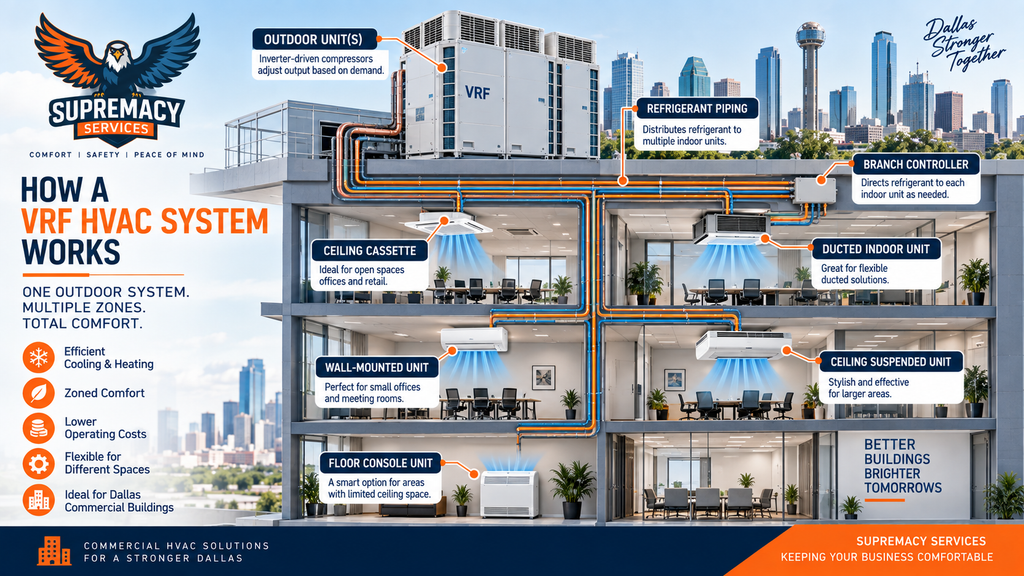
VRF maintenance is the scheduled inspection, cleaning, testing and performance verification of a Variable Refrigerant Flow HVAC system.
VRV—Variable Refrigerant Volume—is Daikin’s terminology for its version of the technology, while VRF is the broader industry term.
Unlike a basic single-zone system, VRF equipment may connect one or more inverter-driven outdoor units to numerous indoor units through an interconnected refrigerant and controls network.
That means proper maintenance can involve much more than replacing filters.
Depending on the equipment and manufacturer requirements, service may include:
- inspecting indoor-unit filters;
- cleaning indoor and outdoor heat exchangers where needed;
- checking condensate drains, pans and pumps;
- examining refrigerant piping and insulation;
- inspecting electrical connections;
- checking temperature sensors;
- reviewing compressor operation;
- checking electronic expansion valves;
- investigating refrigerant leaks;
- reviewing fault histories and operating data;
- testing communication between indoor and outdoor components; and
- verifying centralized controls and zone operation.
Daikin documentation, for example, specifically provides procedures for cleaning or replacing VRV indoor-unit filters, while commercial VRF maintenance programs commonly include refrigerant, compressor, condensate, electrical and sensor inspections.
How Much Does VRF HVAC Maintenance Cost in Dallas in 2026?
There is no reliable one-price-fits-all Dallas VRF maintenance rate. Commercial systems need to be priced according to their equipment inventory and service scope.
For planning—not quoting—the following published market data provides useful context:
| Maintenance scenario | Published 2026 planning range | Important limitation |
|---|---|---|
| Dallas commercial HVAC PM, per conventional unit/year | $420–$1,150 | General commercial HVAC, not VRF-specific |
| DFW single RTU inspection | $150–$350/visit | RTU benchmark only |
| DFW 5–10-unit commercial contract | $2,000–$6,000/year | General HVAC benchmark |
| DFW 10,000–25,000 sq. ft. office with 4–8 RTUs or VRF | $2,000–$5,000/year | Market planning estimate |
| Published VRF contract benchmark outside Texas | $1,200–$2,400/outdoor unit/year | Useful VRF complexity benchmark, not Dallas pricing |
Dallas/DFW figures above come from commercial contractors publishing local planning ranges. The VRF-specific figure is from another U.S. market and should not be presented as a Dallas quote.
The practical takeaway
A small commercial VRF installation may require a relatively straightforward maintenance program. A multi-story office, hotel, medical property, restaurant, school or mixed-use building with many indoor units can require substantially more technician time.
The best way to price VRF maintenance is through an equipment inventory rather than square footage alone.
A contractor should ideally determine:
- Number of outdoor modules
- Number and type of indoor units
- Manufacturer and model families
- System capacity
- Number of refrigerant circuits
- Controller configuration
- Accessibility
- Filter quantity and type
- Condensate-system configuration
- Current fault or repair history
- Required maintenance frequency
- Whether maintenance occurs during normal or after-hours periods
That produces a far more meaningful commercial maintenance estimate than simply multiplying the building’s square footage by a generic rate.
What Factors Affect VRF Maintenance Cost?
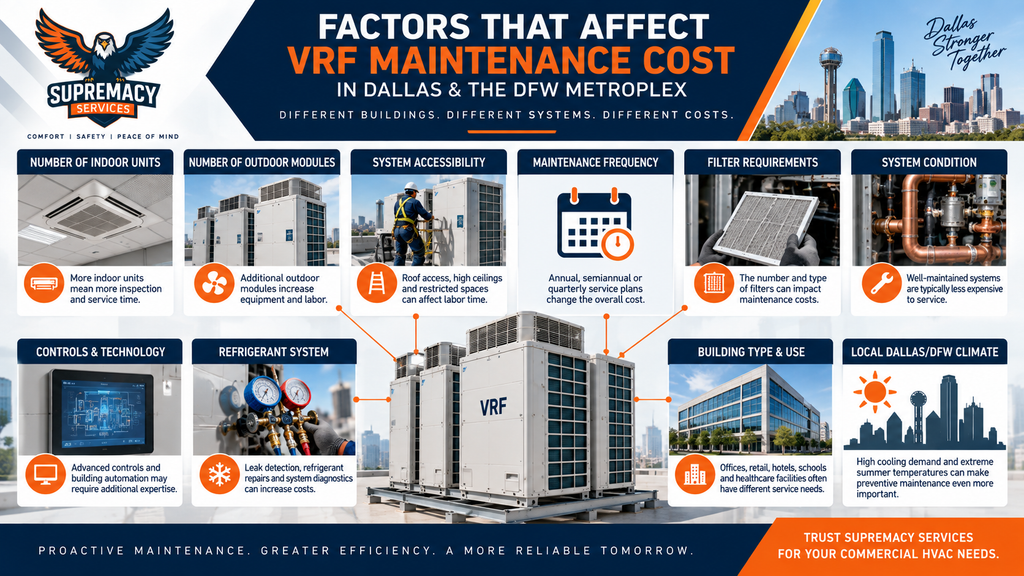
1. Number of Indoor Units
This is one of the biggest differences between VRF and conventional commercial HVAC.
A VRF network may serve numerous zones, each with its own cassette, ducted fan coil, wall-mounted unit or other indoor terminal.
Every additional indoor unit can add inspection and maintenance time.
For example, technicians may need to inspect its filter, coil, drain pan, condensate pathway, fan operation, thermistors and controller communication.
A building with 30 indoor units therefore presents a very different maintenance workload from one with six.
2. Number of Outdoor Modules
Larger VRF installations frequently use multiple outdoor modules.
These contain important components such as inverter-driven compressors, heat exchangers, fans, sensors and control electronics.
Additional modules increase the amount of equipment that needs to be inspected and documented.
3. System Accessibility
Accessibility can materially affect labor.
An indoor cassette accessible from an ordinary ceiling grid is different from equipment positioned above a high ceiling or in a restricted mechanical space.
Outdoor equipment may likewise be located at ground level, on a roof or in another area requiring special access procedures.
When requesting bids, property managers should tell contractors about access restrictions rather than comparing proposals based only on the number of units.
4. Maintenance Frequency
Two visits per year and quarterly preventive maintenance are not equivalent contracts.
Buildings with demanding operating schedules may need more frequent inspection than lightly occupied properties.
Maintenance frequency should ultimately reflect the manufacturer’s instructions, equipment condition, building use and operating environment rather than an arbitrary calendar rule.
5. Filter Requirements
Filters are relatively simple components, but a commercial building may have many of them.
Daikin documentation shows that some VRV indoor units use washable or long-life filters and provides specific filter-maintenance instructions. Different indoor-unit types and applications can have different requirements.
A proposal should therefore make clear whether filter cleaning or replacement is included—and whether replacement filters are included in the contract price.
6. Coil Condition
Dirty heat exchangers restrict heat transfer.
DOE guidance identifies coil cleaning as an important HVAC preventive-maintenance activity and notes that proper operations and maintenance can improve commercial HVAC performance and reduce energy waste.
VRF outdoor heat exchangers deserve particular attention because outdoor equipment in a commercial environment can accumulate dust, vegetation and other debris.
7. Refrigerant-System Problems
A basic preventive-maintenance visit is different from refrigerant leak diagnosis and repair.
VRF installations can contain substantial interconnected refrigerant piping. Diagnosing a leak may require additional testing and technician time beyond normal preventive maintenance.
A good proposal should clearly distinguish:
routine refrigerant-system inspection from leak detection, repair, evacuation and corrective refrigerant work.
8. Controls and Communication Problems
Modern VRF equipment depends heavily on sensors, communication wiring, control boards and centralized controls.
A zone that appears to have a mechanical cooling problem may actually have a sensor, controller, address or communication problem.
Troubleshooting these issues can require manufacturer-specific diagnostic tools and additional labor.
9. Existing System Condition
A clean, documented system that has received regular service is usually easier to maintain than equipment with:
- unresolved fault codes;
- clogged coils;
- recurring drain problems;
- deteriorated insulation;
- undocumented repairs;
- intermittent communication faults; or
- suspected refrigerant leakage.
An initial baseline inspection may therefore cost more than subsequent scheduled maintenance visits.
Why VRF Maintenance Matters in Dallas
Dallas commercial HVAC systems operate in a cooling-intensive climate.
National Weather Service climate normals for Dallas/Fort Worth show approximately 2,825 annual cooling degree days, with July and August accounting for the highest monthly cooling-degree-day totals. DFW also averages about 20 days per year with temperatures reaching at least 100°F.
That does not automatically mean every VRF system requires the same maintenance schedule.
It does mean Dallas facility managers should pay particular attention to cooling-season readiness.
A sensible maintenance strategy should consider performing important inspections and corrective work before sustained summer demand exposes an existing problem.
What Should Professional VRF Maintenance Include?
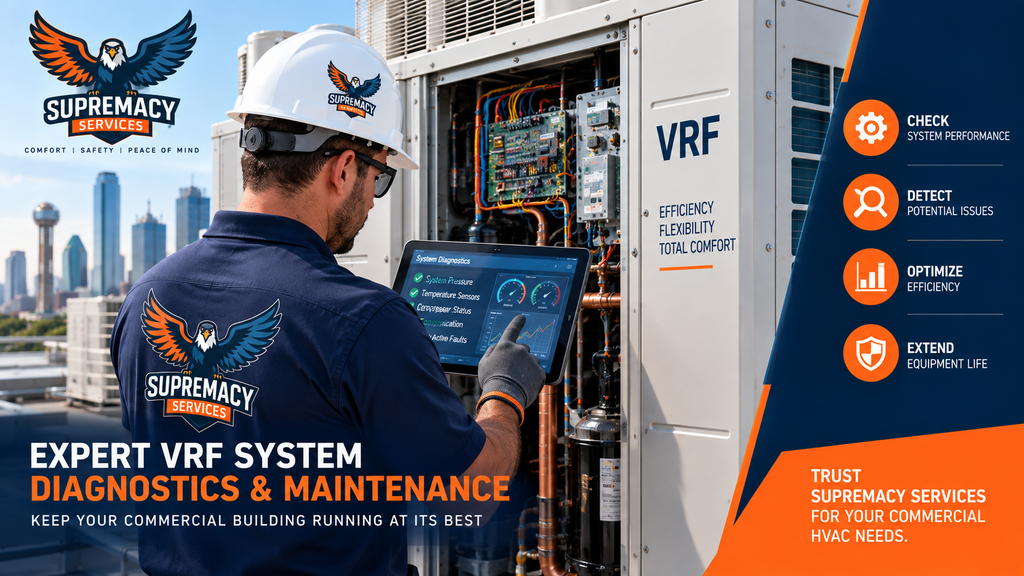
A useful VRF maintenance proposal should specify tasks rather than simply promise a “tune-up.”
Indoor Units
Typical inspection points can include:
- filters;
- evaporator coils;
- fan/blower condition;
- condensate pans;
- drain lines;
- condensate pumps where installed;
- thermistors;
- abnormal noise or vibration;
- airflow;
- controller operation; and
- visible signs of leakage or deterioration.
Outdoor Units
Depending on manufacturer procedures and system design, service may include:
- condenser/heat-exchanger inspection;
- coil cleaning where required;
- fan inspection;
- compressor operating checks;
- electrical inspection;
- sensor checks;
- refrigerant-system observations;
- abnormal vibration/noise inspection; and
- fault-history review.
Refrigerant Distribution System
The technician may inspect accessible:
- refrigerant piping;
- insulation;
- branch components;
- supports;
- joints;
- evidence of oil staining or leakage; and
- operating conditions indicating a possible refrigerant problem.
Controls and Communications
A VRF system should also be evaluated as a network.
That may include checking:
- zone controllers;
- centralized controllers;
- communication errors;
- sensor readings;
- equipment addressing;
- schedules;
- operating modes;
- stored fault codes; and
- communication between indoor and outdoor equipment.
This is one reason hiring a contractor familiar with the installed VRF manufacturer matters.
Preventive Maintenance vs. VRF Repair
| Preventive maintenance | Repair/diagnostic work |
|---|---|
| Scheduled | Triggered by a problem |
| Filter inspection | Failed component diagnosis |
| Coil inspection/cleaning | Control-board repair |
| Drain inspection | Condensate-pump replacement |
| Electrical inspection | Communication fault diagnosis |
| Operating-data review | Refrigerant leak repair |
| Sensor checks | EEV/component replacement |
| Identify developing issues | Correct existing failures |
The two should not be confused.
A maintenance agreement generally helps identify developing conditions, but it does not mean every repair, replacement component or refrigerant issue is automatically included.
Before signing a commercial maintenance agreement, ask exactly what is included and what becomes separately billable repair work.
Warning Signs Your VRF System Needs Service
Facility managers should consider professional diagnosis when they notice:
- one or more zones failing to cool or heat;
- repeated fault codes;
- multiple indoor units unexpectedly going offline;
- water leaking from a cassette or fan coil;
- persistent condensate problems;
- unexplained compressor shutdowns;
- unusual noise or vibration;
- reduced airflow;
- inconsistent temperatures;
- unexplained increases in HVAC energy use; or
- recurring controller/communication errors.
The presence of one symptom does not automatically identify the failed component.
For example, a warm room could result from an airflow problem, controller setting, thermistor issue, electronic expansion valve problem, refrigerant issue or another system condition.
Proper diagnosis should come before component replacement.
Can Building Staff Maintain a VRF System?
Building personnel can handle some basic facility-management tasks when permitted by the equipment documentation and company procedures.
That may include:
- keeping outdoor equipment clear of obvious debris;
- monitoring controller alarms;
- documenting comfort complaints;
- maintaining service records; and
- cleaning approved washable filters according to manufacturer instructions.
But refrigeration, electrical and technical diagnostic work should be handled by qualified personnel.
Texas regulates air-conditioning and refrigeration contracting. TDLR states that contractors who install, repair or maintain covered air-conditioning, refrigeration or heating systems must hold the applicable license, and Texas distinguishes Class A and Class B contractor privileges.
Facility managers should verify licensing and confirm that the contractor has experience with the specific VRF/VRV manufacturer installed at the property.
How Often Should Commercial VRF Equipment Be Maintained?
There is no universal schedule that should override the equipment manufacturer’s instructions.
Maintenance frequency can depend on:
- manufacturer requirements;
- building operating hours;
- indoor-unit quantity;
- environmental conditions;
- filtration;
- occupancy;
- system age;
- equipment condition; and
- criticality of the conditioned spaces.
Commercial preventive-maintenance programs are commonly structured around semiannual or quarterly inspections, while certain tasks may occur at different intervals.
The important distinction is that maintenance frequency and maintenance scope are not the same thing.
A quarterly visual inspection does not necessarily mean every coil receives deep cleaning four times per year.
The maintenance plan should define which tasks occur at each interval.
Is a VRF Maintenance Contract Worth It?
For commercial properties, a structured maintenance agreement can make HVAC spending more predictable and create a service history for the equipment.
DOE commercial-building guidance says effective HVAC maintenance can improve performance, decrease operating costs, extend equipment service life and reduce failure risk. DOE’s Better Buildings resources also cite estimates that O&M best practices can reduce organizational energy bills by approximately 5%–20%, although that is a broad commercial-building estimate and should not be interpreted as a guaranteed VRF savings percentage.
The strongest reason for a maintenance agreement is therefore not a promised percentage of savings.
It is systematic equipment management.
For a VRF property, that means having a documented process for monitoring filters, coils, condensate systems, compressors, controls, refrigerant circuits and developing faults.
What Should You Ask Before Signing a VRF Maintenance Agreement?
Use this checklist when comparing Dallas commercial HVAC proposals:
- How many indoor and outdoor units does the quote cover?
- Are all VRF components listed by model or equipment ID?
- How many visits are included?
- What work occurs during each visit?
- Are filters cleaned, replaced or only inspected?
- Are replacement filters included?
- Is coil cleaning included?
- Are condensate drains and pumps inspected?
- Are system fault codes downloaded and documented?
- Are controls and communication networks tested?
- Is refrigerant leak inspection included?
- What constitutes separately billable leak detection?
- Are repair parts included?
- Is repair labor included?
- Is after-hours work included?
- Are service reports provided?
- Does the contractor have experience with your VRF manufacturer?
- Is the contractor appropriately licensed in Texas?
Two quotes that appear far apart in price may actually include very different scopes.
Compare scope against scope, not just annual price.
VRF Maintenance vs. Conventional Commercial HVAC Maintenance
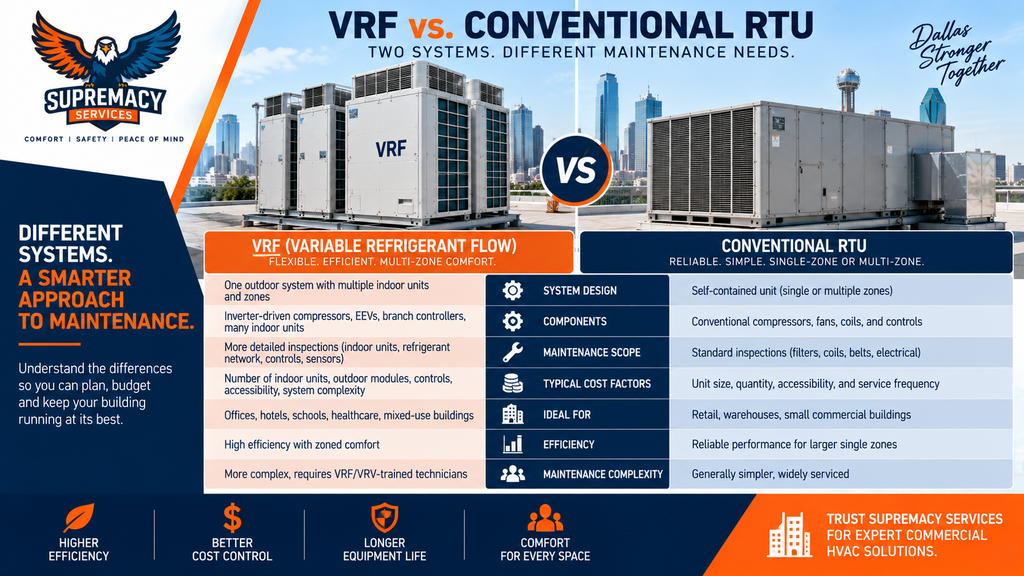
VRF systems require a different maintenance mindset from conventional packaged equipment.
| Factor | Conventional RTU | VRF/VRV |
|---|---|---|
| Zones | Usually limited | Potentially many |
| Indoor units | Generally centralized | Numerous possible |
| Compressor control | Conventional/staged or variable depending on equipment | Inverter-driven system architecture |
| Refrigerant network | Relatively localized | Can serve many connected zones |
| Controls | Often comparatively straightforward | Highly integrated |
| Electronic expansion valves | System-dependent | Important part of VRF refrigerant control |
| Communication network | Less extensive in many systems | Critical to system operation |
| Maintenance pricing | Often quoted per unit | Better based on complete system inventory |
This complexity is why an inexpensive generic commercial “AC tune-up” should not automatically be treated as equivalent to specialized VRF preventive maintenance.
Dallas VRF Maintenance: Repair, Maintain or Replace?
Maintenance is appropriate when equipment is fundamentally operational and the objective is to preserve performance, correct minor deficiencies and detect developing problems.
Repair becomes appropriate when testing identifies a failed component or system fault.
Replacement or major modernization deserves consideration when the property faces broader problems such as repeated major failures, obsolete components, major refrigerant-system issues, inadequate capacity or a system that no longer serves the building’s operational requirements.
Those decisions should be based on diagnostics, equipment age and condition, repair history, parts availability, operating costs and the economics of the specific building—not an arbitrary age cutoff.
If your property is considering an entirely new VRF/VRV system rather than maintaining the existing equipment, Supremacy’s VRV System Installation in Dallas service provides a separate path for system design and installation.
How to Get an Accurate VRF Maintenance Quote in Dallas
The most useful commercial quote starts with an equipment survey.
Before requesting pricing, gather:
- Property address
- Building use
- Approximate operating hours
- Manufacturer
- Outdoor-unit model numbers
- Indoor-unit count
- Controller type
- Current alarms or fault codes
- Existing maintenance records
- Known refrigerant or condensate problems
- Access restrictions
- Preferred service frequency
The contractor can then build a maintenance scope around the actual system rather than applying generic commercial HVAC pricing.
Supremacy Services provides VRV/VRF system service and maintenance in Dallas and the DFW Metroplex, including system diagnostics, refrigerant and EEV analysis, coil and airflow maintenance, sensor evaluation and controls work.
For a commercial property, request an equipment-specific maintenance assessment so the proposed scope reflects the number of indoor units, outdoor modules, controls and actual operating condition of your system.
Frequently Asked Questions
How much does VRF HVAC maintenance cost in Dallas?
There is no standard Dallas price because VRF systems vary substantially in size and complexity. Published Dallas commercial HVAC benchmarks range from hundreds of dollars per conventional unit annually to several thousand dollars for larger commercial properties. VRF systems should generally be quoted after an equipment inventory.
Why can VRF maintenance cost more than a conventional AC tune-up?
A VRF network may contain numerous indoor units, inverter compressors, electronic expansion valves, refrigerant branches, sensors and networked controls. More components and zones can mean more inspection and diagnostic time.
How often should a commercial VRF system be serviced?
Follow the manufacturer’s requirements and a maintenance schedule appropriate for the building. Semiannual or quarterly professional inspections are common commercial arrangements, but individual tasks may have different intervals.
Is VRV the same as VRF?
They refer to the same general variable-refrigerant technology. VRV is Daikin’s terminology; VRF is the broader industry term.
What should be included in VRF preventive maintenance?
Depending on the system, maintenance can include filters, coils, condensate systems, electrical components, sensors, compressor operation, refrigerant-system inspection, fault codes, controllers and communication networks.
Does VRF maintenance include refrigerant?
Not necessarily. Routine inspection and corrective refrigerant work should be treated separately unless the maintenance agreement explicitly states otherwise.
Can my building maintenance staff service VRF equipment?
Facility personnel may be able to perform approved basic tasks such as monitoring alarms or maintaining certain filters. Refrigeration, electrical and technical diagnostic work should be performed by appropriately qualified personnel.
How can I compare VRF maintenance contracts?
Compare equipment coverage, service frequency, included tasks, filters, coil cleaning, controls diagnostics, refrigerant inspection, reporting, repair exclusions and emergency-service terms—not just the annual price.
Should VRF maintenance include diagnostic reports?
For a commercial system, documented readings, fault histories, findings and recommendations can be particularly useful because they allow facility managers to track changes over time and plan corrective work.
Schedule Commercial VRF/VRV Maintenance in Dallas
If you manage a Dallas–Fort Worth commercial property with VRF or VRV equipment, start with an accurate equipment inventory and system assessment rather than relying on generic per-unit pricing.
Request VRV/VRF service and maintenance from Supremacy Services to establish the condition of your equipment, identify maintenance requirements and build an appropriate service plan for your property.

