
If your water heater is making popping or rumbling noises, sediment or mineral buildup inside a tank-style water heater is one of the most common causes. As water heats beneath accumulated deposits, bubbles can form and escape through the sediment, producing popping, crackling or low rumbling sounds.
That deserves particular attention in Dallas because the City of Dallas has reported water hardness in the range of approximately 120–155 mg/L as calcium carbonate, placing much of that range within the commonly defined “hard water” category. Mineral content can therefore contribute to scale and sediment accumulation inside water-heating equipment over time.
A noisy water heater does not automatically mean the tank needs replacement. Sometimes professional flushing or maintenance is enough. But loud noises accompanied by leaking, corrosion, inconsistent hot water or an aging tank can justify a more complete inspection.
Table of Contents
- What causes popping and rumbling?
- Why sediment causes noise
- Is the noise dangerous?
- Other water-heater noises
- Dallas hard-water considerations
- Can flushing stop the noise?
- DIY vs professional service
- Professional diagnosis
- Repair vs replacement
- Cost
- Prevention
- FAQs
What Causes a Water Heater to Pop or Rumble?
Popping and rumbling in a conventional tank water heater most commonly point to mineral sediment accumulating near the bottom of the tank. Other possibilities include scale on electric heating elements, normal thermal expansion, pressure-related noises, water hammer or component problems.
Manufacturer guidance from both Rheem and A. O. Smith identifies sediment accumulation as a common explanation for popping or rumbling in tank-style heaters.
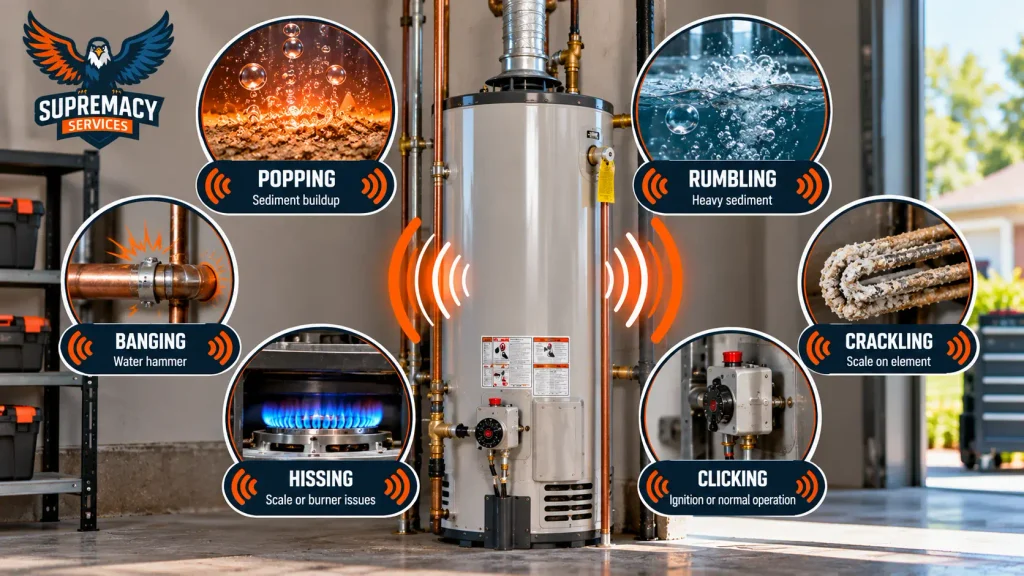
Common causes at a glance
| Sound | Possible cause | Typical response |
|---|---|---|
| Popping | Sediment trapping heated water or steam bubbles | Inspect and consider flushing |
| Low rumbling | Heavy sediment or scale | Professional maintenance may be appropriate |
| Crackling | Sediment or scale around an electric element | Inspect element and tank |
| Banging from pipes | Water hammer rather than the tank itself | Evaluate plumbing pressure/flow |
| Hissing | Scale on an element or, in some situations, water contacting hot components | Inspect promptly |
| Light clicking | Ignition, controls or normal expansion on some systems | Often normal if brief and consistent |
| Screeching/whistling | Restricted water flow or valve-related issue | Professional diagnosis recommended |
The sound alone is not always enough to identify the problem. Where the sound originates, when it happens and whether other symptoms appear at the same time are important clues.
Why Does Sediment Make a Water Heater Pop?
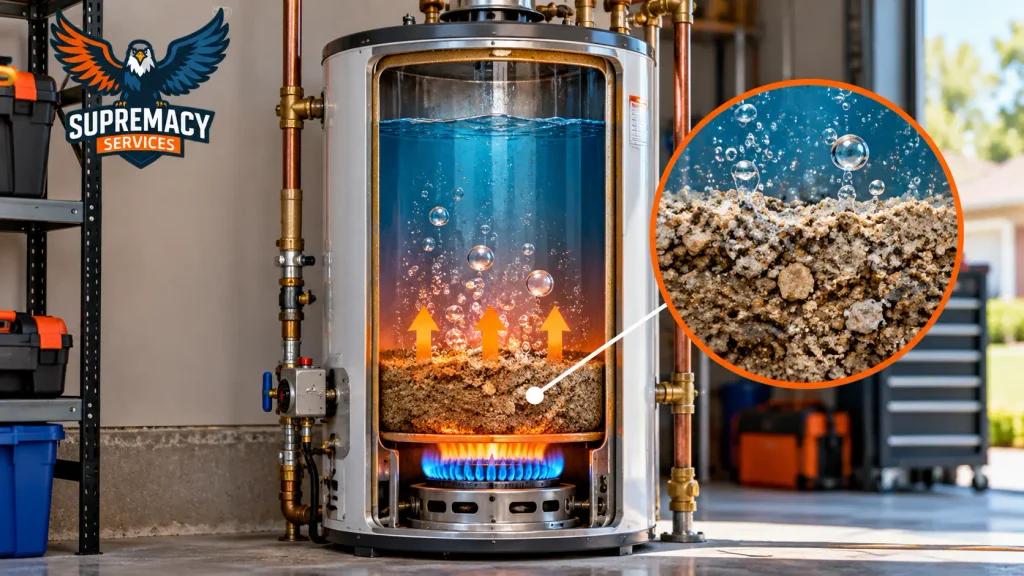
Sediment settles between the water and the heat source. As the heater operates, water trapped around or beneath those deposits can heat rapidly and force its way through the sediment, producing popping and rumbling.
A. O. Smith specifically explains that sediment near the tank bottom can trap bubbles, which then escape through the deposits and create a popping sound. The same buildup can interfere with efficient heat transfer.
Think of the bottom of the tank as the working surface where much of the heat transfer occurs.
In a clean system:
heat source → tank/water → hot water
With substantial sediment:
heat source → sediment layer → water
That additional layer can interfere with heat transfer and may make the equipment work harder to heat the stored water.
Manufacturer documentation also warns that sediment accumulation can create noise and contribute to premature tank deterioration.
Where does the sediment come from?
Water naturally carries dissolved minerals and small quantities of other material.
As water is repeatedly heated, minerals can precipitate and deposits can accumulate inside the tank.
The amount and rate of buildup depend on factors including:
- Local water chemistry
- Water temperature
- Household hot-water consumption
- Age of the water heater
- Maintenance history
- Equipment design
- Whether the system has previously been flushed
Is a Popping or Rumbling Water Heater Dangerous?
Occasional mild expansion noises may be normal, but loud or worsening popping and rumbling should not simply be ignored.
Sediment itself does not mean the tank is about to explode. However, persistent noise can indicate that maintenance has been neglected or that heat transfer and internal components are being affected.
Rheem recommends further attention when a water heater develops persistent loud rumbling, screeching, sizzling, leaking or continued noise even after maintenance.
Call for professional inspection promptly if noise occurs with:
- Water around the bottom of the heater
- Visible tank corrosion
- Rust-colored hot water
- A burning smell
- Hissing or sizzling near electrical or burner components
- Repeated loss of hot water
- Water temperatures that change unexpectedly
- Frequent breaker trips
- Burner or ignition problems
- Significant vibration
- Pressure-related symptoms
- An older tank with multiple developing problems
Hearing loud popping or rumbling every time your water heater runs? Supremacy Services can inspect the system, determine whether sediment, scale or another component is responsible, and explain whether maintenance, repair or replacement makes the most sense for your DFW home.
What If the Noise Is Not Caused by Sediment?
Not every sound from a water heater means sediment.
Water hammer
A loud bang or thump that happens when a faucet, appliance or valve closes may originate in the plumbing rather than inside the water heater.
Water hammer happens when moving water changes velocity abruptly and creates a pressure shock through the piping.
This is different from the repetitive popping that occurs while a tank is actively heating.
Electric heating-element scale
Electric water heaters use immersed heating elements.
Mineral deposits can form around these elements. A. O. Smith notes that scale on heating elements may contribute to hissing or related noises.
Normal expansion and contraction
Metal components expand as they heat and contract as they cool.
Manufacturer documentation recognizes some expansion and contraction noises as part of normal water-heater operation.
Quiet, occasional ticks are therefore different from a tank that suddenly begins loudly rumbling throughout every heating cycle.
Leaking water contacting hot components
Hissing or sizzling deserves more attention, particularly if moisture is visible.
A. O. Smith notes that sizzling around gas water-heater components can be associated with water reaching the burner area and warrants professional inspection.
Tankless water-heater scale
Tankless equipment does not accumulate sediment in a large storage tank in the same way a conventional heater does.
However, mineral scale can form inside heat exchangers and water passages.
Tankless noises should therefore be diagnosed according to the specific model, error codes, flow characteristics and manufacturer maintenance requirements.
Does Dallas Water Contribute to Sediment Buildup?
Yes, Dallas water contains enough calcium and magnesium to make mineral accumulation a relevant maintenance consideration for water-heating equipment.
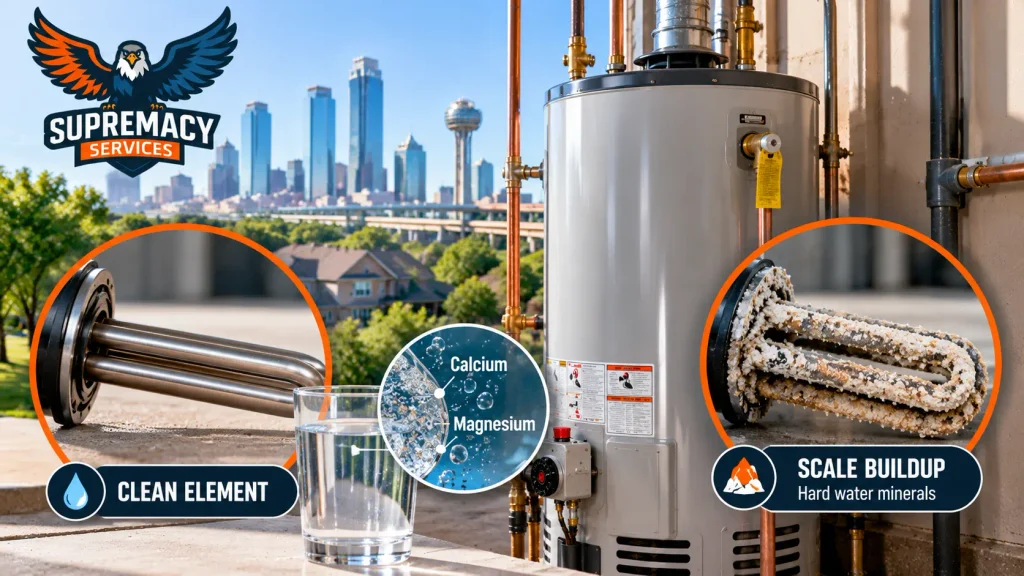
A City of Dallas memorandum reports water hardness of approximately 120–155 mg/L as CaCO₃. The same document identifies 121–180 mg/L as the “hard” range.
That does not mean every Dallas water heater will develop severe sediment, nor does it mean Dallas drinking water is unsafe.
Dallas Water Utilities states that its drinking water meets or exceeds applicable federal, state and local requirements.
Water hardness is primarily a mineral-management and appliance-maintenance issue, not an indication that the municipal drinking water is unsafe.
What Dallas homeowners may notice
Mineral accumulation can appear as:
- White or chalky scale around fixtures
- Deposits on showerheads
- Scale on heating elements
- Sediment during tank flushing
- Reduced hot-water performance
- Increasing popping or rumbling from an older tank
Dallas obtains its municipal supply from surface-water reservoirs and treats the water before distribution.
Will Flushing a Water Heater Stop the Popping?
If loose sediment is causing the noise, properly flushing the tank may significantly reduce or eliminate the popping.
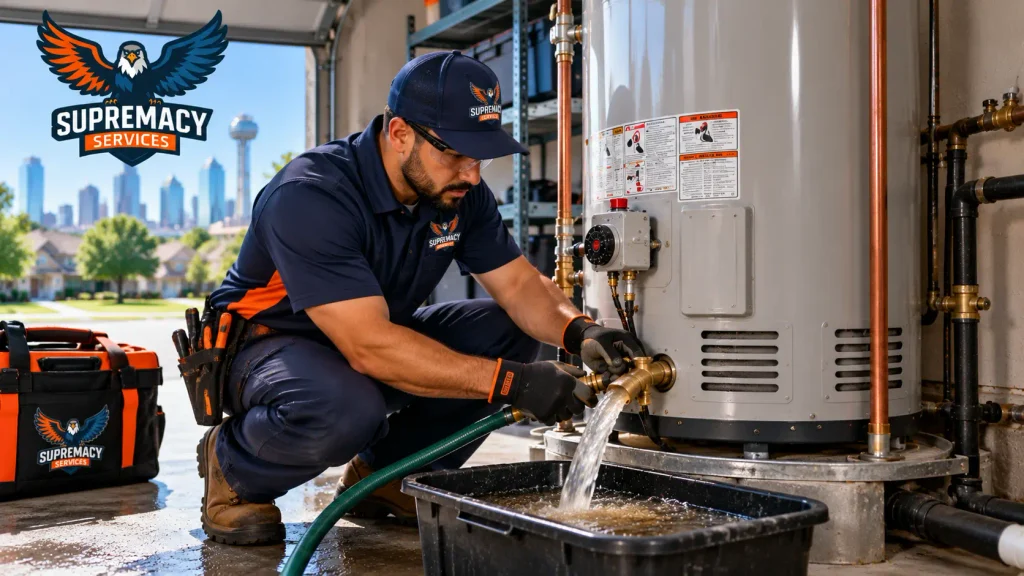
A. O. Smith recommends draining and flushing a tank when sediment is responsible for popping, while manufacturer documentation also identifies tank flushing as the remedy for sediment-related noise.
However, flushing is not guaranteed to solve every noisy-water-heater problem.
Flushing is most likely to help when:
- The noise began gradually
- The heater has not been flushed recently
- There are no visible tank leaks
- Sediment is discharged from the drain
- Hot-water performance has gradually deteriorated
- The tank is otherwise in serviceable condition
Flushing may not completely solve the problem when:
- Deposits have hardened substantially
- Heating elements are heavily scaled
- The drain valve is clogged
- Internal tank deterioration has occurred
- Noise originates in the plumbing rather than the heater
- Another component is failing
- The tank has reached advanced age and developed several symptoms
A professional can determine whether flushing remains worthwhile before disturbing an older tank that may already have significant deterioration.
Can You Flush a Noisy Water Heater Yourself?
Some homeowners can perform routine tank flushing, but the correct procedure depends on the exact heater, fuel source and manufacturer instructions.
A water heater contains extremely hot water and may involve electricity or natural gas, so this is not a maintenance task to improvise.
DIY may be reasonable when:
- You have the manufacturer instructions
- The unit is in otherwise good condition
- The drain valve operates normally
- You understand how to safely shut down and restart the specific heater
- You have a safe drainage location
- There are no signs of leaking, gas problems or electrical faults
Call a plumber instead when:
- The heater is very old
- The drain valve will not operate
- The tank is corroded
- Water is already leaking
- You smell gas
- Electrical components show damage
- The heater is located in a difficult attic or enclosed location
- You are unsure how to shut down and restart it correctly
- Flushing has not stopped the noise
Always follow the maintenance instructions for the actual make and model rather than a generic internet procedure.
What Does a Plumber Check on a Noisy Water Heater?
A professional diagnosis should determine the cause of the sound before recommending replacement.
Depending on the heater, an inspection may include:
- Listening to the noise during a heating cycle
- Checking for leaks or tank corrosion
- Reviewing the age and condition of the equipment
- Looking for sediment or scale accumulation
- Checking accessible burner or heating-element operation
- Evaluating thermostatic controls
- Inspecting the anode rod where appropriate
- Checking the temperature-and-pressure relief system
- Evaluating plumbing pressure and possible water hammer
- Flushing or descaling when appropriate
- Determining whether further component repair is justified
- Comparing continued repair with replacement if the tank is significantly deteriorated
Supremacy’s existing water-heater service page already describes its diagnostic process as including checks for sediment buildup, anode-rod condition, burner efficiency and tank integrity.
Does a Noisy Water Heater Need to Be Replaced?
Not necessarily. Noise caused primarily by removable sediment may be a maintenance problem rather than a replacement problem.
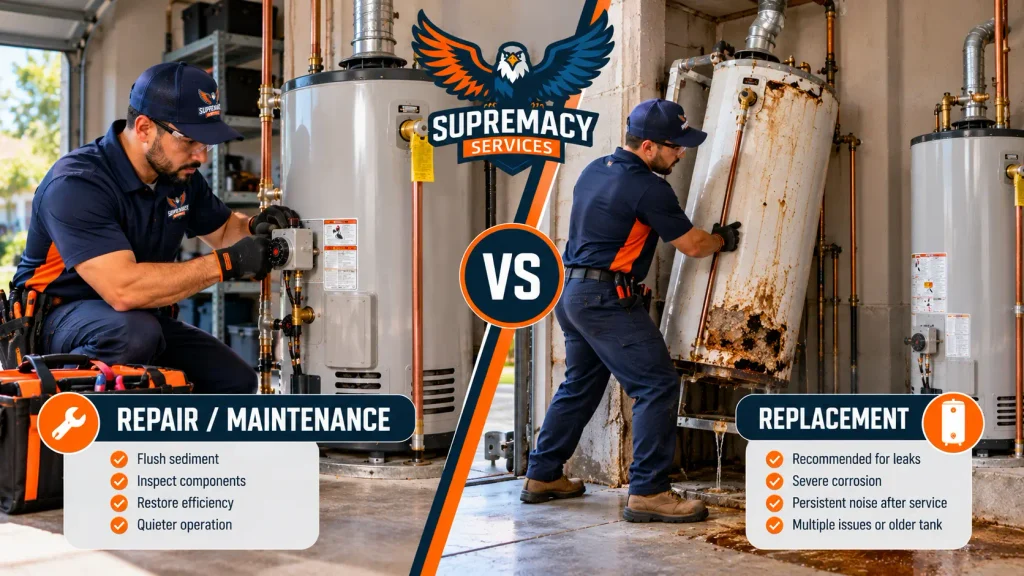
Replacement becomes more reasonable when popping or rumbling is only one symptom among several.
| Situation | Maintenance/repair may make sense | Replacement deserves consideration |
|---|---|---|
| Sediment but no leak | ✓ | |
| Heater otherwise performs normally | ✓ | |
| Serviceable heating element or component | ✓ | |
| Noise stops after maintenance | ✓ | |
| Tank itself is leaking | ✓ | |
| Serious internal corrosion | ✓ | |
| Repeated repairs | ✓ | |
| Persistent performance problems | ✓ | |
| Older heater plus multiple failure symptoms | ✓ | |
| Noise persists after appropriate maintenance | Depends | ✓ |
Avoid using an arbitrary age alone as an automatic replacement rule.
The better decision considers:
equipment age + tank condition + repair history + leak status + hot-water performance + expected repair cost
If the tank is leaking, heavily corroded or still rumbling after appropriate maintenance, schedule a professional assessment before investing in repeated repairs. Supremacy Services provides water-heater diagnostics and replacement throughout Dallas–Fort Worth.
How Much Does It Cost to Fix a Popping Water Heater in Dallas?
The cost depends on whether the problem requires only flushing or involves a failed component, severe scale, leaking or complete replacement.
For a market benchmark—not a Supremacy quote—Angi’s May 2026 Dallas cost guide estimates professional water-heater flushing at approximately $113–$206 on average, with a broader reported range of about $75–$250, depending on heater type, size and labor requirements.
These are third-party consumer estimates, not fixed Supremacy pricing.
Factors affecting the actual cost
- Tank versus tankless equipment
- Tank size
- Severity of sediment
- Accessibility
- Whether the drain valve is clogged or damaged
- Gas versus electric equipment
- Whether heating elements need attention
- Additional plumbing problems
- Need for anode-rod or valve replacement
- Whether the tank has started leaking
- Whether replacement becomes more economical
A diagnosis is therefore more useful than assuming every popping sound requires the same repair.
How Can You Prevent Water-Heater Sediment?
The most useful preventive strategy is to follow the maintenance schedule specified by the manufacturer for your particular water heater and local water conditions.
Manufacturer sources commonly recommend periodic flushing because sediment and mineral deposits can accumulate over time.
Practical prevention checklist
- Follow your manufacturer’s flushing schedule
- Do not wait for loud rumbling before considering maintenance
- Check the heater periodically for leaks
- Watch for rust or corrosion
- Have the anode rod inspected according to manufacturer guidance
- Address hard-water scale where appropriate
- Have tankless equipment descaled as required by its manufacturer
- Investigate sudden changes in hot-water recovery time
- Do not ignore persistent pressure or water-hammer problems
- Keep records of repairs and maintenance
Important distinction: flushing vs. descaling
Flushing a storage tank primarily helps remove loose sediment from the bottom.
Descaling generally involves removing mineral scale from components such as tankless heat exchangers.
The correct maintenance process depends on the equipment.
When Should You Call a Plumber?
Schedule professional water-heater service when:
- Popping becomes louder or more frequent
- Rumbling continues through most heating cycles
- Flushing does not resolve the noise
- Hot water runs out faster than before
- Water takes unusually long to reheat
- Rust-colored hot water appears
- Moisture appears around the tank
- Corrosion is visible
- Hissing or sizzling develops
- The heater repeatedly shuts down
- The unit develops several symptoms at once
A small maintenance problem is generally easier to evaluate before it becomes a loss-of-hot-water or leaking-tank problem.
Supremacy services
Frequently Asked Questions
Why does my water heater sound like popcorn?
A popcorn-like popping sound commonly occurs when water and bubbles force their way through sediment accumulated near the bottom of a storage tank. Flushing may help if sediment is the primary cause.
Is it normal for a water heater to rumble?
Very mild operational sounds can be normal. Persistent or loud rumbling is different and commonly points to sediment or scale that deserves inspection.
Can sediment ruin a water heater?
Heavy sediment can interfere with heat transfer and place additional stress on a storage water heater. Manufacturer documentation also warns that sediment accumulation can contribute to premature tank deterioration.
Will flushing my water heater stop the popping noise?
Often, yes—when loose sediment is the cause. If the noise continues after proper flushing, another issue or more severe buildup may be present.
Why does my electric water heater crackle?
Mineral scale can accumulate around electric heating elements and contribute to crackling, popping or hissing. An element may need inspection if maintenance does not solve the problem.
Can hard water cause my water heater to make noise?
Yes. Calcium- and magnesium-related mineral deposits can accumulate in water-heating equipment. Dallas has documented water hardness around 120–155 mg/L as CaCO₃, making mineral buildup a relevant local maintenance consideration.
Should I replace a water heater because it is popping?
Not based on noise alone. A serviceable tank may simply need maintenance. Replacement becomes more compelling when the heater is leaking, heavily corroded, unreliable or repeatedly needs repairs.
How often should a Dallas water heater be flushed?
Use the maintenance interval specified by the heater manufacturer. Water conditions and equipment type can change the appropriate schedule, so a universal interval is not ideal for every home.
Can a tankless water heater make mineral-related noises?
Yes. Tankless systems do not collect bottom sediment like storage tanks, but mineral scale can accumulate within the heat exchanger and water passages and may require manufacturer-specified descaling.
Is a sizzling water heater more serious than popping?
Potentially. Hissing or sizzling can sometimes indicate water reaching hot components or scale affecting an element. If moisture, leaking, electrical problems or burner issues are present, professional inspection is appropriate.
Final Takeaway
A water heater making popping or rumbling noises is often telling you that sediment or mineral scale has accumulated somewhere it should not.
In Dallas and the wider DFW Metroplex, local water hardness makes mineral accumulation a legitimate maintenance consideration, but the noise does not automatically mean you need a new water heater.
Start by identifying:
what sound you hear → when it happens → whether other symptoms exist → condition and age of the heater → maintenance history
If sediment is the problem, maintenance may restore quieter operation. If the tank is leaking, badly corroded or continuing to malfunction despite maintenance, replacement may provide better long-term value.
Water heater still popping, rumbling or struggling to keep up? Supremacy Services can diagnose the cause and help you compare maintenance, repair and replacement options for your Dallas–Fort Worth home. Schedule professional water-heater service before a manageable issue becomes a larger plumbing problem.

