
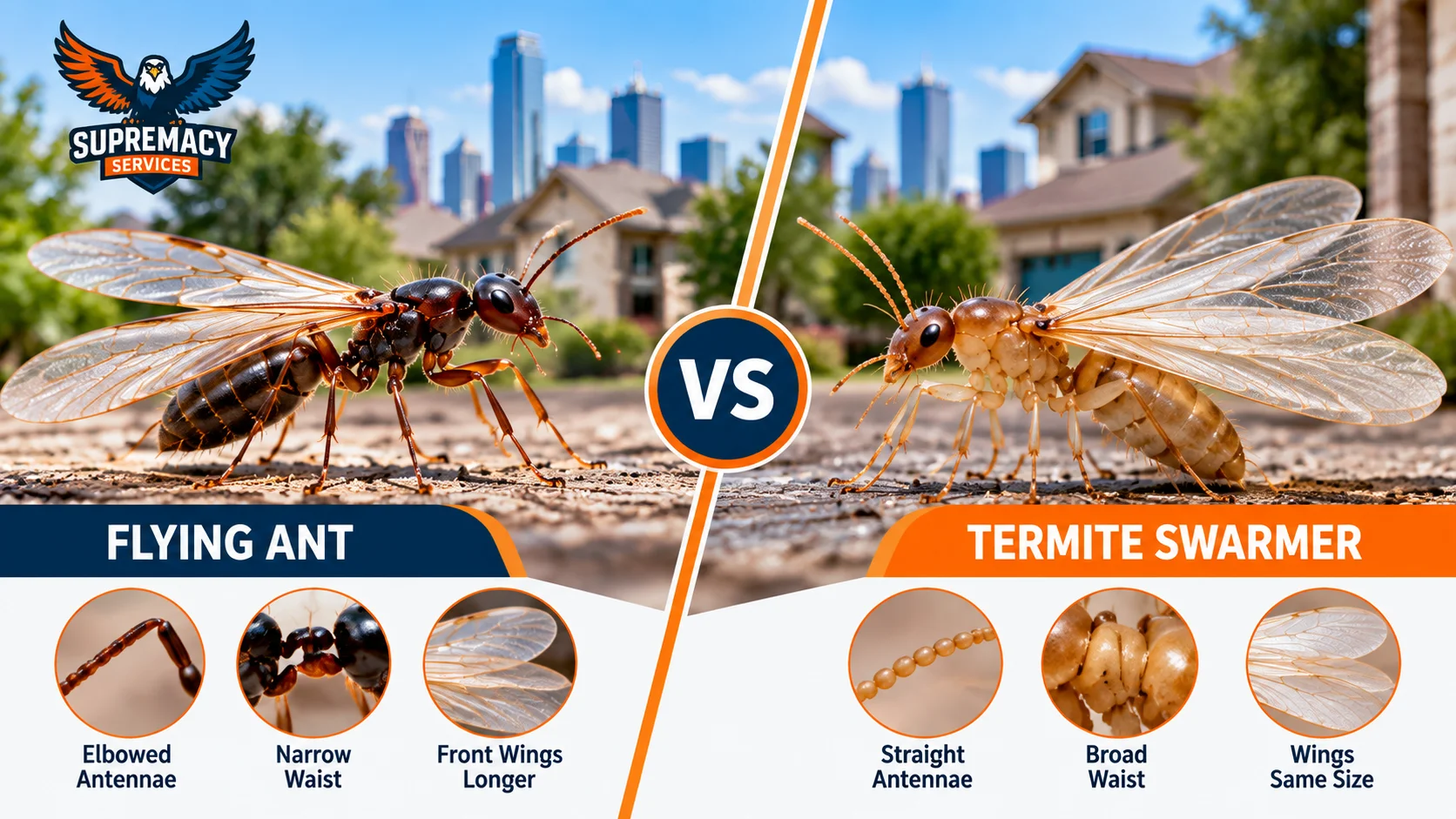
If you find dozens of winged insects around your Dallas home, look first at their antennae, waist and wings. Flying ants generally have elbowed antennae, a narrow or pinched waist, and front wings longer than their hind wings. Termite swarmers have straighter antennae, a broader waist and two pairs of wings that are roughly equal in length. Texas A&M AgriLife Extension Service
That distinction matters because a termite swarm can indicate a nearby termite colony—and termites can damage structural wood without being obvious from inside the living space. The EPA notes that homeowners often do not discover termites until they encounter a swarm or find damage during construction. US EPA
For Dallas and DFW homeowners, the safest approach is therefore identify first, treat second. Don’t assume every winged insect is a termite, but don’t dismiss suspected termite swarmers as ordinary flying ants either.
Table of Contents
- Flying Ants vs. Termites: Quick Comparison
- What Are Termite Swarmers?
- What Are Flying Ants?
- How to Tell Flying Ants From Termites
- What Does a Termite Swarm Mean?
- What Should You Do If You Find Them Indoors?
- Other Signs of Termites
- DIY Identification vs. Professional Inspection
- How to Reduce Termite and Ant Problems
- When to Call a Professional
- Frequently Asked Questions
Flying Ants vs. Termites: Quick Comparison
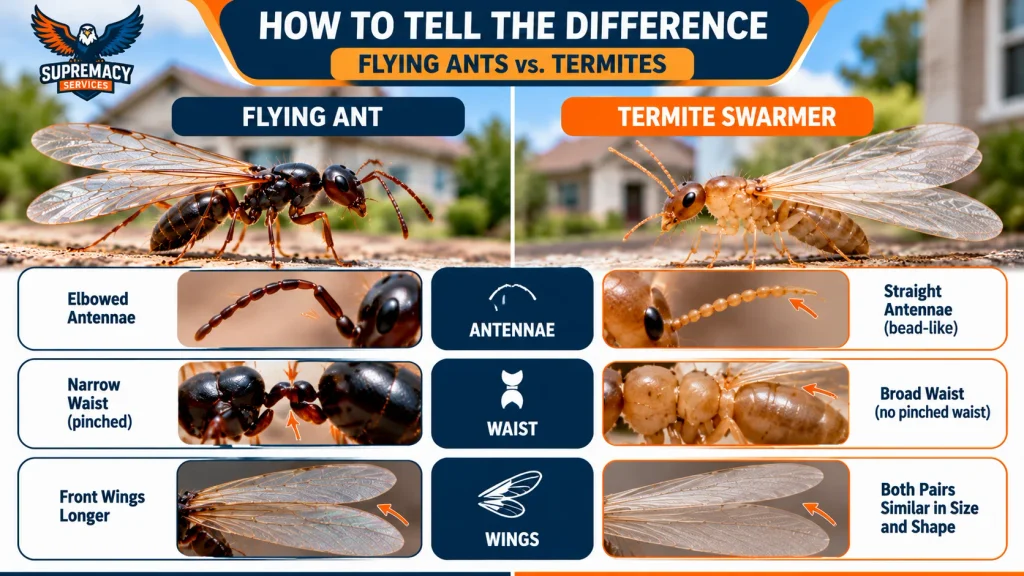
The easiest way to distinguish a flying ant from a termite swarmer is to compare three features at the same time: antennae, waist and wings.
| Feature | Flying Ant | Termite Swarmer |
|---|---|---|
| Antennae | Elbowed/bent | Relatively straight, bead-like |
| Waist | Narrow and visibly constricted | Broad, without an ant-like constriction |
| Wings | Front pair larger/longer than rear pair | Two pairs similar in size and shape |
| Body profile | Clearly segmented appearance | More uniformly broad through the middle |
| What it may indicate | Reproductive ants establishing or leaving a colony | Reproductive termites leaving a mature colony |
| Homeowner response | Identify the ant species and source | Investigate promptly for additional termite evidence |
Texas A&M AgriLife uses these same characteristics when differentiating winged carpenter ants from termites. Texas A&M AgriLife Extension Service
Don’t rely on color alone. Body color can be much less useful than the combination of wings, antennae and waist.
What Are Termite Swarmers?
Termite swarmers are winged reproductive members of a termite colony. They are also commonly called alates.
A termite colony normally operates out of sight. Swarmers are different because they leave an established colony as part of the reproductive cycle.
That is why seeing winged termites can suddenly make a previously hidden problem visible.
The EPA specifically lists termite swarms as one of the ways homeowners discover termite activity. US EPA
Do termite swarmers eat your house?
The swarmers themselves are not the workers responsible for most feeding damage.
Their importance is what their presence may reveal: a mature termite colony exists somewhere in the surrounding environment or structure.
Finding a single unidentified insect outside does not establish that your home is infested. Finding numerous suspected termite swarmers inside the structure, however, deserves closer investigation.
What Are Flying Ants?
Flying ants are reproductive ants produced by established ant colonies. Their wings allow males and reproductive females to leave colonies during mating flights.
They are not a separate species called a “flying ant.”
Many different ant species can produce winged reproductives.
Texas A&M notes that mature carpenter ant colonies produce winged males and females and that winged carpenter ants can resemble winged termites. Importantly for Texas homeowners, the university notes that the two groups can sometimes swarm during the same general period, making accurate identification especially important. Texas A&M AgriLife Extension Service
That means:
Seeing wings does not automatically mean termites.
You need to look at the insect itself.
How to Tell Flying Ants From Termites
1. Look at the antennae
Flying ants: antennae are noticeably bent or elbowed.
Termite swarmers: antennae appear relatively straight and are composed of bead-like segments.
This can be difficult to see without getting close, so safely collect a dead specimen or take a sharp close-up photograph rather than trying to identify insects while they are moving.
2. Look at the waist
This is often one of the easiest characteristics to recognize.
A flying ant has a clearly constricted or pinched waist between the thorax and abdomen.
A termite does not have the same narrow ant-like waist. Its body looks much more uniformly joined through the middle. Texas A&M AgriLife Extension Service
3. Compare the wings
Flying ants have unequal wing pairs. Their front wings are longer than the rear wings.
Termite swarmers have four wings that are much more similar in length, shape and pattern. Texas A&M AgriLife Extension Service
A simple three-point homeowner test
Ask:
- Are the antennae elbowed?
- Is the waist noticeably pinched?
- Are the front wings longer than the rear wings?
If all three are obvious, you are likely looking at a winged ant.
If the insect instead has relatively straight antennae, a broad waist and approximately equal-length wings, termite swarmers should be considered.
Not sure which insect you found? Learn about Supremacy Services’ Dallas pest-control options and have the pest correctly identified before deciding on treatment.
What Does a Termite Swarm Around Your Dallas Home Mean?
A termite swarm indicates that reproductive termites have left a mature colony, but a swarm outdoors does not by itself prove that the colony is inside your house.
Location is therefore important.
Swarmers outside
Termites outdoors can originate from colonies in the surrounding environment.
Don’t assume that seeing a few outdoors means the structure is actively infested.
Instead, inspect for additional evidence around the house.
Swarmers emerging indoors
If numerous suspected termite swarmers appear from:
- a wall;
- baseboard;
- window frame;
- door frame;
- floor opening;
- expansion joint;
- plumbing penetration; or
- another part of the structure,
a professional termite inspection is a reasonable next step.
The same applies if you repeatedly find discarded wings indoors without seeing the insects themselves.
Why Dallas homeowners should take swarmers seriously
Texas A&M provides extensive guidance specifically for subterranean termites and notes that Texas has substantial termite risk.
That does not mean every Dallas house has termites or every winged insect around a DFW property is a termite.
It means suspected termite activity deserves proper identification rather than guesswork.
What Should You Do If You Find Flying Ants or Termites Indoors?
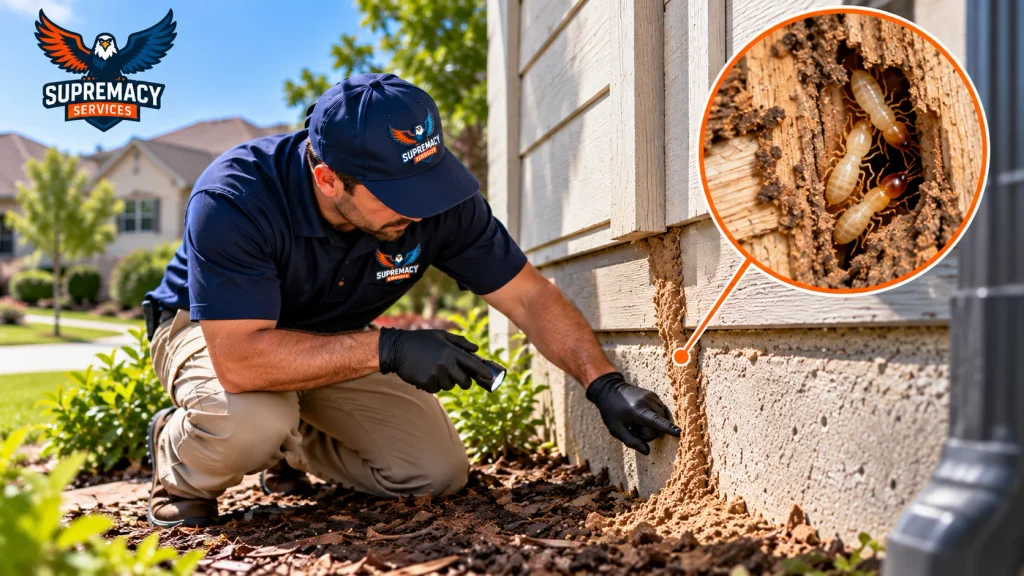
Don’t immediately spray or discard all the insects. Preserve a sample, document where they appeared and inspect the surrounding area for additional clues.
Homeowner checklist
1. Collect a specimen
Save several insects in a small container or sealed bag if you can do so safely.
2. Take close-up photographs
Photograph the:
- wings;
- antennae;
- waist;
- body;
- exact location where they appeared.
3. Record where you found them
Was it:
- near a window?
- along a baseboard?
- beside the foundation?
- in the garage?
- around a bathroom?
- coming directly from a wall or piece of wood?
That context can help distinguish incidental outdoor swarmers from potential structural activity.
4. Look for discarded wings
Check windowsills, floors and other areas around the swarm.
5. Look for additional termite evidence
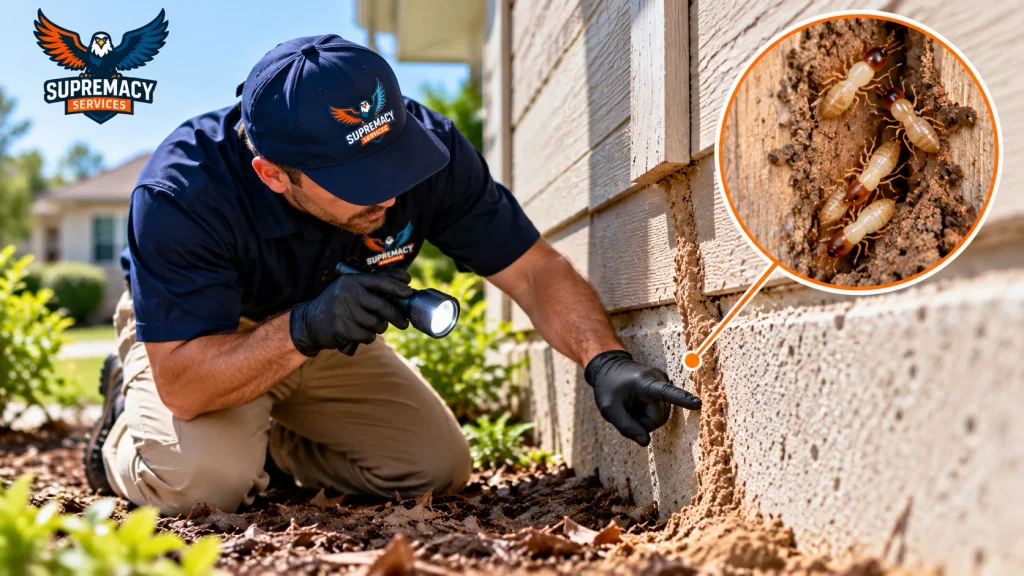
Pay attention to mud tubes and suspicious wood damage.
6. Avoid assuming the pest based solely on an internet photo
Scale, lighting and insect position can make identification surprisingly difficult.
7. Arrange an inspection when termite activity is reasonably suspected
Correct identification should come before selecting a treatment.
What Other Signs Can Point to Termites?
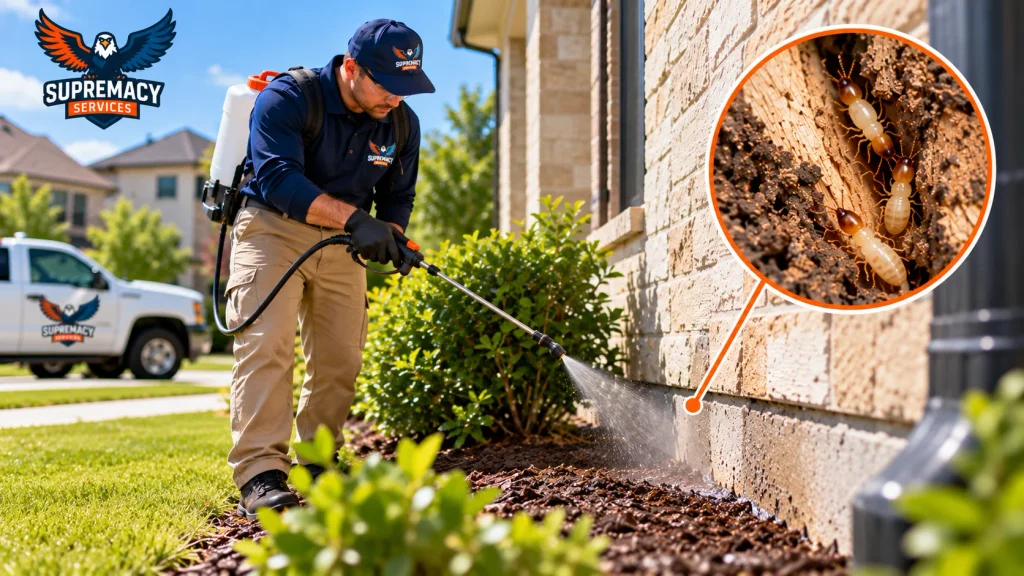
Swarmers are only one potential clue.
The EPA recommends watching for termite swarms and examining exposed wood for hollow areas. US EPA
Depending on the termite involved and conditions around the property, possible warning signs can include:
- discarded wings;
- mud or shelter tubes;
- suspicious wood deterioration;
- hollow areas in exposed wood;
- termites encountered during remodeling or repairs;
- repeated swarming from within the structure.
Mud tubes
Subterranean termites normally live in association with soil and use protected pathways when moving between their colony and food sources.
A suspicious tube around a foundation or structural area should not automatically be diagnosed from appearance alone, but it is useful evidence to show an inspector.
Damaged wood
Termite damage may remain concealed.
That’s one reason the absence of obvious surface damage isn’t proof that termites are absent.
Carpenter Ants vs. Termites: Another Important Difference
Carpenter ants deserve special attention because homeowners may associate both insects with damaged wood.
However, carpenter ants and termites interact with wood differently.
Carpenter ants excavate wood to create nesting galleries rather than consuming wood as termites do. Texas A&M describes carpenter ants as nuisance pests that can nest in wood and emphasizes that accurate identification is important because their control differs significantly from termite control. Texas A&M AgriLife Extension Service
This distinction matters because treating suspected carpenter ants as termites—or termites as ants—can address the wrong problem.
Are Flying Ants a Sign of a Termite Infestation?
No. Flying ants are ants, not termites, and their presence alone does not indicate that termites are present.
However, the two insects are commonly confused.
You could also have ant activity and termite activity on the same property, so identifying one flying ant does not automatically rule out every other wood-destroying insect.
The better question is:
What insect is actually swarming, and where is it coming from?
Do Termite Swarmers Mean You Need Treatment?
Not automatically. They mean you need enough information to determine whether the structure has termite activity.
An outdoor swarmer may have come from the surrounding environment.
Suspected swarmers emerging from within a building, combined with other evidence such as tubes or damaged wood, create a stronger reason for professional evaluation.
Treatment decisions should follow inspection and identification.
Found suspected termite swarmers inside your home? Explore Supremacy’s termite protection service for Dallas and DFW homes and schedule an evaluation if termite activity is suspected.
DIY Identification vs. Professional Termite Inspection
You can perform a useful initial identification yourself.
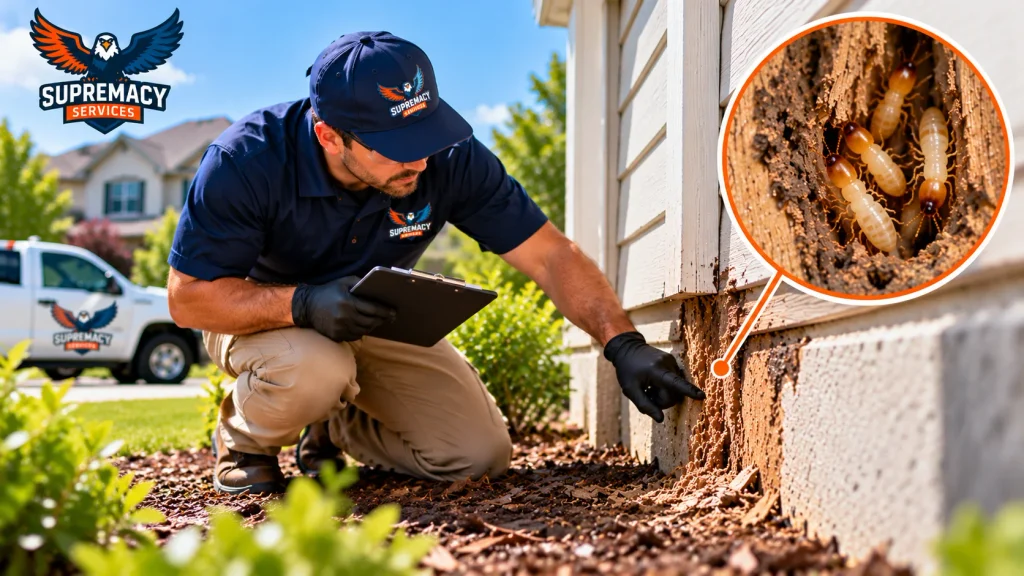
Treatment is a different matter.
| Homeowner can reasonably do | Professional evaluation is appropriate when |
|---|---|
| Photograph insects | Swarmers emerge indoors |
| Compare antennae | Identification remains uncertain |
| Compare wings | Mud tubes are present |
| Compare waist | Wood damage is suspected |
| Record swarm location | Swarming repeatedly occurs |
| Save specimens | You’re buying/selling a property |
| Check accessible areas | Termite treatment may be required |
The EPA states that termite treatment often requires a trained pest-management professional and warns that improper termiticide applications can create risks and fail to protect the structure. US EPA
Texas licensing matters
Structural pest-control activities are regulated in Texas.
The Texas Department of Agriculture’s Structural Pest Control Service licenses and regulates applicators who inspect and control termites and other wood-destroying organisms. Texas Agriculture
For termite-treatment proposals, TDA also describes specific consumer disclosure requirements involving treatment areas, activity, warranties/guarantees and treatment information. Texas Agriculture
So homeowners comparing termite companies should look beyond a headline price.
What Does a Professional Termite Inspection Look For?
The exact inspection depends on the property and purpose, but the objective is broader than simply identifying one insect.
A termite evaluation may consider:
- the insect specimen;
- where swarmers appeared;
- accessible structural wood;
- foundation conditions;
- evidence of termite activity;
- mud tubes;
- previous damage or treatment;
- moisture or other conducive conditions;
- possible termite entry areas.
If the inspection is part of a Texas real-estate transaction, additional requirements apply. TDA states that official wood-destroying insect inspection reports for real-estate transactions use the state’s designated WDI report form. Texas Agriculture
Supremacy also has a separate WDI inspection page specifically for this transaction-oriented intent. Supremacy Services
How Can Dallas Homeowners Reduce Termite and Ant Problems?
Pest prevention works best when homeowners reduce the conditions pests need rather than relying only on pesticides.
EPA recommends limiting pest access to food, water and shelter and sealing entry points where practical. US EPA
Around the home, practical measures can include:
- addressing persistent moisture problems;
- repairing plumbing or drainage issues;
- keeping structural areas accessible for inspection;
- sealing appropriate insect entry points;
- correcting damaged exterior components;
- avoiding conditions that unnecessarily keep wood damp;
- monitoring areas where swarmers previously appeared.
Don’t treat prevention as proof that termites cannot occur.
Even well-maintained properties can experience pest activity.
Flying Ants vs. Termites: What Should Dallas Homeowners Remember?
The fastest identification rule is simple:
Ant = elbowed antennae + pinched waist + unequal wings.
Termite swarmer = relatively straight antennae + broad waist + approximately equal wings.
But identifying the insect is only step one.
If suspected termite swarmers are emerging from inside your house, you repeatedly find discarded wings, or you also notice mud tubes or suspicious wood damage, investigate the source rather than simply killing the visible insects.
A swarm can disappear quickly. That does not necessarily tell you whether the underlying colony or structural problem is gone.
Think the winged insects in your Dallas-area home may be termites? Schedule a professional evaluation with Supremacy Services to identify the activity and determine whether termite protection or treatment is appropriate.
Frequently Asked Questions
What is the easiest way to tell flying ants from termites?
Check the antennae, waist and wings. Flying ants have elbowed antennae, a pinched waist and front wings longer than their rear wings. Termite swarmers have straighter antennae, a broad waist and approximately equal-length wings.
Are flying ants actually termites?
No. Flying ants are reproductive ants. Termite swarmers are reproductive termites. They can look similar from a distance but belong to different insect groups.
Why are there suddenly winged insects inside my house?
A mature ant or termite colony may release reproductive insects during suitable environmental conditions. The species and point of emergence matter. Suspected termite swarmers emerging from the structure warrant further investigation.
Do termites lose their wings?
Termite swarmers shed their wings after their dispersal flight. Therefore, piles of similar discarded wings can be an important clue even when no live swarmers remain.
Are discarded wings always evidence of termites?
No. Winged ants also have wings, so wings alone should not be treated as definitive proof of termites. Examine the insects where possible and consider where the wings were found.
Should I spray termite swarmers?
Killing visible swarmers does not establish whether a termite colony is present or resolve structural termite activity. Identification and inspection should come before selecting a termite-control strategy.
What should I do if I find termite swarmers inside my Dallas home?
Save specimens or photographs, note where the insects emerged, look for additional accessible evidence such as discarded wings or mud tubes, and consider a professional termite inspection.
Can flying ants damage wood?
Some ants, particularly carpenter ants, can excavate wood for nesting. That differs from termite feeding behavior, so correct identification is important.
Do I need a WDI inspection if I’m buying a house?
A real-estate WDI inspection is different from casually identifying insects around a home. Texas has specific requirements for official WDI reports used in real-estate transactions.

