
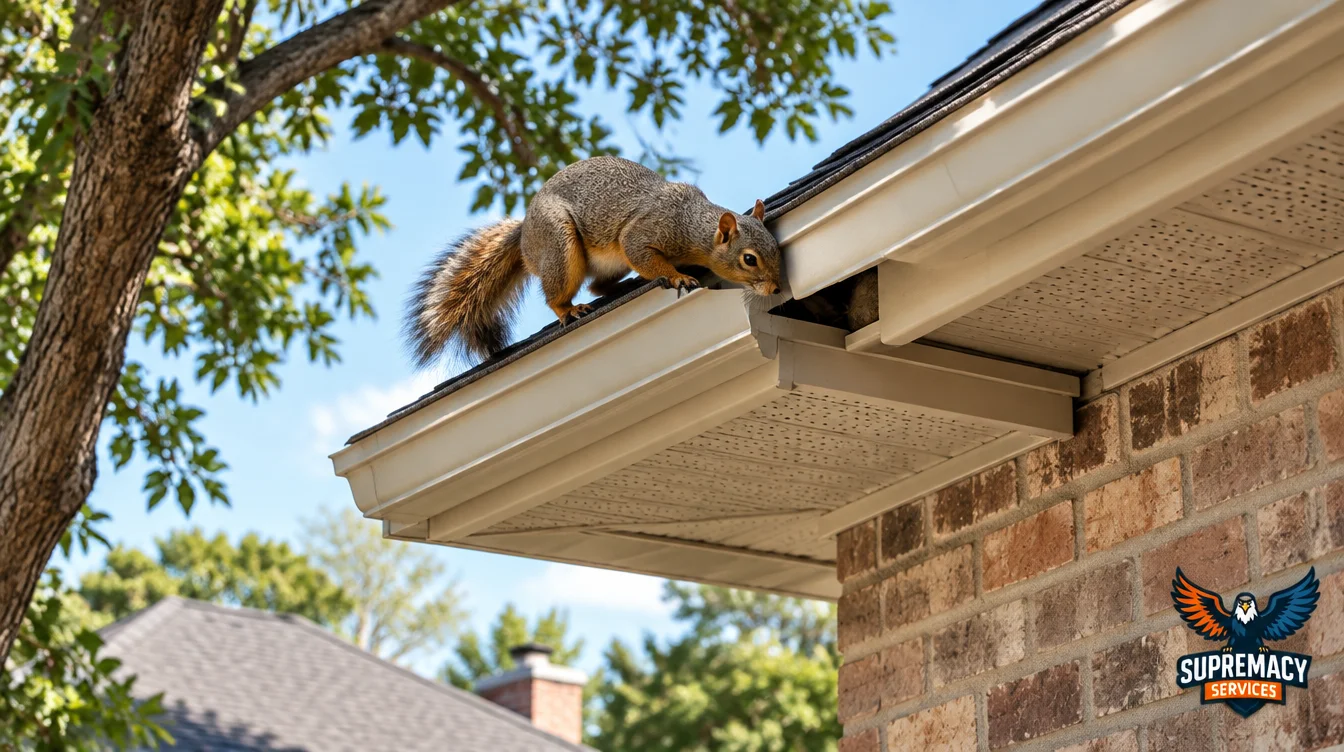
How do Squirrels usually get into attics? Often through vulnerable areas along the roofline—including damaged soffits, loose fascia boards, unscreened vents, gaps around eaves and openings where different roof sections meet. They may use an existing opening or enlarge a weak spot by gnawing.
For Dallas–Fort Worth homeowners, the first challenge is not simply getting the squirrel out. It is finding how the squirrel is getting into the attic and correcting that opening without accidentally trapping an animal—or young squirrels—inside.
If you have heard scratching overhead or seen squirrels repeatedly disappearing around your roof, here are the areas worth checking first.
Table of Contents
- Why Squirrels Enter Attics
- 8 Common Squirrel Roof Entry Points
- How Squirrels Reach Your Roof
- Signs of a Squirrel Entry Point
- Squirrel vs. Rat or Raccoon
- Should You Seal the Hole Yourself?
- What Professional Squirrel Exclusion Includes
- How to Prevent Squirrels From Returning
- FAQs
Why Do Squirrels Enter Attics?
Squirrels may enter an attic because it offers a sheltered location away from weather and predators and can provide a suitable nesting space.
Texas Parks and Wildlife identifies the eastern fox squirrel as Texas’ most common squirrel and notes that fox squirrels naturally use tree cavities or leaf-and-twig nests. They are generally most active early in the morning and late in the afternoon.
An attic can become an attractive substitute when a squirrel discovers an accessible opening in a house.
The important distinction is that squirrels do not necessarily create every entry point from scratch. A house may already have:
- deteriorated wood;
- a damaged soffit;
- an uncovered vent;
- a construction gap;
- storm-damaged roof components; or
- an opening previously used by another animal.
Once a squirrel finds a vulnerable area, gnawing can enlarge or worsen the opening.
8 Common Squirrel Roof Entry Points
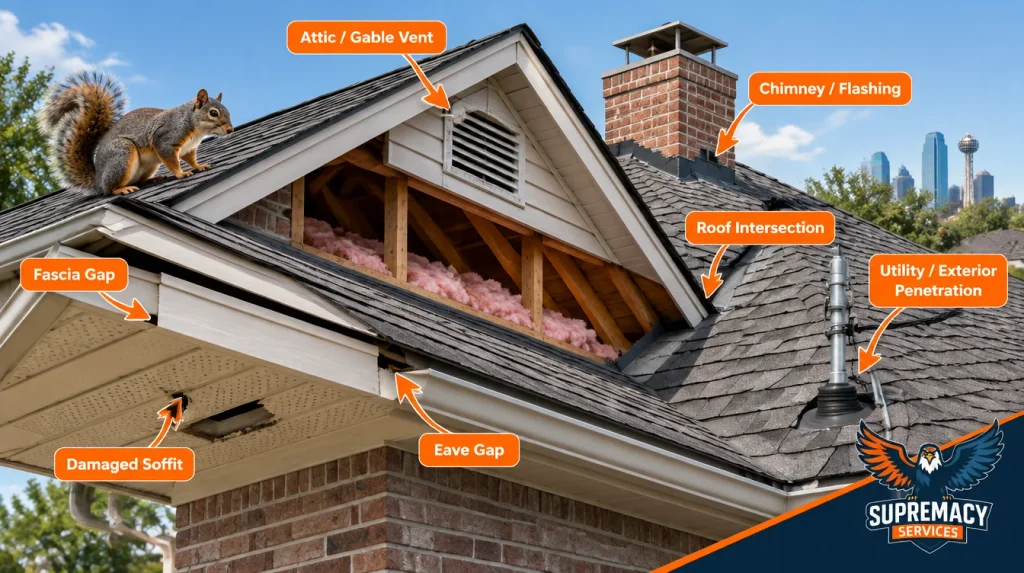
1. Damaged or Loose Soffits
Soffits are one of the first areas to inspect when squirrels repeatedly appear near the edge of a roof.
The soffit covers the underside of the roof overhang. Loose panels, deteriorated wood or openings where the soffit meets adjoining components can provide access to the space above.
Look for:
- displaced soffit panels;
- broken or rotting wood;
- dark openings at corners;
- chew marks;
- staining around an opening; and
- squirrels repeatedly visiting the same section of roof.
Simply pushing a loose panel back into place is not sufficient if an animal is already inside.
2. Fascia and Roof-Edge Gaps
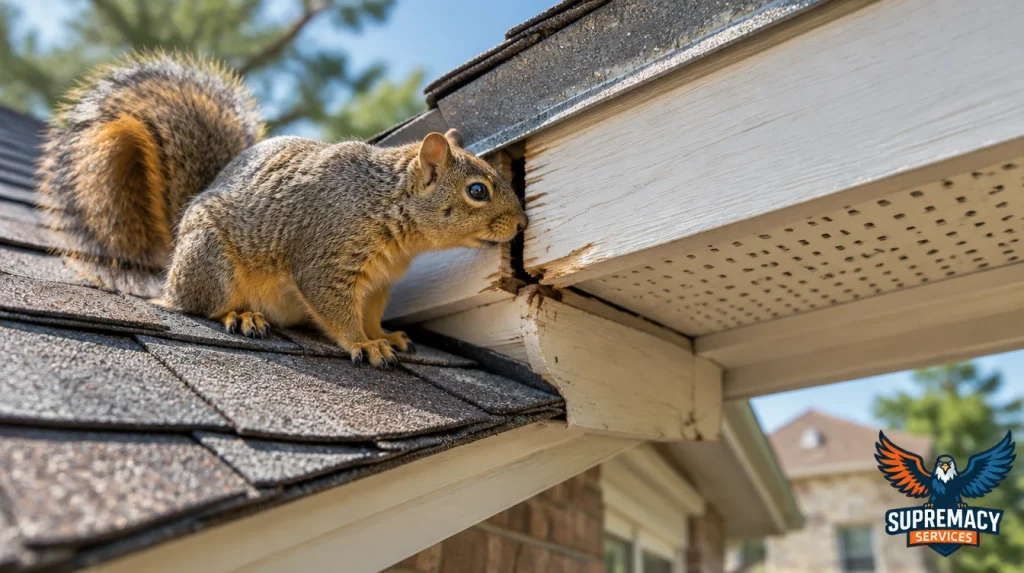
The fascia runs along the edge of the roof and helps close the area around the ends of the rafters.
Deterioration or separation between fascia, soffit and roofing components can expose an opening into the roof structure.
These areas can be difficult to evaluate from the ground because a small-looking exterior defect may connect to a larger cavity behind it.
3. Attic, Gable and Roof Vents
An attic vent can become a wildlife entry point when its screen or cover is missing, loose or damaged.
Attics need ventilation, so vents cannot simply be sealed shut. Instead, the objective is to maintain their intended airflow while preventing wildlife from passing through.
University extension guidance specifically recommends protecting attic vents and similar openings with durable screening or hardware cloth appropriate for wildlife exclusion.
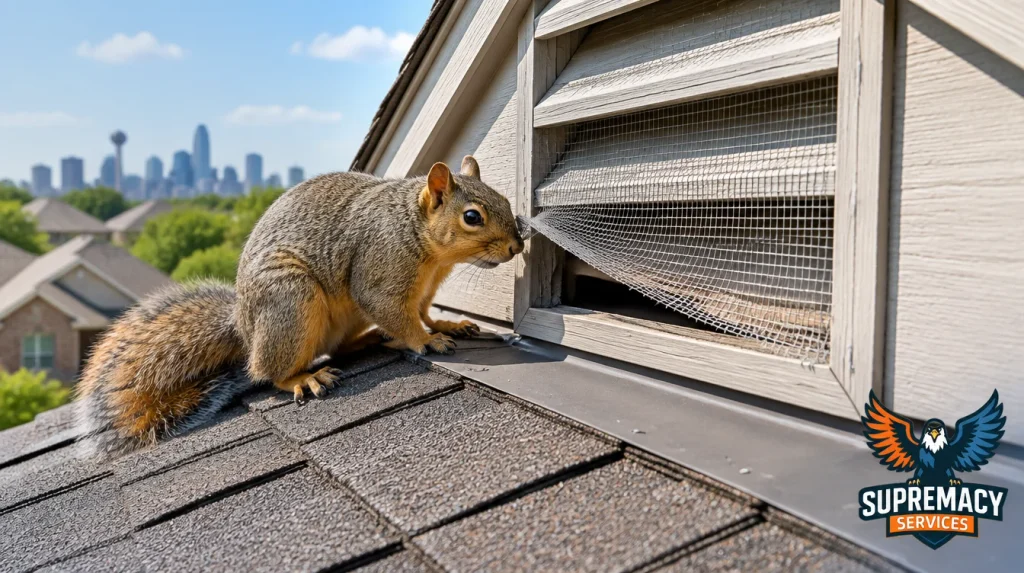
Inspect:
- gable vents;
- roof vents;
- turbine vents;
- vent screens; and
- surrounding roof material.
A bent screen or damaged vent assembly deserves attention if squirrels are active on the roof.
4. Gaps Around Eaves
Eaves contain multiple transitions between roofing, fascia, soffits and wall materials.
Those intersections can develop gaps as materials age, shift or deteriorate.
A squirrel moving along the roof edge can investigate these protected areas and repeatedly return once it finds an accessible cavity.
5. Roof Intersections and Construction Gaps
Complex rooflines contain valleys, dormers and intersections where one roof section meets another.
Not every gap is a defect, but poorly sealed or damaged transitions can create sheltered openings that are difficult to see from ground level.
This is one reason a proper wildlife inspection should evaluate the entire roofline, rather than patching only the first obvious hole.
6. Chimney and Flashing Areas
A chimney creates several potential areas of concern:
- an uncapped chimney opening;
- damaged chimney screening;
- gaps near flashing;
- deteriorated trim; or
- openings where the chimney meets the roof structure.
Chimney caps and properly maintained surrounding materials can reduce wildlife access while still allowing the chimney system to function as designed.
7. Damaged Roofing or Roof Deck Openings
Missing or damaged roofing materials can expose vulnerable sections underneath.
A squirrel may also exploit deterioration near roof edges or other areas where damaged materials provide access to the underlying structure.
Seeing a squirrel on the shingles does not necessarily mean it is entering through the shingles themselves. Watch where the animal goes immediately before it disappears.
That location often provides a much better clue.
8. Utility and Exterior Penetrations Near the Roofline
Homes contain penetrations for cables, pipes and other building systems.
Where those components enter the structure, poorly sealed openings may provide access into wall or attic cavities.
University of Missouri Extension specifically recommends checking openings created for utility pipes and electrical wiring as part of squirrel-proofing a building.
How Do Squirrels Reach the Roof?
Finding an opening is only half of the investigation. You should also ask:
How is the squirrel reaching that part of the house?
Common access routes include:
Overhanging Tree Branches
Tree squirrels are exceptionally comfortable moving through elevated environments.
Branches extending toward a house can provide convenient access to the roof.
Trees do not need to touch the building for squirrels to investigate nearby roof areas, so pruning decisions should consider the overall route rather than only branches physically resting against shingles.
Fences and Nearby Structures
Fences, pergolas, sheds and other structures can create elevated travel routes around a property.
Utility Lines
Squirrels can also move along overhead lines.
Never attempt to modify electrical or utility lines yourself. Any work involving utility infrastructure should be handled by the appropriate utility or qualified professional.
What Does a Squirrel Entry Point Look Like?
A squirrel entry point may look like a hole, but sometimes the clues are subtler.
Watch for:
| Exterior clue | What it may indicate |
|---|---|
| Chewed wood | An opening may have been enlarged |
| Loose soffit | Possible access behind the roof edge |
| Damaged vent screen | Potential attic access |
| Repeated squirrel activity | A frequently used route may be nearby |
| Nesting material near an opening | Possible active nesting area |
| Worn or disturbed opening | Repeated animal movement |
| Damaged fascia | Possible access to roof cavity |
The strongest clue is often repeated behavior.
From a safe location, observe where squirrels travel. If the same animal repeatedly approaches one section of the roof and disappears beneath an edge, vent or soffit, that area deserves closer inspection.
Avoid climbing onto a steep roof simply to investigate wildlife activity.
What Are the Signs of Squirrels in an Attic?
Common signs can include:
- scratching or scurrying overhead;
- activity that is especially noticeable during daylight hours;
- gnaw marks;
- disturbed attic insulation;
- nesting material;
- droppings;
- damage around a roof opening; and
- squirrels repeatedly traveling to and from the same roof area.
Texas Parks and Wildlife notes that fox squirrels are commonly active early in the morning and late in the afternoon. That makes the timing of noises a useful clue, although timing alone cannot confirm which animal is present.
If you can safely observe the exterior, watch the roof around the time you normally hear activity.
Is It a Squirrel, Rat or Raccoon in the Attic?
Several animals can produce scratching noises above a ceiling.
| Clue | Squirrel | Rat/Mouse | Raccoon |
|---|---|---|---|
| Typical activity clue | Often daytime, especially morning/late afternoon | More commonly noticed at night | Often noticed at night |
| Sound | Running, scratching, gnawing | Light scratching/scurrying | Heavier movement or thumping |
| Entry area | Roofline, vents, soffits, eaves | Small gaps throughout structure | Larger roof/soffit openings |
| Potential damage | Gnawing, insulation disturbance | Gnawing, contamination | Torn materials, larger disturbance |
These are diagnostic clues—not guarantees.
A homeowner hearing scratching should avoid assuming every attic noise is caused by squirrels. Rats, mice, raccoons, birds and other wildlife can occupy similar spaces.
Can Squirrels Damage an Attic?
Yes. Once inside, squirrels can disturb insulation and gnaw building materials.
University extension resources specifically identify damage to walls, insulation and electrical wiring as potential consequences of squirrels entering buildings.
Electrical wiring deserves particular attention. Visible animal-damaged wiring should be evaluated by a qualified electrical professional rather than taped over or treated as a wildlife repair.
The longer-term problem is also the opening itself. Removing an animal without addressing the route it used leaves the structure vulnerable to another animal.
Should You Seal a Squirrel Hole Yourself?
Do not permanently close a suspected active squirrel entry point until you know animals are no longer inside.
This is one of the most important steps in squirrel exclusion.
Penn State Extension specifically warns homeowners to make sure squirrels are not locked inside when attic openings are closed.
That becomes especially important when young squirrels may be present.
Closing the obvious entrance too early can create several problems:
- an adult may attempt to force its way back inside;
- an animal trapped indoors may cause additional damage trying to escape;
- dependent young may remain in the attic; and
- another unnoticed opening may continue to provide access.
For an old, clearly inactive opening, straightforward maintenance may be reasonable.
For an active infestation, removal and exclusion should be coordinated.
If squirrels are actively entering your attic, Supremacy Services can inspect the roofline, identify wildlife entry points and determine the appropriate removal and exclusion approach for your Dallas–Fort Worth home.
Why Spray Foam Alone Is Not a Squirrel-Proof Repair
Wildlife exclusion is different from ordinary gap filling.
Squirrels are rodents and can gnaw. A repair should therefore address the underlying structural opening using materials appropriate for that part of the building.
University extension guidance recommends durable barriers such as hardware cloth for appropriate openings and repair of damaged soffit/eave materials.
The correct repair depends on whether the opening involves:
- ventilation;
- roofing;
- wood trim;
- flashing;
- masonry;
- utility infrastructure; or
- another building component.
The objective is not simply to make the hole disappear. The repair needs to prevent re-entry without interfering with drainage, ventilation or another intended building function.
What Does Professional Squirrel Exclusion Include?
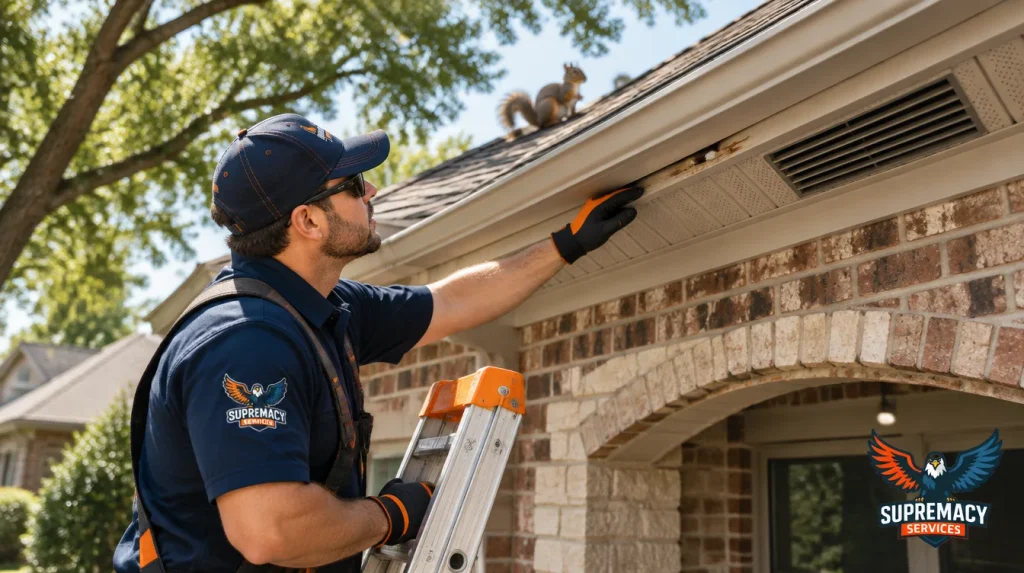
A thorough wildlife service should begin by determining both what animal is present and how it entered.
A typical process may involve:
1. Exterior and Roofline Inspection
The technician evaluates likely entry areas including:
- soffits;
- fascia;
- eaves;
- vents;
- roof transitions;
- chimney areas;
- penetrations; and
- other visible exterior defects.
2. Attic Inspection
Where accessible and appropriate, the attic is checked for signs such as nesting material, disturbed insulation, droppings, gnawing and travel paths.
3. Identification of Active Entry Points
The goal is to distinguish an active entrance from unrelated building damage.
4. Wildlife Removal or Exclusion
The appropriate approach depends on the species, conditions and whether young animals are present.
5. Entry-Point Repair
Once exclusion can be completed safely, vulnerable openings are repaired or protected with materials appropriate for the location.
6. Follow-Up Inspection
The property should be checked to confirm that activity has stopped and repaired areas remain secure.
If you are seeing squirrels repeatedly enter the same roof area, schedule a wildlife inspection and entry-point assessment before closing the opening.
How Can Dallas Homeowners Prevent Squirrels From Getting Into the Attic?
Prevention is primarily an exclusion and maintenance problem.
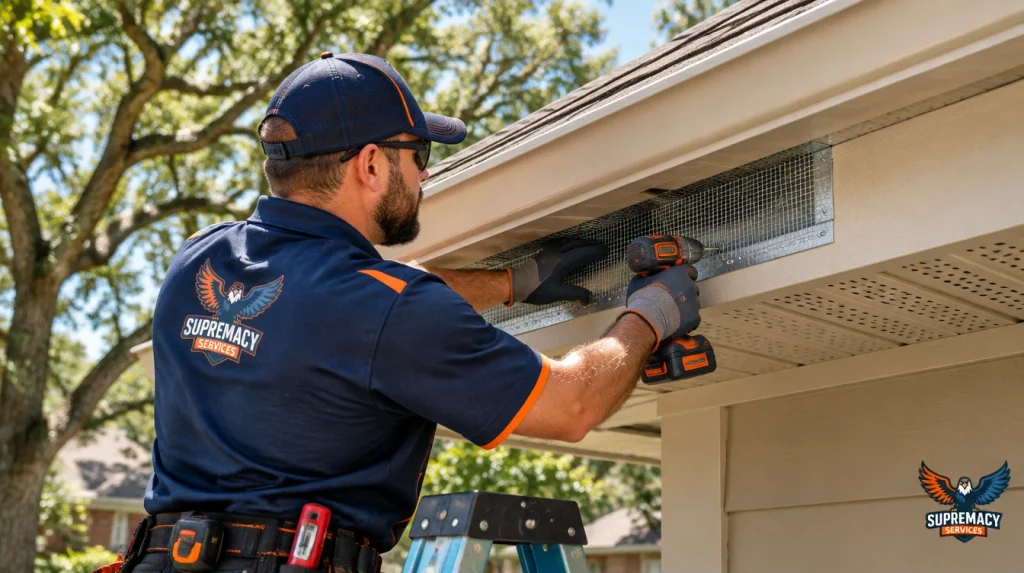
Inspect the roofline periodically
Look for:
- loose soffits;
- deteriorating fascia;
- damaged vent screens;
- openings around roof transitions;
- missing or damaged chimney protection; and
- obvious exterior gaps.
Repair deterioration early
Small exterior defects are generally easier to correct before wildlife begins using them.
Protect ventilation openings correctly
Do not eliminate required attic ventilation. Instead, use appropriately designed wildlife-resistant screening or vent protection where needed.
Manage easy roof access
Evaluate branches and nearby structures that provide squirrels with convenient roof access.
University of Missouri Extension recommends trimming overhanging branches as part of squirrel prevention.
Do not rely on repellents instead of repairs
Making an attic unpleasant does not correct the opening that allowed an animal inside.
Physical exclusion and building maintenance address the actual access route.
Reinspect previously repaired areas
A house can develop new vulnerabilities over time. Roof work, storms, aging materials and repairs can all change exterior conditions.
Dallas–Fort Worth Considerations
Squirrels are a normal part of the North Texas environment.
Texas Parks and Wildlife describes the eastern fox squirrel as Texas’ most common squirrel and notes that it adapts to a variety of habitats. Fox squirrels are also among the urban wildlife documented by TPWD.
That means seeing squirrels in a Dallas neighborhood is not itself a pest problem.
The problem begins when wildlife gains access to the structure.
Homes with mature trees and complicated rooflines deserve particular attention because squirrels can move through elevated environments and multiple roof intersections create more locations that need to be checked during an exclusion inspection.
The practical goal is not eliminating squirrels from your property. It is keeping the boundary between the outdoor habitat and your attic intact.
Squirrel Attic Inspection Checklist
If you suspect an attic problem, use this checklist from ground level where possible:
- Watch where squirrels travel across the roof.
- Note where they disappear from view.
- Check soffits for loose or damaged sections.
- Look for fascia deterioration.
- Inspect visible vent covers/screens.
- Check chimney protection.
- Look for gnawing or disturbed materials.
- Note nearby tree branches and elevated access routes.
- Listen for the time of day attic activity occurs.
- Do not close an active opening until occupancy is resolved.
- Arrange professional inspection when the entry point cannot be safely identified.
Frequently Asked Questions
How do squirrels usually get into attics?
Squirrels commonly exploit vulnerable roofline areas such as damaged soffits, fascia gaps, vents, eaves and other exterior openings. They may use an existing defect or enlarge a weak area by gnawing.
Can squirrels enter through roof vents?
Yes. A damaged, loose or inadequately protected roof or attic vent can provide access. Ventilation should be maintained while the opening is protected with an appropriate wildlife-resistant barrier.
Can squirrels chew through soffits?
Squirrels can gnaw vulnerable materials and enlarge existing weak points. Damaged or deteriorated soffit areas should therefore be inspected rather than simply covered temporarily.
What time of day are squirrels most active in an attic?
Tree squirrels are generally active during daylight. Texas Parks and Wildlife notes that fox squirrels are commonly active early in the morning and late in the afternoon. Activity timing is useful evidence but should not be used as the only identification method.
Should I seal the hole if I see a squirrel enter my attic?
Not immediately. First determine whether squirrels or dependent young remain inside. Sealing an active entrance prematurely can trap animals in the structure.
How do I find a squirrel’s entry point?
Observe the roof from a safe location and watch for repeated travel to one area. Then inspect accessible soffits, fascia, vents, eaves, chimney areas and roof transitions for damage, gnawing or openings.
Are squirrels in the attic dangerous?
The main structural concerns include damage to insulation and building materials and possible gnawing of electrical wiring. Avoid direct handling of wildlife and have damaged electrical components professionally evaluated.
Will squirrels leave an attic on their own?
An animal leaving temporarily does not mean the problem is resolved. If the entry point remains available, the attic can continue to be used. The long-term solution is appropriate removal or exclusion followed by repair of the access point.
How do I keep squirrels from returning?
Correct the entry points, maintain roofline materials, protect vents appropriately and reduce easy roof access where practical. Exclusion works by removing access rather than simply trying to repel squirrels.
Stop the Entry Point, Not Just the Noise
Hearing a squirrel leave the attic does not mean your house is protected.
The real solution is determining how the squirrel entered, confirming that the attic is clear and securing vulnerable roof openings so the problem does not repeat.
If you are hearing scratching, seeing squirrels disappear beneath the roofline or finding damage around your attic, Supremacy Services provides wildlife inspection, removal and exterior entry sealing throughout Dallas and the DFW Metroplex.

