
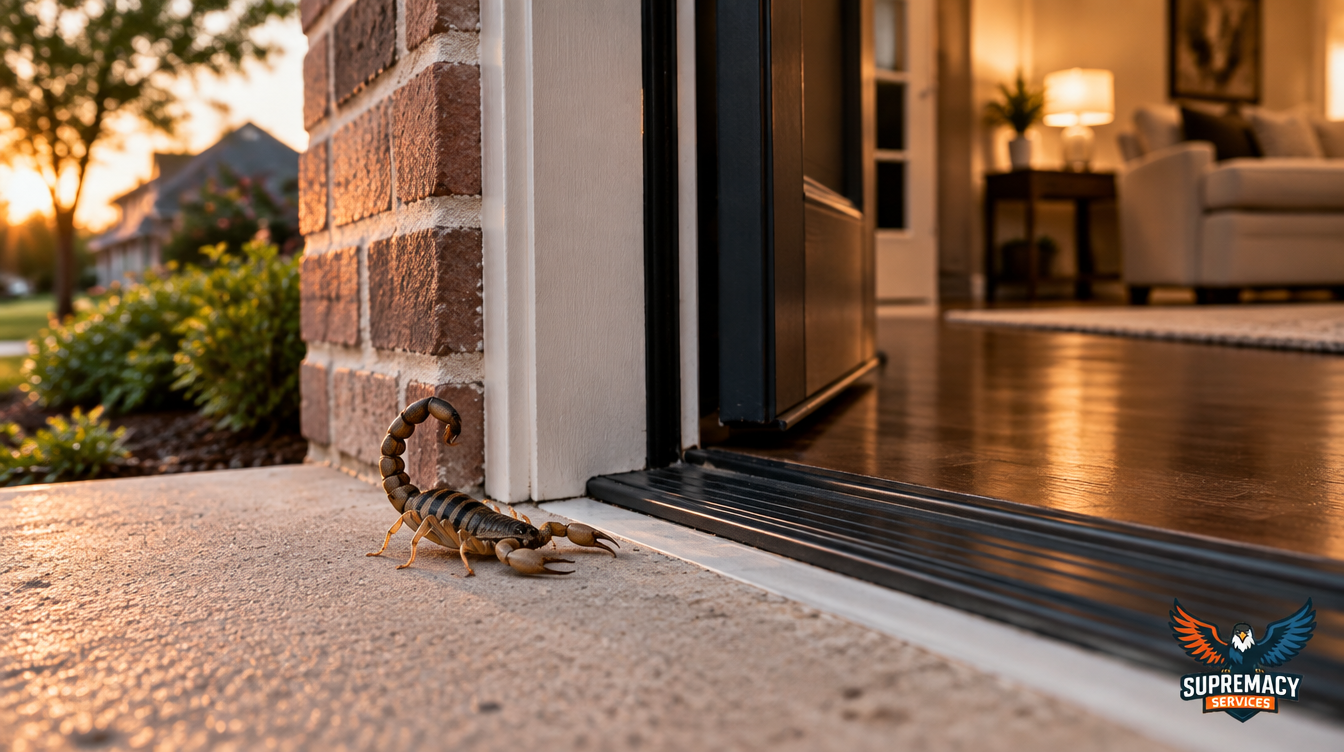
Why are scorpions in my house?
Finding a scorpion inside your house usually means it found an opening from outdoors and entered while searching for shelter, moisture or prey. Scorpions can squeeze through cracks and crevices, climb exterior surfaces and hide in protected areas around homes. Texas A&M AgriLife reports that scorpions are common across much of Texas and specifically notes that they can enter structures through cracks and crevices. Texas A&M AgriLife Extension Service
For Dallas–Fort Worth homeowners, seeing one scorpion does not automatically prove there is a large indoor infestation. But repeated sightings are worth investigating because they can point to accessible entry points, favorable hiding places around the property or abundant insects that provide food.
The most effective response is usually broader than simply killing the scorpion you found. You need to determine where scorpions are coming from, what is allowing them close to the house and how they are getting inside.
Table of Contents
- Why are scorpions getting inside?
- What attracts scorpions to a house?
- How are scorpions getting inside?
- Where do scorpions hide indoors?
- Does one scorpion mean there are more?
- How to inspect your home
- How to keep scorpions out
- DIY vs. professional control
- What professional scorpion control involves
- Dallas and DFW considerations
- Frequently asked questions
Why Are Scorpions Getting Inside My House?
Scorpions generally enter homes accidentally or while seeking favorable shelter, water or prey. An accessible crack, poorly sealed door, utility penetration or other small opening can turn an outdoor scorpion into an indoor visitor.
The striped bark scorpion is especially relevant in Texas. Texas A&M describes it as occurring throughout the state and notes that scorpions are nocturnal, can climb trees and house exteriors, and can enter homes through cracks and crevices. Texas A&M AgriLife Extension Service
If scorpions repeatedly appear inside your Dallas-area home, investigate three things:
- Entry: Where can they physically get inside?
- Harborage: Where can they hide around the house?
- Prey: Are other insects providing a reliable food source?
That approach is more useful than treating every sighting as an isolated incident.
What Attracts Scorpions to Your House?
Your house itself is not necessarily attracting scorpions. More often, the property provides shelter, access to prey or favorable hiding places.
1. Other insects around your home
Scorpions are predators. A property supporting plenty of insects can consequently provide feeding opportunities.
This is one reason scorpion prevention overlaps with general pest management: reducing insect activity around a structure can make the surrounding environment less favorable.
2. Protected hiding places
Texas A&M recommends removing trash, logs, boards, stones, bricks and similar objects around structures as part of scorpion management. It also specifically identifies wood piles, stored boards and firewood as favored areas. Texas A&M AgriLife Extension Service
Common hiding areas include:
| Outside | Inside |
|---|---|
| Firewood piles | Closets |
| Landscape stones | Garages |
| Boards and construction material | Attics |
| Debris near foundations | Storage areas |
| Dense vegetation | Wall or cabinet voids |
| Objects resting on soil | Dark undisturbed corners |
3. Easy access into the structure
A house can have very little scorpion activity indoors until an entry point becomes available.
Potential access areas include gaps around exterior doors, damaged screens, cracks around utility lines and plumbing penetrations, gaps around eaves and openings associated with masonry construction.
4. Vegetation touching the structure
Texas A&M advises pruning bushes and overhanging tree branches away from structures because branches can provide scorpions with a route toward a roof. Texas A&M AgriLife Extension Service
That makes landscaping part of the inspection—not just the foundation.
How Do Scorpions Get Inside a House?
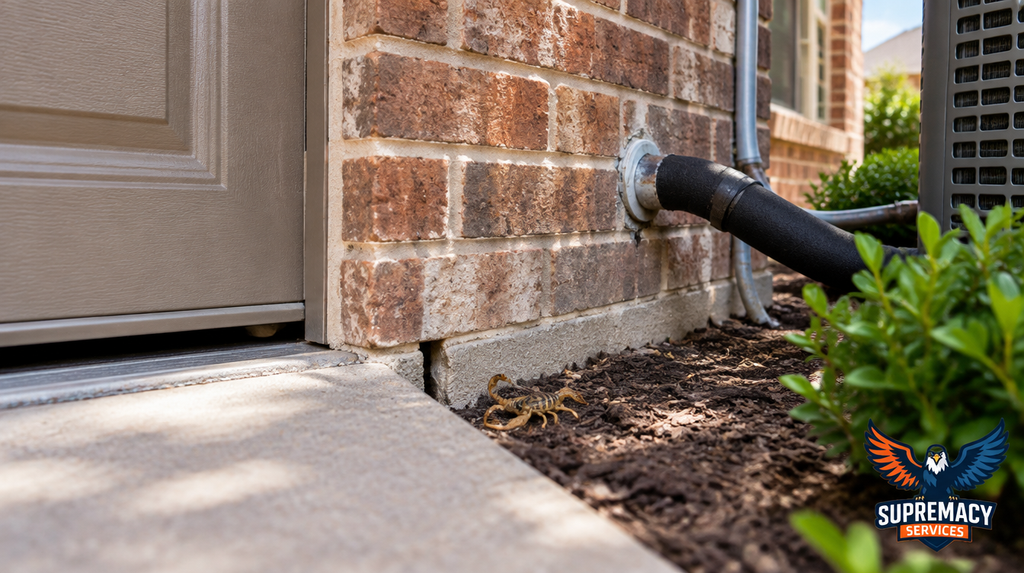
Scorpions can enter through surprisingly small structural openings rather than needing an obvious hole.
Check these locations first:
Exterior doors
Inspect the bottom and sides of garage doors, patio doors and exterior doors.
Look for daylight underneath the door when viewed from inside. Damaged or missing weather-stripping can create an accessible route.
Windows and screens
Loose screens, damaged frames and gaps around windows deserve inspection.
Texas A&M recommends keeping screens in good repair and ensuring they fit tightly. Texas A&M AgriLife Extension Service
Plumbing and utility penetrations
Look where:
- water lines enter walls;
- electrical or communications lines penetrate siding;
- HVAC refrigerant lines enter the house;
- pipes pass through cabinets or walls.
Small gaps around penetrations can provide pest entry routes.
Cracks and exterior gaps
Inspect the transition between the foundation and exterior wall, masonry joints, siding gaps and openings around trim.
EPA pest-management guidance similarly recommends closing entryways and caulking cracks and crevices as part of an integrated pest-management approach. US EPA
Items brought indoors
Firewood, boxes and stored materials can occasionally transport pests indoors.
Texas A&M specifically advises against bringing firewood indoors unless it is going directly onto the fire. Texas A&M AgriLife Extension Service
Where Do Scorpions Hide Inside a House?
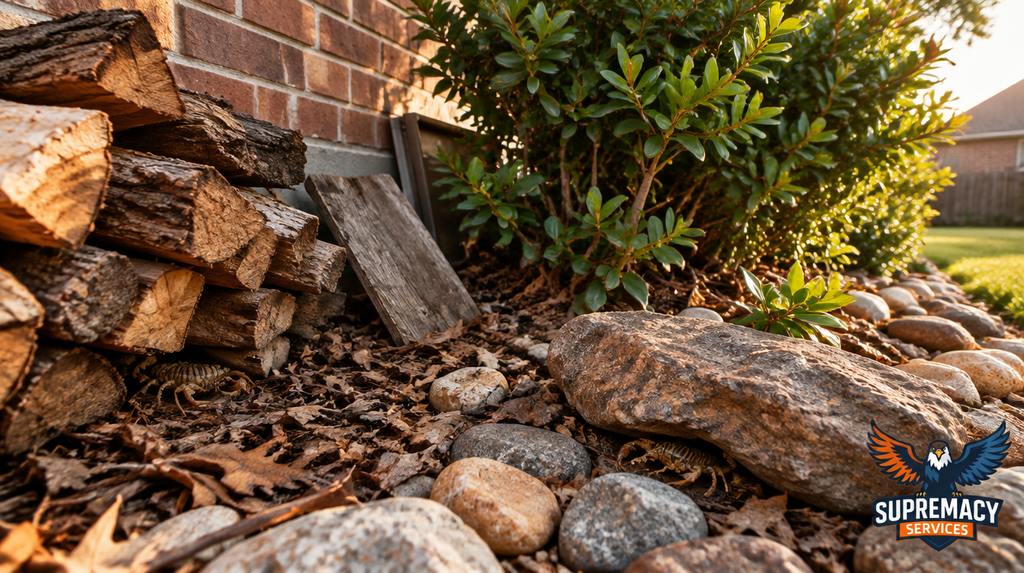
Scorpions usually prefer protected, relatively undisturbed locations rather than open living areas.
Check:
- closets;
- garages;
- storage rooms;
- attics;
- underneath stored objects;
- around plumbing;
- cabinets;
- cracks and wall gaps;
- shoes or clothing left undisturbed;
- boxes stored on floors.
Scorpions are primarily active at night. Texas A&M notes their nocturnal behavior, which explains why homeowners may discover one moving across a floor at night even though it remained hidden during the day. Texas A&M AgriLife Extension Service
Can a blacklight help find scorpions?
Yes. Scorpions fluoresce under ultraviolet light, which can make nighttime inspection easier. This can help determine whether you’re dealing with a single incidental visitor or recurring activity around specific exterior areas. Texas A&M AgriLife Extension Service
Use a flashlight as well, wear closed shoes and avoid placing your hands blindly beneath rocks, lumber or other potential hiding areas.
Does Finding One Scorpion Mean There Are More?
Not necessarily. One scorpion can simply have wandered inside. Repeated sightings, however, justify a more thorough inspection.
Unlike social insects such as ants, finding one scorpion should not automatically be interpreted as evidence of a large colony somewhere inside your walls.
Instead, look at the pattern.
| Situation | What it may suggest |
|---|---|
| One isolated sighting | Accidental entry is possible |
| Several sightings near one door | Entry gap may be present |
| Repeated garage sightings | Exterior access or nearby harborage |
| Scorpions plus many insects | Property may provide abundant prey |
| Frequent sightings in several rooms | Broader inspection is warranted |
| Outdoor sightings around debris | Exterior harborage may be contributing |
The frequency and location of sightings are often more informative than one encounter.
How to Find Where Scorpions Are Coming From
Instead of immediately spraying the room where you found the scorpion, perform a structured inspection.
Step 1: Record where you found it
Note the room, approximate time and nearest exterior wall, door or window.
If another appears, patterns may emerge.
Step 2: Inspect the closest exterior wall
Go outside and examine the corresponding area.
Look for cracks, pipe penetrations, vegetation, stacked materials and other protected spaces.
Step 3: Check door seals
Inspect exterior and garage doors for visible gaps.
Step 4: Examine landscaping
Move unnecessary boards, stones, debris and similar hiding places away from the structure.
Keep vegetation from creating direct pathways onto the building.
Step 5: Check screens and penetrations
Inspect window screens and gaps around cables, pipes and HVAC lines.
Step 6: Inspect after dark
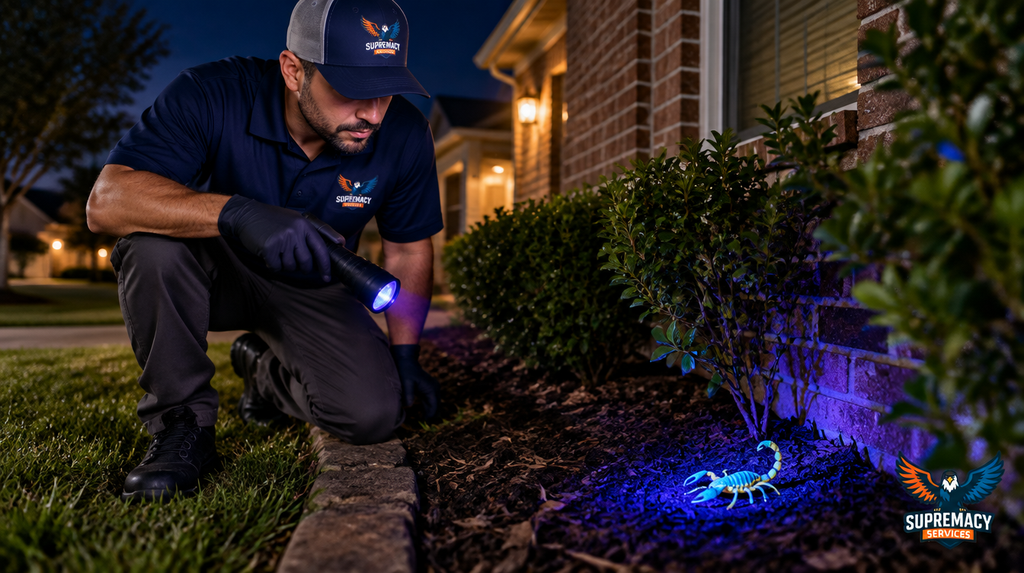
Because scorpions are nocturnal, a nighttime exterior inspection can reveal activity that is invisible during daylight.
A UV flashlight can make scorpions considerably easier to spot.
Step 7: Look for other pest activity
Crickets, roaches and other insects around the structure can indicate that the property is supporting a broader pest population.
That matters because successful scorpion management often requires dealing with the surrounding pest ecosystem rather than only individual scorpions.
How Do You Keep Scorpions Out of Your House?
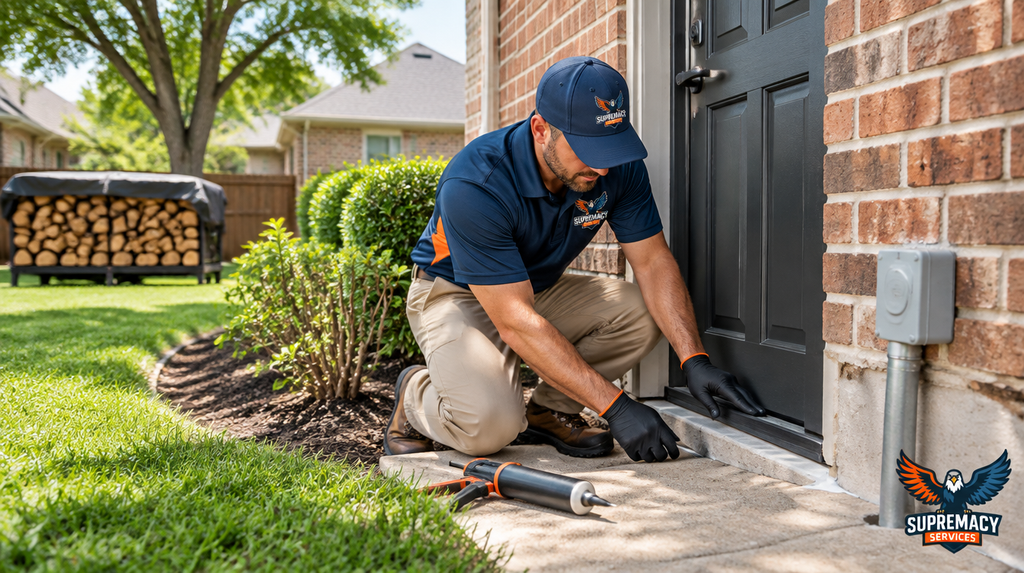
The best long-term strategy combines exclusion, habitat modification and control of other pests rather than relying exclusively on indoor pesticide applications.
Texas A&M specifically notes that scorpions can be difficult to manage with insecticides alone and recommends first modifying conditions surrounding the structure. Texas A&M AgriLife Extension Service
Scorpion-Prevention Checklist
Around the exterior
- Remove unnecessary boards, bricks, stones and debris.
- Keep firewood away from the immediate house perimeter.
- Trim vegetation away from walls and rooflines.
- Keep grass maintained near the structure.
- Inspect foundation and exterior-wall gaps.
- Reduce unnecessary insect activity around the house.
Doors and windows
- Replace worn weather-stripping.
- Install or repair door sweeps.
- Repair damaged window screens.
- Seal appropriate cracks around frames.
Utility penetrations
- Inspect gaps around plumbing.
- Inspect HVAC penetrations.
- Check electrical and communications lines.
- Seal appropriate openings with suitable building materials.
EPA guidance similarly recommends preventing pest problems by eliminating access to food, water and shelter and sealing entryways rather than depending solely on pesticide applications. US EPA
Should you seal weep holes?
Be careful here.
Some pest-prevention guidance discusses screening openings, but masonry weep holes serve a building-envelope function and generally should not simply be sealed shut with ordinary caulk.
If an opening needs pest exclusion, use an approach that preserves its intended drainage and ventilation function.
That distinction is important in brick homes.
DIY Scorpion Control vs. Professional Pest Control
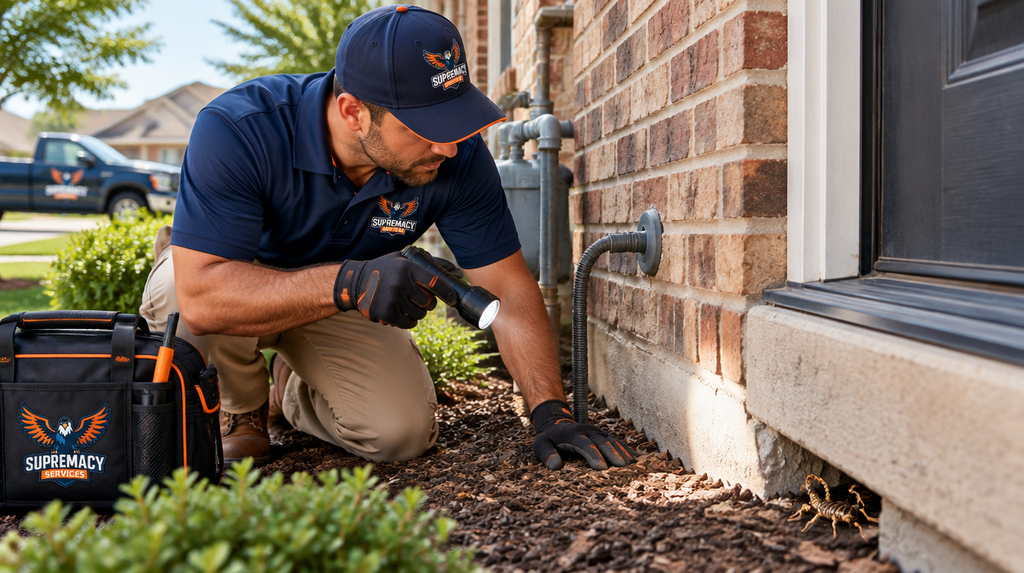
A single scorpion does not automatically require professional treatment.
Homeowners can often make meaningful improvements through exclusion and habitat reduction.
| DIY may be reasonable when… | Professional inspection becomes useful when… |
|---|---|
| You found one isolated scorpion | Scorpions keep appearing |
| An obvious door gap exists | You cannot identify the entry point |
| Exterior clutter can easily be corrected | Activity occurs in several rooms |
| Screens or weather-stripping need repair | Exterior populations appear substantial |
| You can safely reduce hiding areas | Other pest activity is also significant |
What about store-bought pesticides?
Treat pesticides as one tool rather than the entire strategy.
EPA recommends identifying the pest, correcting the source of the problem, using pesticides only as directed by their labels and targeting treatments rather than indiscriminately spraying rooms. US EPA
Texas A&M likewise emphasizes environmental modification before chemical control for scorpions. Texas A&M AgriLife Extension Service
Seeing scorpions repeatedly? Learn how Supremacy’s perimeter pest control for Dallas homes targets pest activity around common exterior entry zones before pests move indoors.
Supremacy’s existing pest-control material identifies scorpions among the pests included in its standard perimeter protection. Supremacy Services
What Does Professional Scorpion Control Include?
A sound scorpion-control program should begin with inspection and identification, not indiscriminate spraying.
Depending on the property and findings, professional service may involve:
- inspecting exterior scorpion activity;
- identifying potential entry points;
- locating harborage around the property;
- checking doors, windows and utility penetrations;
- identifying other insect activity;
- recommending habitat modifications;
- using appropriately labeled targeted treatments where warranted;
- monitoring recurring activity.
Supremacy’s existing perimeter service specifically describes inspection of foundations, plumbing penetrations, doors and windows followed by targeted exterior treatment. Supremacy Services
Why exterior control matters
If scorpions originate outdoors, repeatedly killing individual scorpions after they cross your floor does nothing to address the route they used to enter.
An exterior-focused approach instead asks:
Where are they living → why are they approaching the structure → where are they entering → what can be changed?
That is much closer to integrated pest management.
Finding scorpions in more than one part of your home? Schedule a Dallas pest inspection with Supremacy Services to identify likely entry areas and exterior pest pressure.
Are Scorpions Common Around Dallas and North Texas?
Scorpions occur across Texas, including the species most commonly encountered around homes.
Texas A&M identifies the striped bark scorpion (Centruroides vittatus) as occurring throughout Texas. It is brownish with darker longitudinal stripes, generally relatively small, nocturnal and capable of climbing exterior surfaces. Texas A&M AgriLife Extension Service
That does not mean every Dallas home has a scorpion problem.
Property-level conditions matter considerably.
A house with accessible cracks, stored materials against exterior walls and abundant insect prey can present very different conditions from a tightly sealed, well-maintained neighboring property.
Why garages deserve special attention
DFW garages often create an easy transition between outdoors and conditioned living space.
Inspect:
- the bottom garage-door seal;
- corners around the door frame;
- boxes stored directly on the floor;
- exterior penetrations;
- the door between the garage and house.
Reducing garage access can sometimes eliminate the route through which homeowners are seeing scorpions deeper inside the home.
What Should You Do If You Find a Scorpion Indoors?
First, avoid handling it with bare hands.
If it can be done safely, remove or capture the scorpion without direct contact. Then inspect the surrounding room and nearby exterior entry points.
Afterward:
- check shoes, clothing and bedding before use if the scorpion was found nearby;
- inspect door and window gaps;
- look for nearby exterior hiding areas;
- record the location of the sighting;
- monitor for additional activity;
- arrange professional inspection if sightings continue.
What if someone is stung?
Texas A&M reports that Texas scorpion stings generally cause immediate pain and that individual reactions can vary. Persistent pain or swelling and especially breathing difficulty warrant medical attention. Texas A&M AgriLife Extension Service
For medical advice after a sting—particularly when symptoms are significant—contact an appropriate medical professional or poison-control resource rather than relying on pest-control guidance.
Scorpions vs. Other Pests You May Find Indoors
Scorpions can sometimes be part of a broader pest problem.
For example, seeing crickets, roaches, spiders and scorpions around the same property may indicate that the exterior environment offers abundant shelter and prey.
That changes the question from:
“How do I kill this scorpion?”
to:
“Why does my property support so much pest activity?”
Addressing entry points, hiding areas and the underlying insect population generally provides a more complete solution.
When Should You Call a Pest-Control Professional?
Consider professional inspection when:
- you find scorpions repeatedly;
- scorpions appear in multiple rooms;
- you find them around bedrooms or children’s areas;
- you see substantial nighttime activity outside;
- you cannot identify their entry point;
- exclusion improvements have not stopped sightings;
- your home also has significant cricket, roach or other insect activity;
- you are uncomfortable safely inspecting likely hiding areas.
Texas regulates structural pest-control businesses and applicators. The Texas Department of Agriculture states that businesses and individuals performing structural pest control for hire are subject to licensing requirements. Texas Agriculture
Keep Scorpions Outside Where They Belong
If scorpions keep appearing inside your Dallas or DFW home, treating each one individually may leave the underlying entry route untouched.
Schedule pest-control service with Supremacy Services to have your property evaluated for exterior pest pressure and likely entry areas.
Frequently Asked Questions
Why am I suddenly finding scorpions in my house?
A scorpion may have found an accessible opening while moving around outdoors. Repeated sightings can indicate persistent entry points or favorable hiding and feeding conditions around the property.
Does one scorpion mean there are more in my house?
No. One sighting does not prove that numerous scorpions are living indoors. Multiple sightings over a short period, however, justify inspecting the home and exterior more carefully.
What attracts scorpions to a home?
Shelter, hiding areas and available prey can make the area around a house favorable to scorpions. Firewood, boards, stones, debris and other protected locations are especially worth inspecting.
Where do scorpions hide during the day?
Scorpions generally seek dark, protected areas. Outdoors this can include beneath wood, rocks and debris. Indoors, inspect garages, closets, storage areas, attics and undisturbed spaces.
Can scorpions climb walls?
Yes. Texas A&M notes that scorpions can climb trees and the sides of homes, so inspection should not be limited to ground-level foundation cracks.
Do scorpions glow under blacklight?
Yes. Scorpions fluoresce under ultraviolet light, making a UV flashlight useful for nighttime inspection.
Should I spray my entire house if I find a scorpion?
Usually that should not be the first response. EPA guidance favors identifying the pest, correcting access and habitat conditions and using targeted pesticide applications according to label instructions when pesticides are necessary.
How can I prevent scorpions from entering my Dallas home?
Seal appropriate cracks, repair door seals and screens, inspect utility penetrations, remove unnecessary exterior hiding materials, trim vegetation away from the structure and reduce other pest activity around the home.
When should I call pest control for scorpions?
Professional inspection makes sense when sightings are recurring, activity occurs in several areas, the entry point cannot be found or DIY exclusion efforts have not solved the problem.

